Captain Cook in the North Pacific (1778-1779)
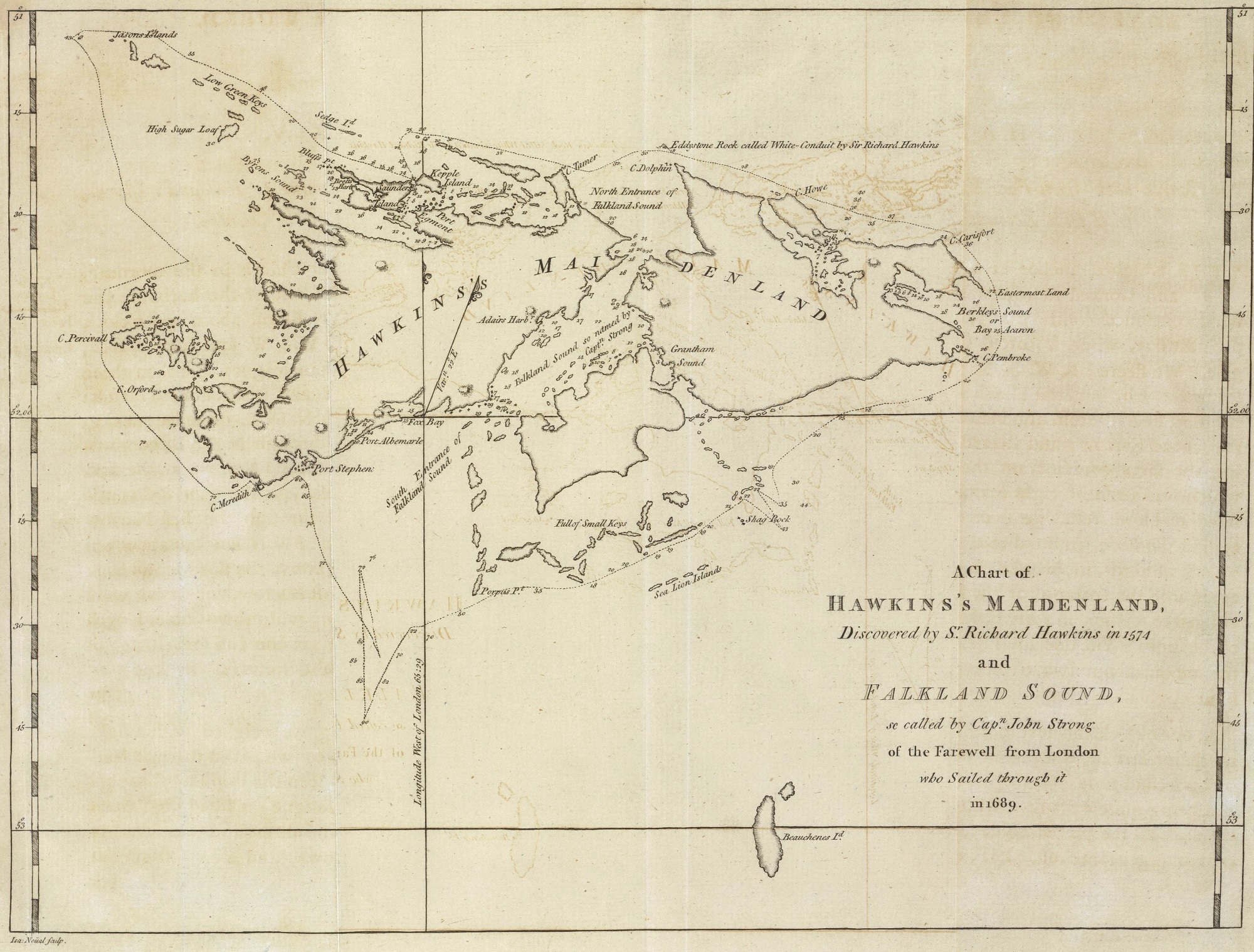
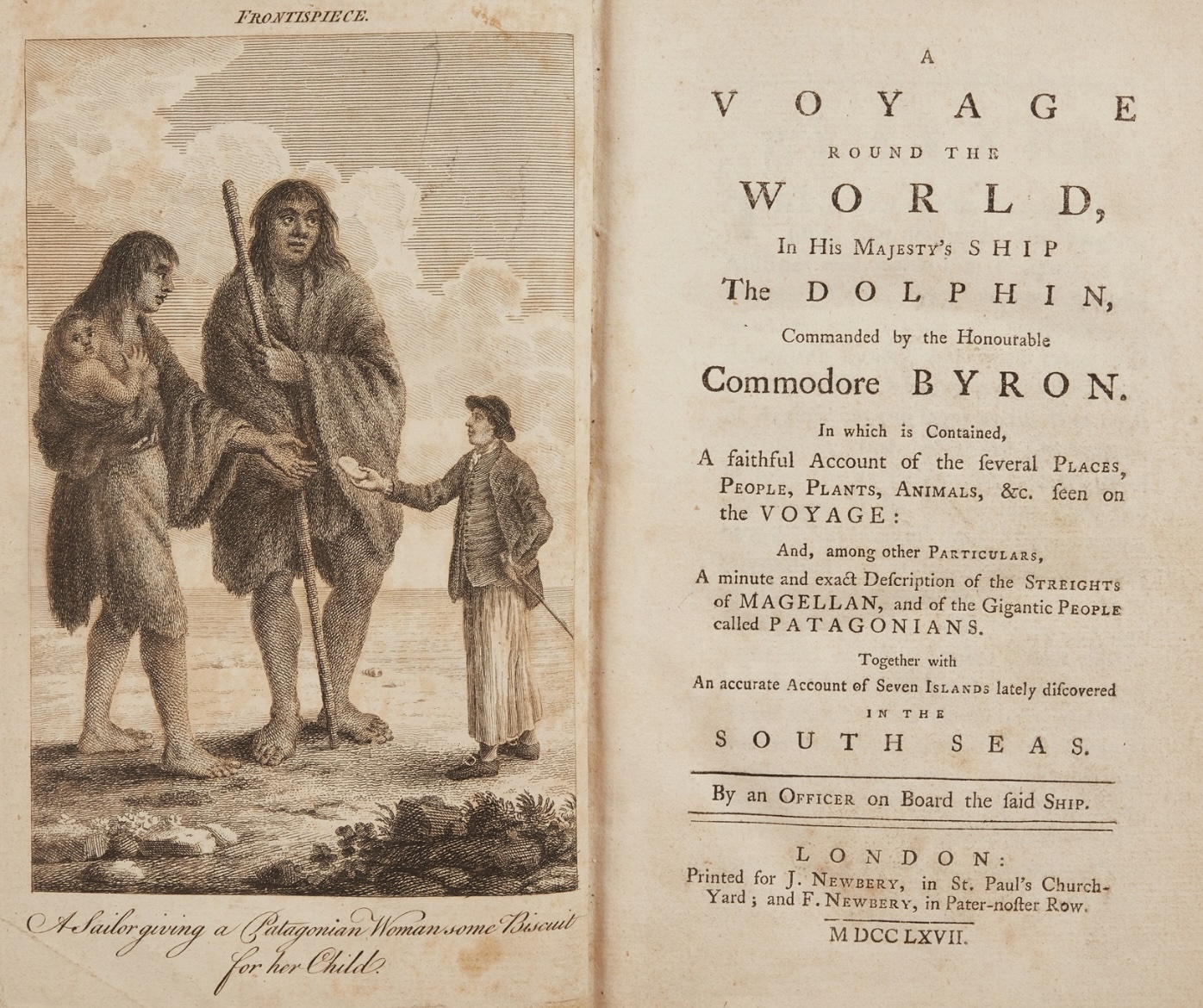
Complications arose because Britain pushed into the Pacific from two directions at the same time. Even as her merchants were pressing in from the Indian Ocean, her whalers were nosing their way around Cape Horn. In 1765, their lead received official sanction when John Byron of the copper-bottomed Dolphin claimed Port Egmont in West Falkland for Britain. It was to serve as a stepping-stone for west-bound voyages, as Cape Town served the eastern route. A little later, Captain Macbride was sent to complete Byron’s settlement and erect a blockhouse for its defence. This caused ructions with Spain and, in 1770, they seized it. Hostilities were only averted, in 1771, when Spain returned Port Egmont to Britain, on the secret promise that the British would later withdraw. When eventually they did, in 1773, they left behind an inscription on the blockhouse to signify continuing possession.[1]
From Port Egmont, Byron had been directed to explore the north-west coast of America. He was to return to England via Hudson’s Bay, if a route could be found, but he decided that his ships ‘were too much disabled’ to make the attempt, and he sailed home via the Tuamotus, the Gilberts, the Marianas, and Batavia. An explorer of greater resilience was required if the western end of the putative North-West Passage was properly to be scrutinised.
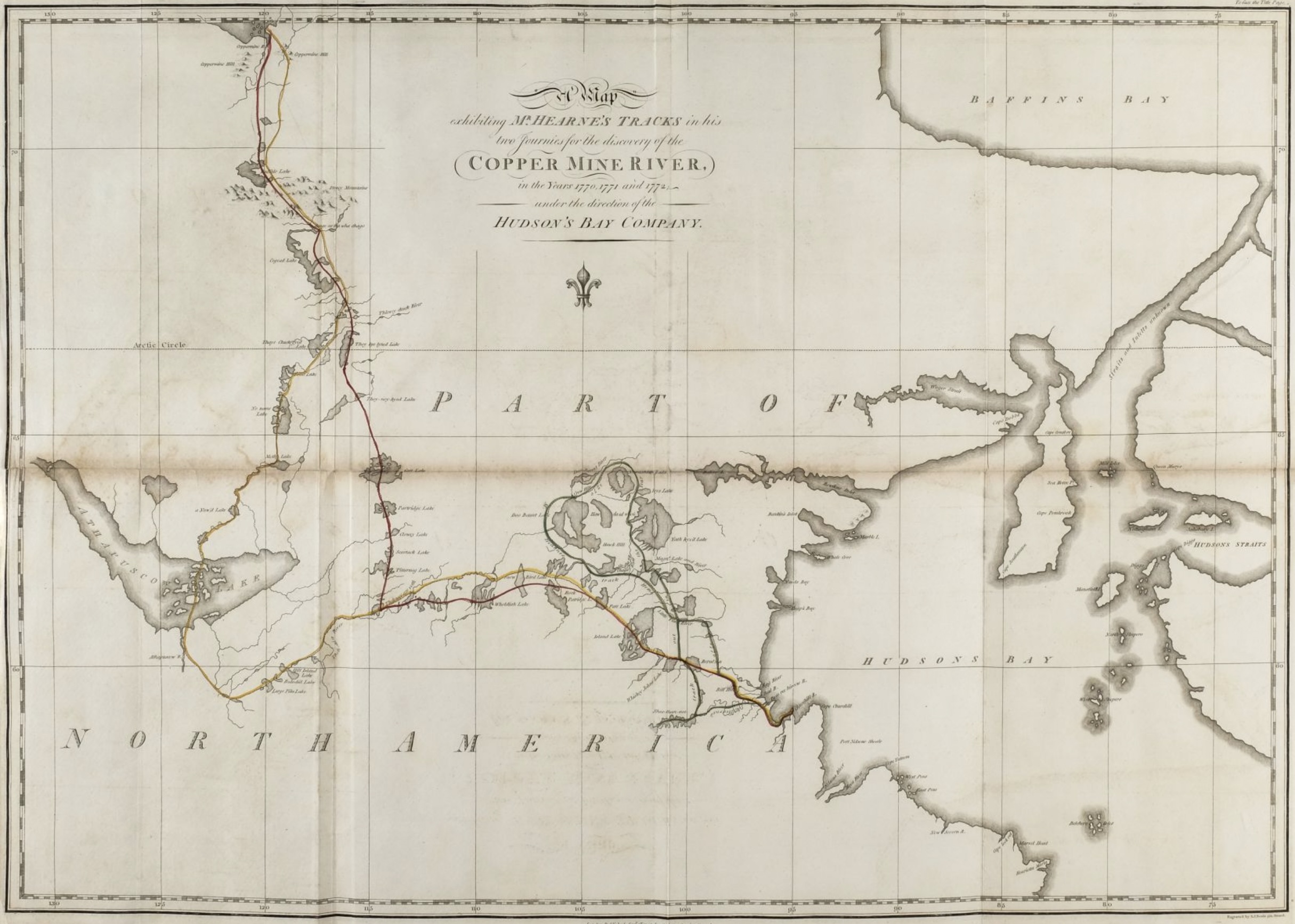
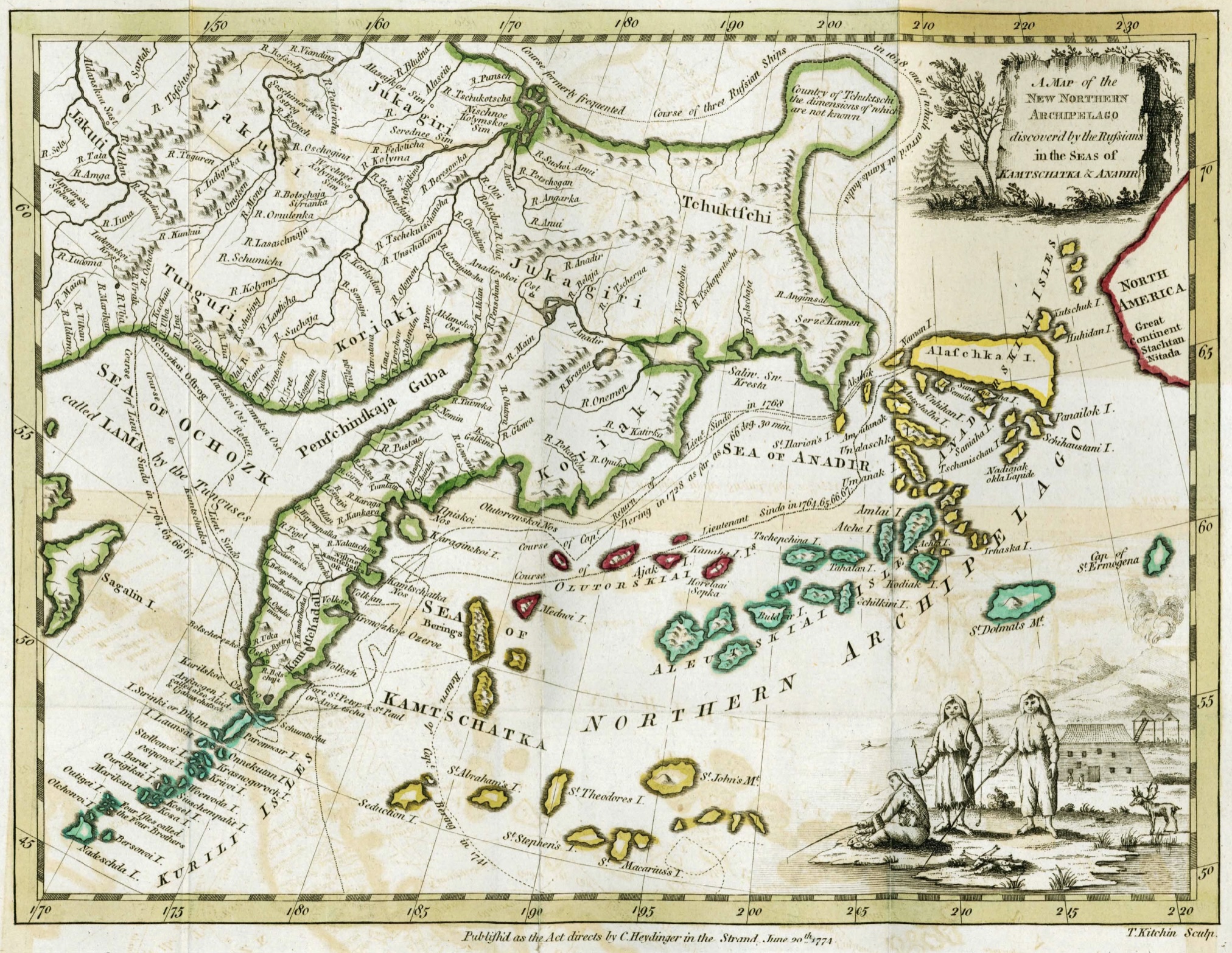
Hopes for it had been revived by Samuel Hearne, who travelled overland from Hudson Bay to the mouth of the Coppermine River (67°N, 115°W), in 1770-1772. There he discovered that the Arctic Ocean was not completely frozen. Then, in 1774, Jacob von Stählin, of the St. Petersburg Academy of Sciences, published charts in London which suggested Alaska was an island separated from the mainland by a passage to the Arctic, at 65°N.[2]
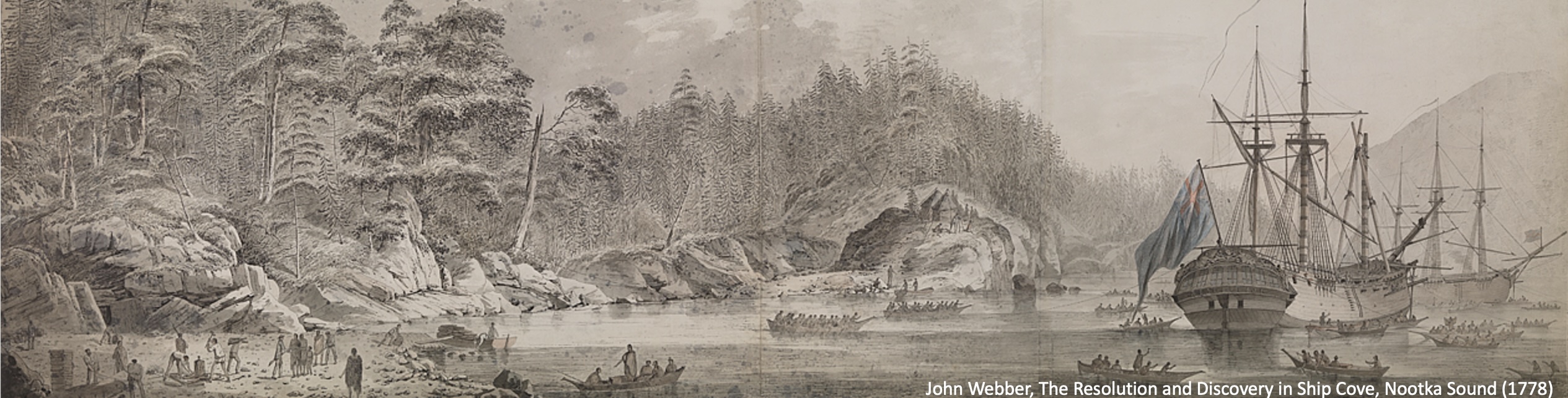
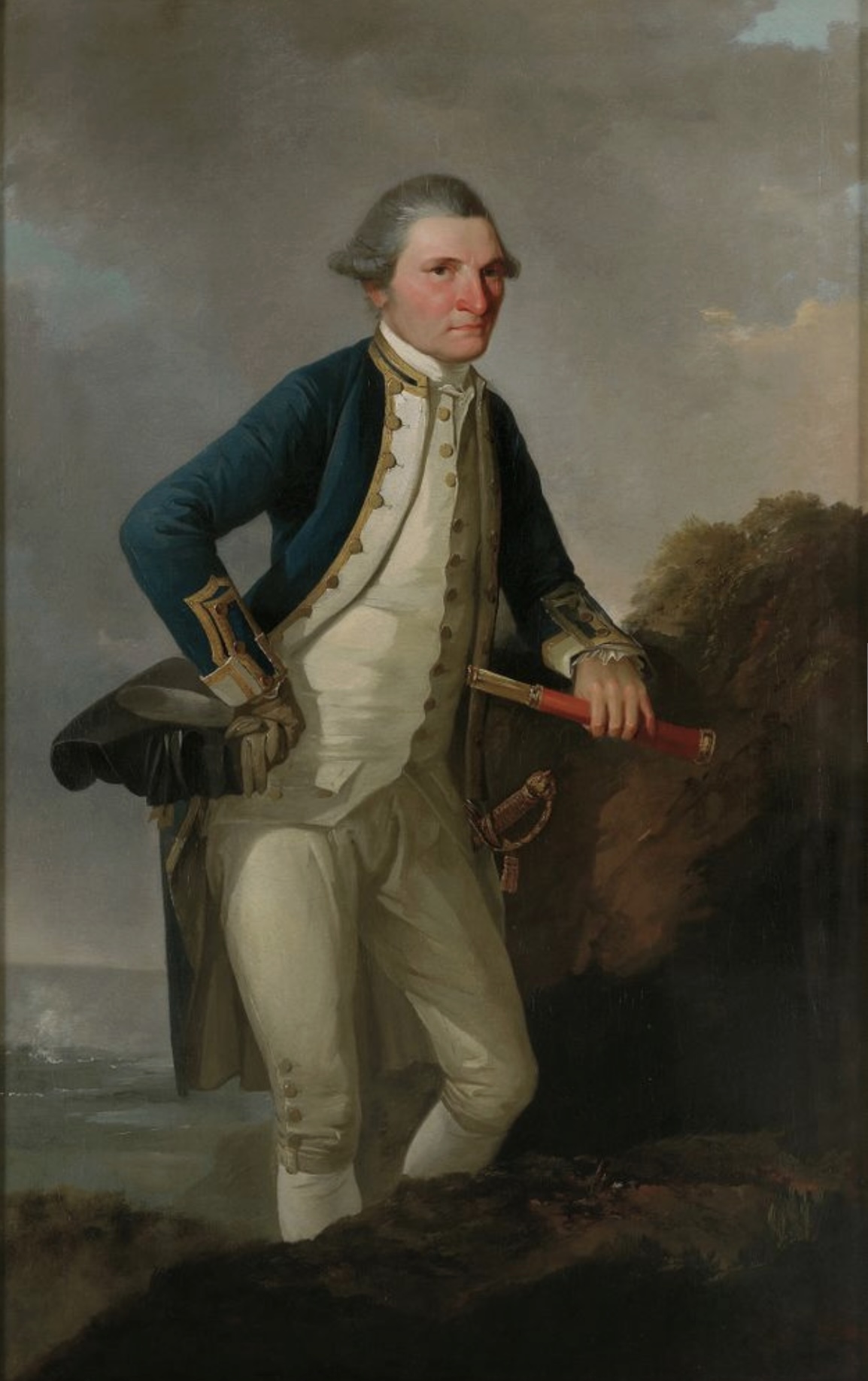
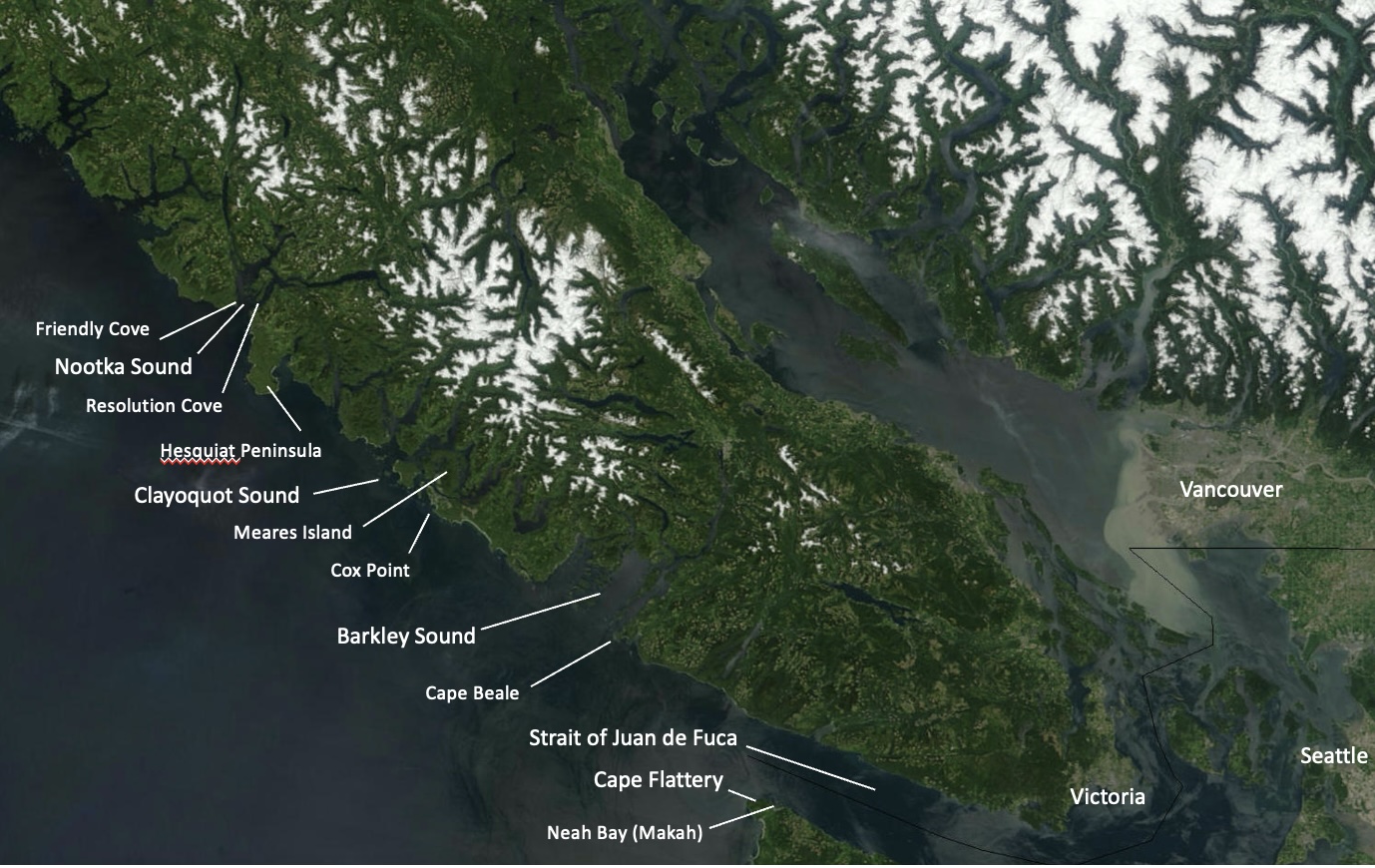
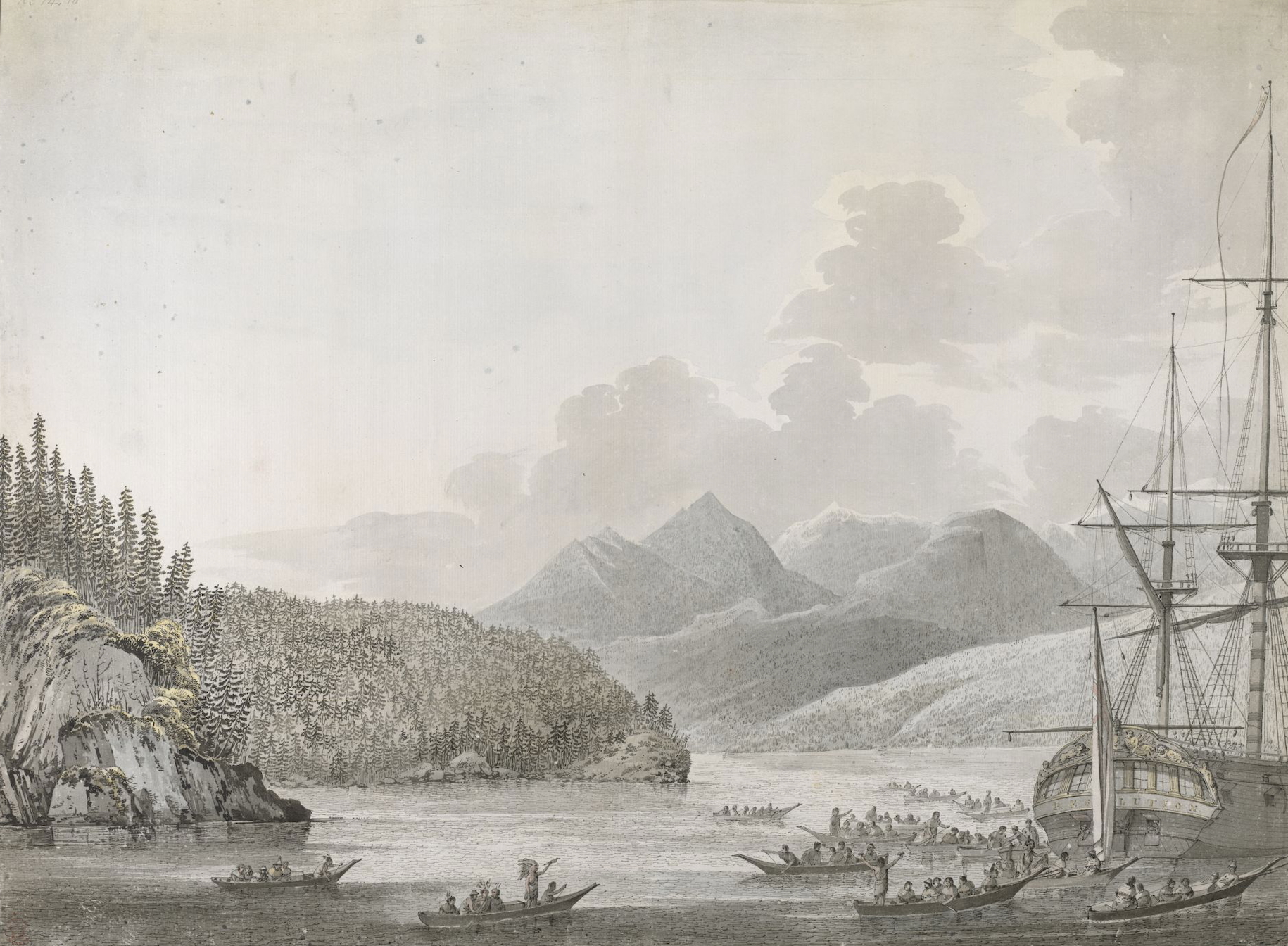
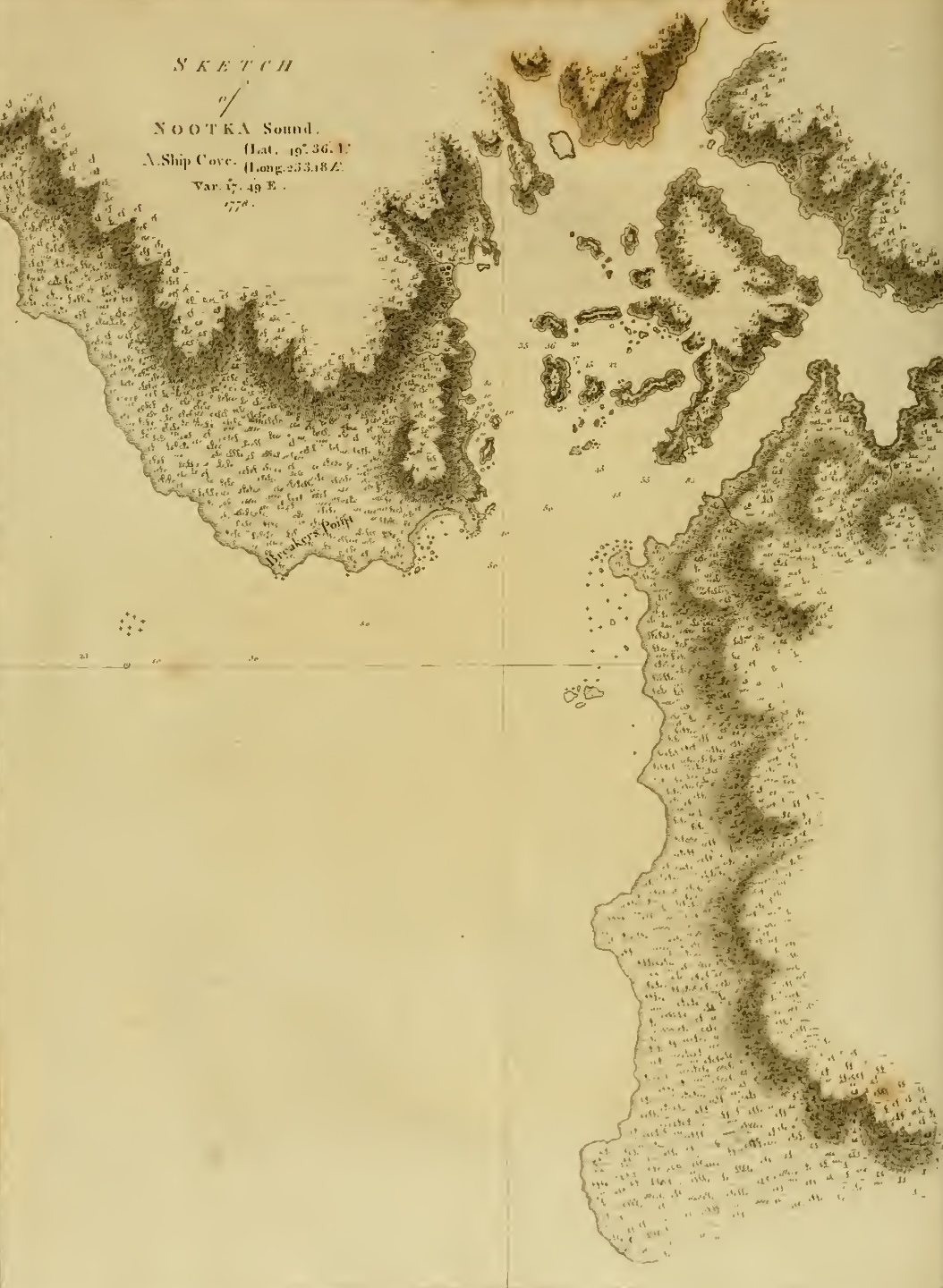
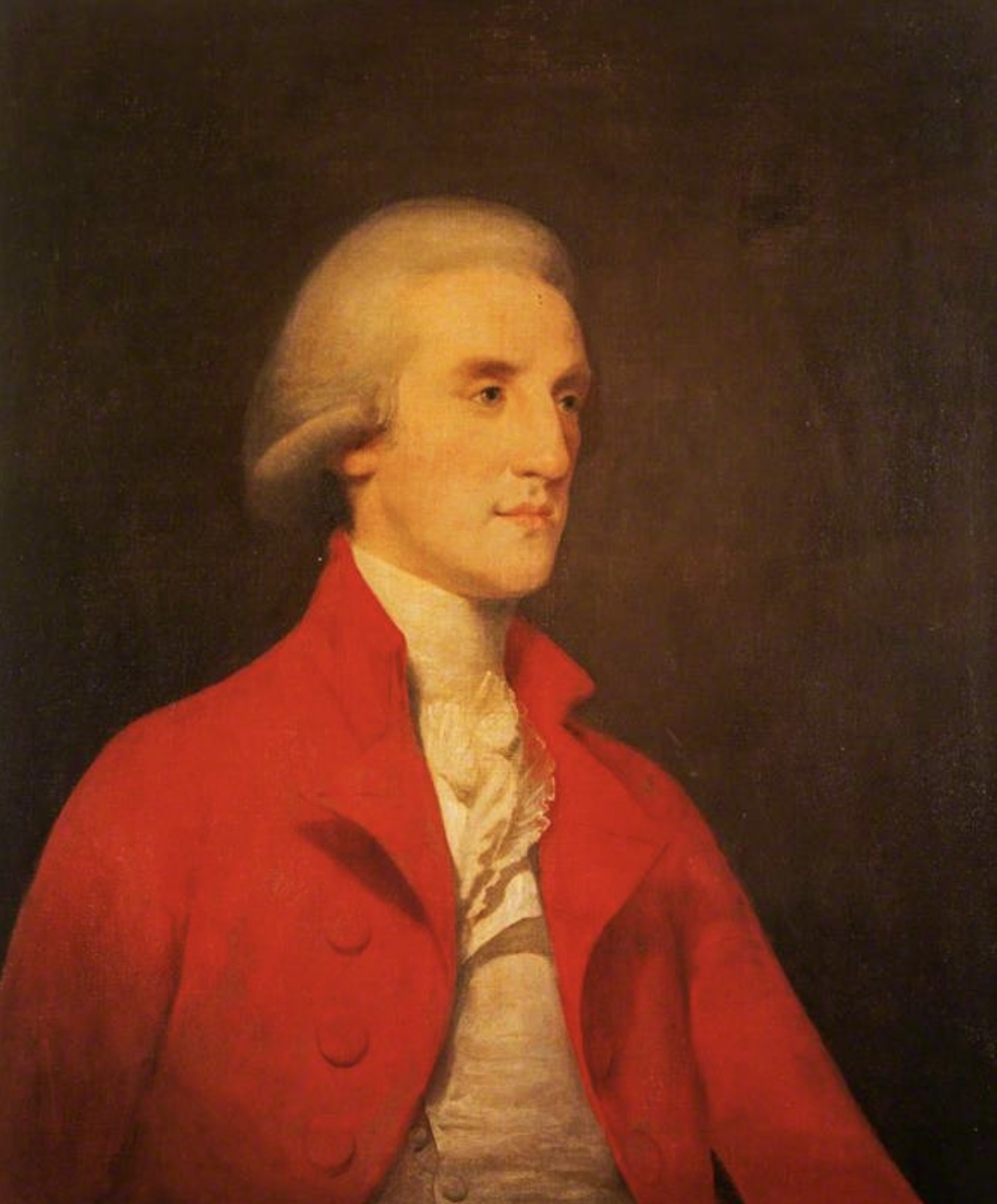
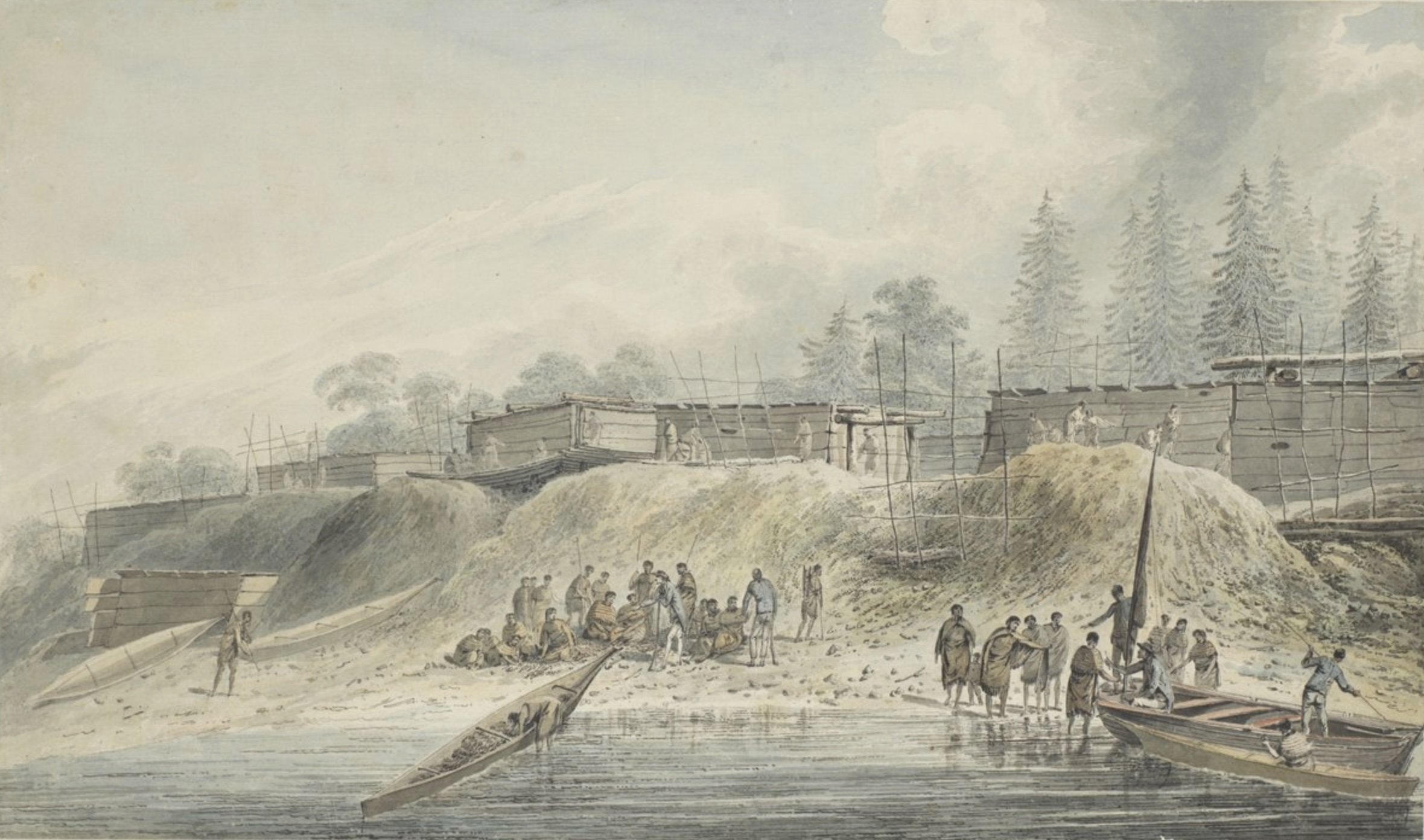
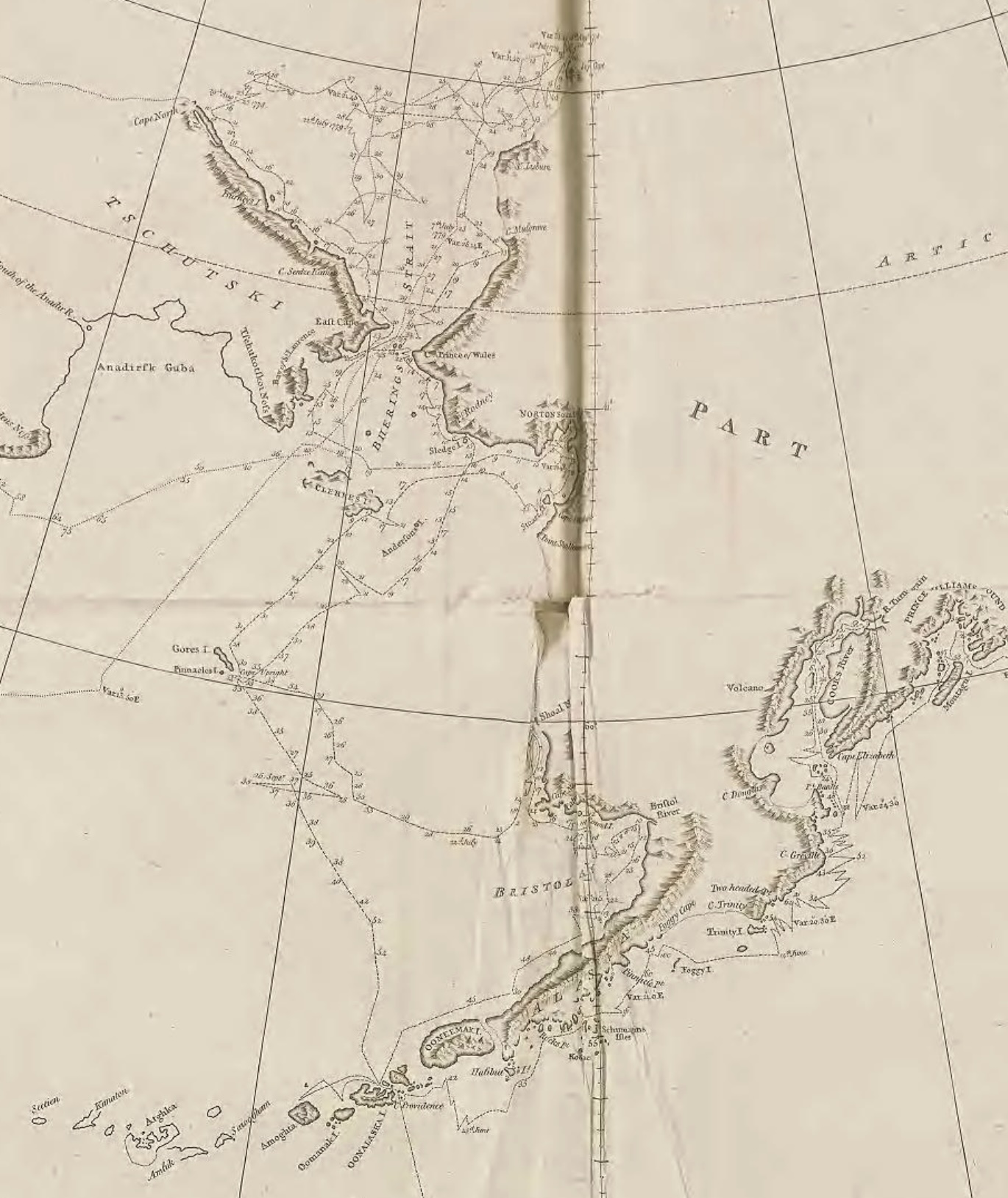
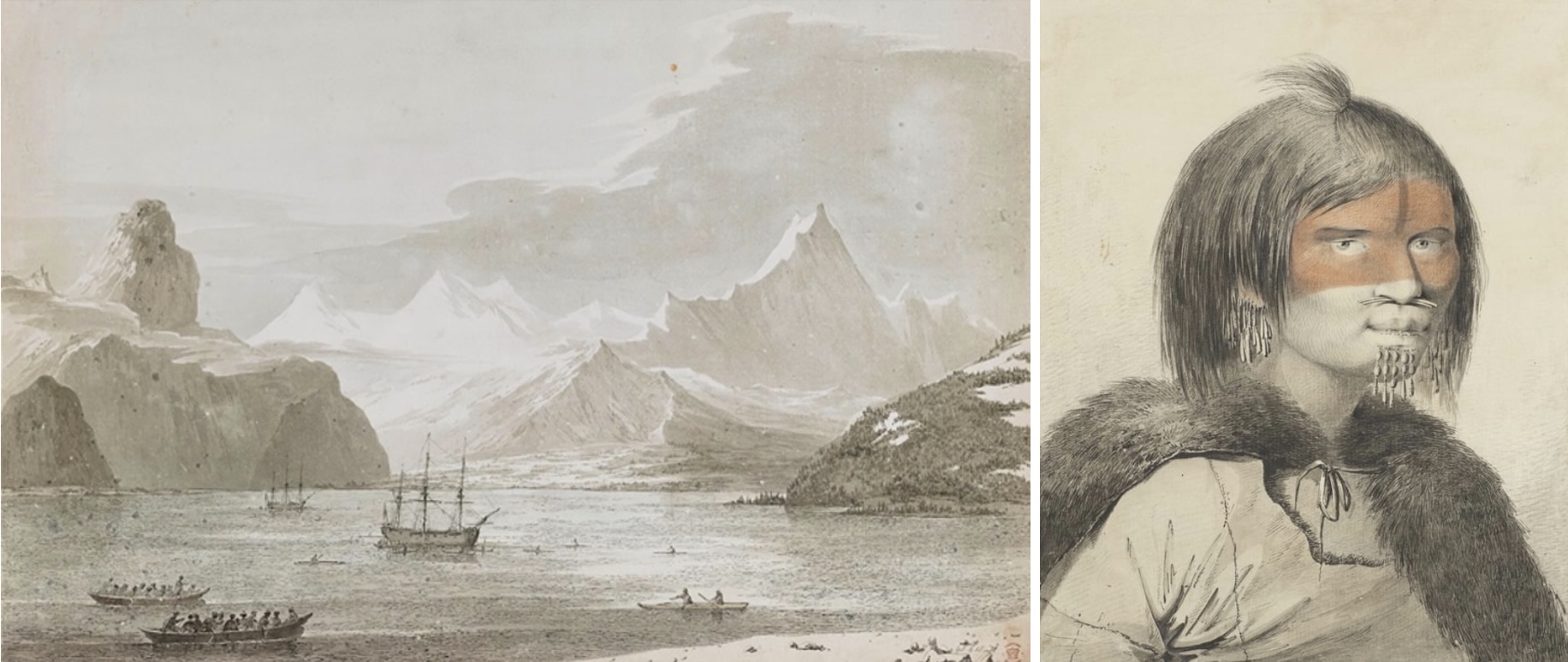
Captain James Cook was on his way to explore it when, on 29 March 1778, he reached Nootka Sound, on the western side of the island later named after George Vancouver. There he found timber to replace the Resolution’s rotten masts, and a people ‘whose inoffensive behaviour promised a friendly intercourse.’ [3]
They soon revealed themselves to be as light-fingered as any Cook had encountered, their appetite for things metallic being quite insatiable. A hook weighing more than twenty pounds was severed from the Resolution’s tackle and her boats were stripped of any iron that caught the eye:
[Cook wrote] Whole suits of clothes were stripped of every button; bureaus of their furniture; and copper kettles, tin canisters, candlesticks, and the like all went to wreck; so that our American friends here got a greater medley and variety of things from us than any other nation whom we had visited in the course of the voyage.
The captain’s gold watch was taken from under the noses of the men placed to guard his cabin. It was later recovered, but Cook became sufficiently exasperated that, on one occasion (he does not himself mention it), he ordered small shot to be fired at a native who refused to surrender the item he had misappropriated. According to William Bayly, the shot ‘wounded three or four men in their backs and backsides,’ and caused the offender’s companions to leave ‘apparently in an ill humour with us.’ Otherwise, however, relations were friendly enough for the duration of Cook’s stay.[4]
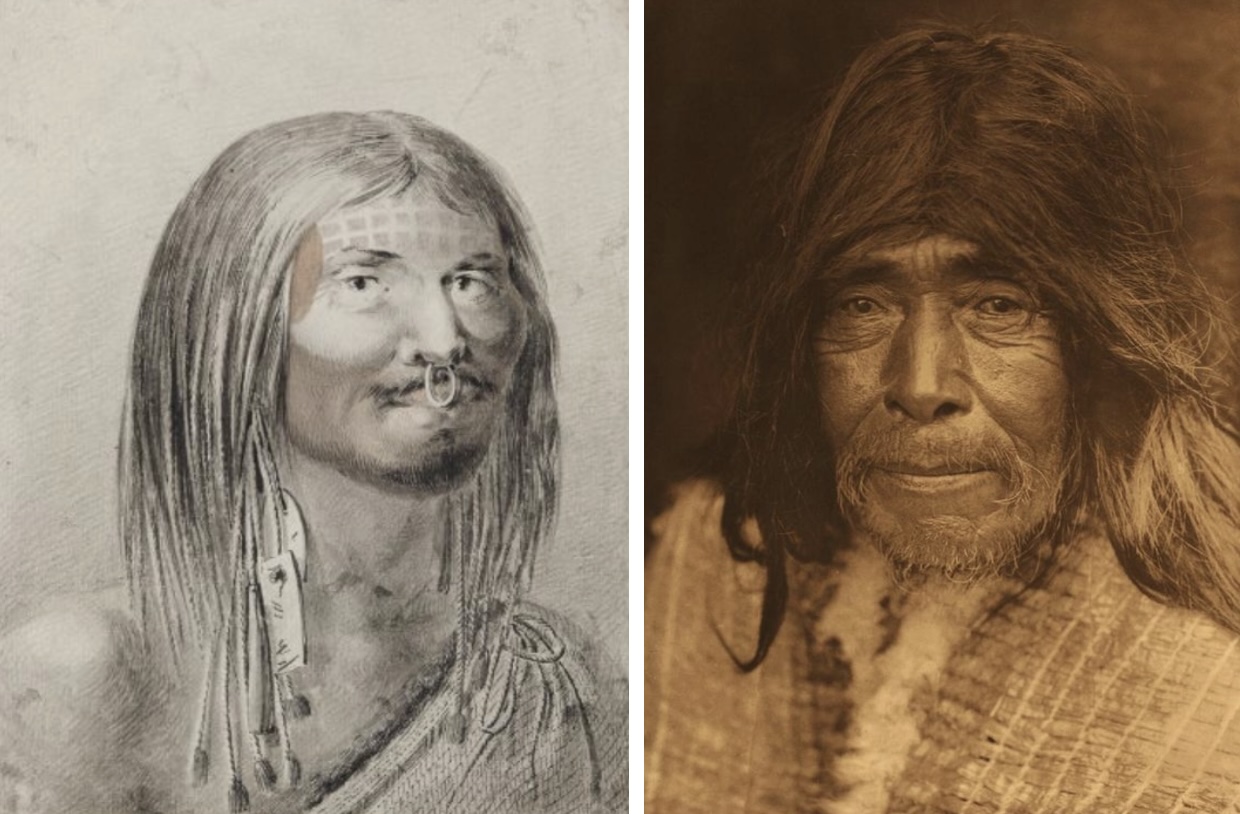
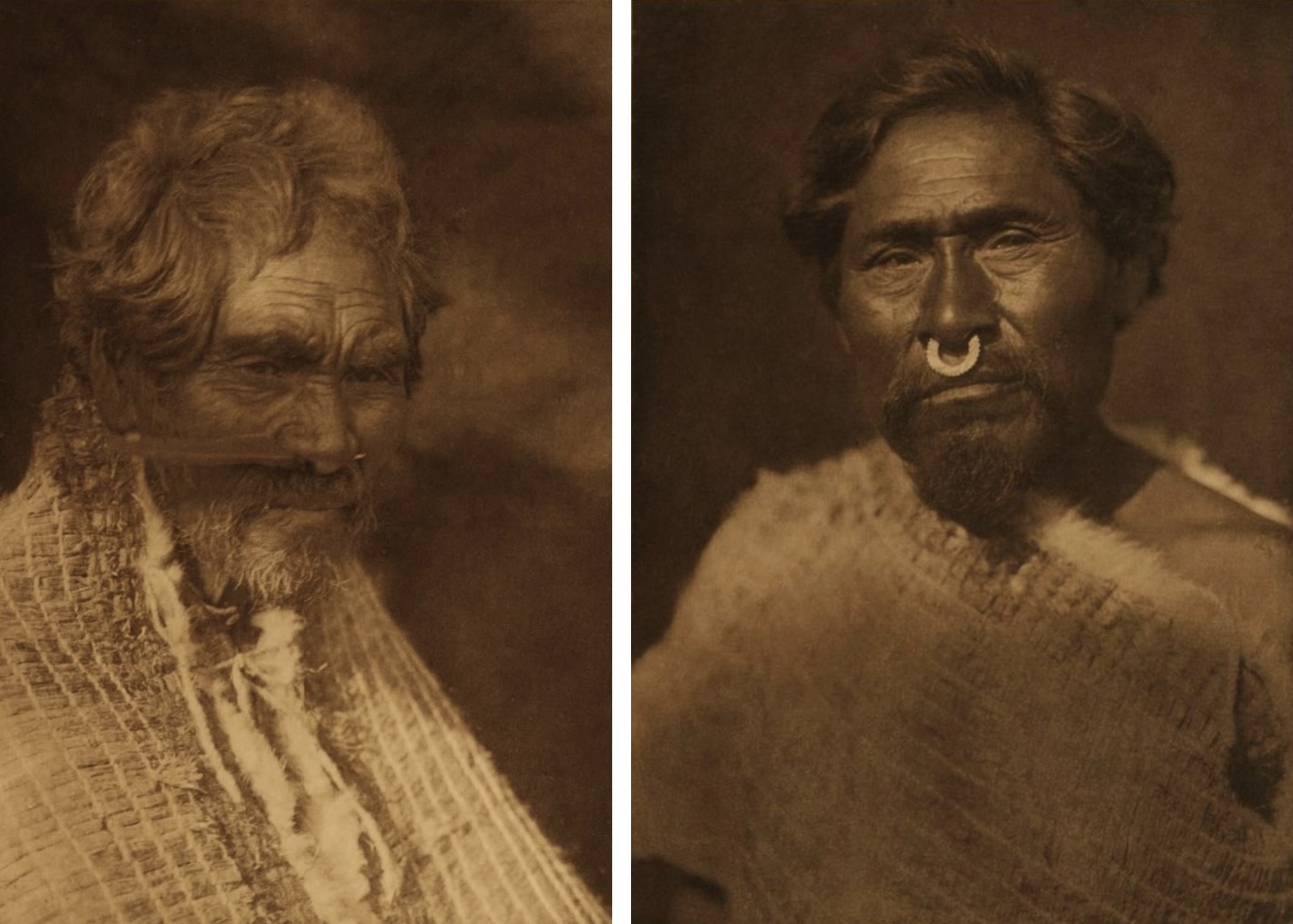
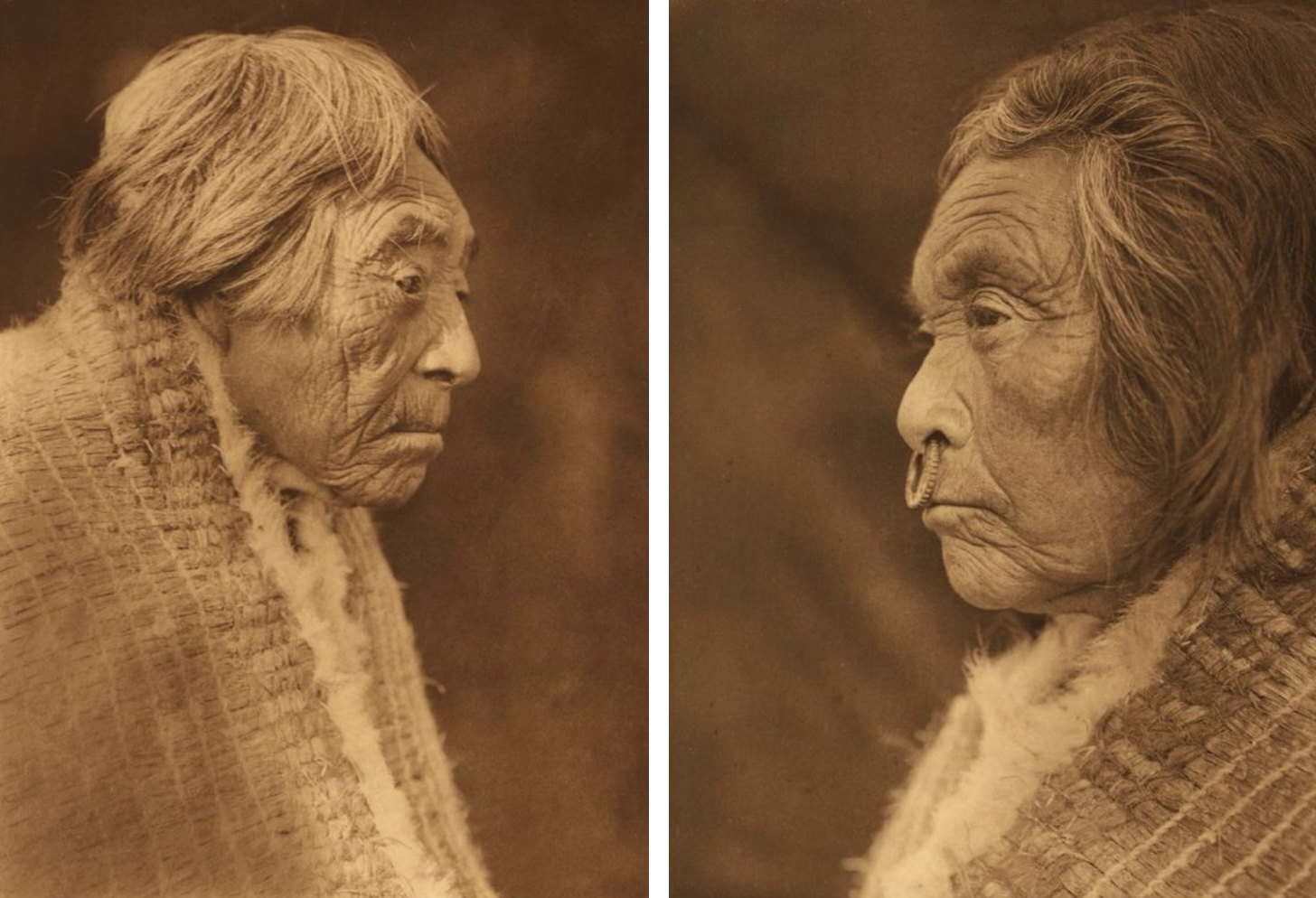
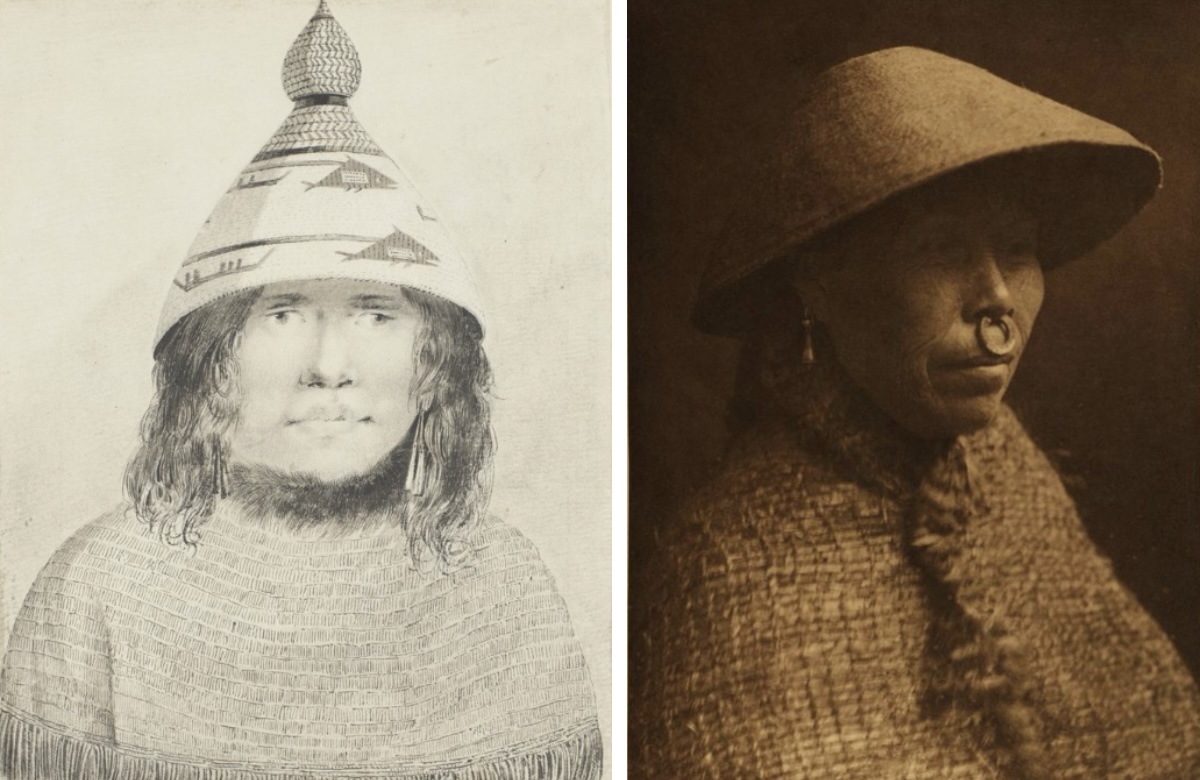
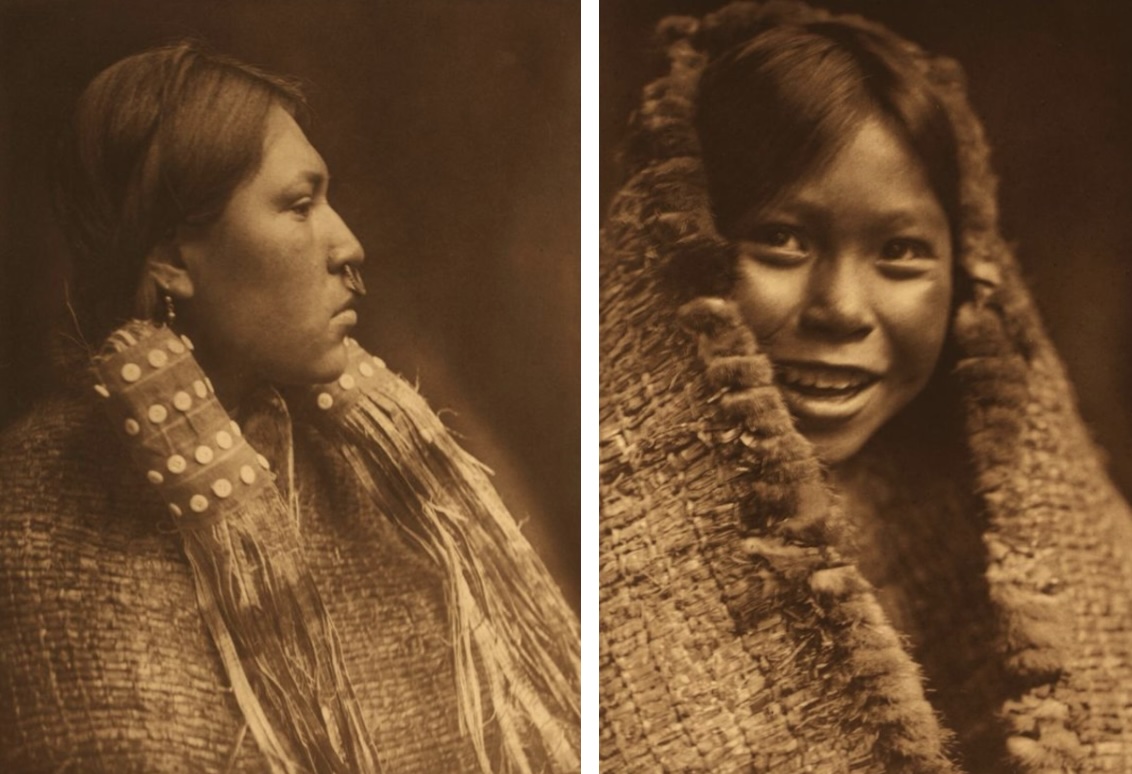
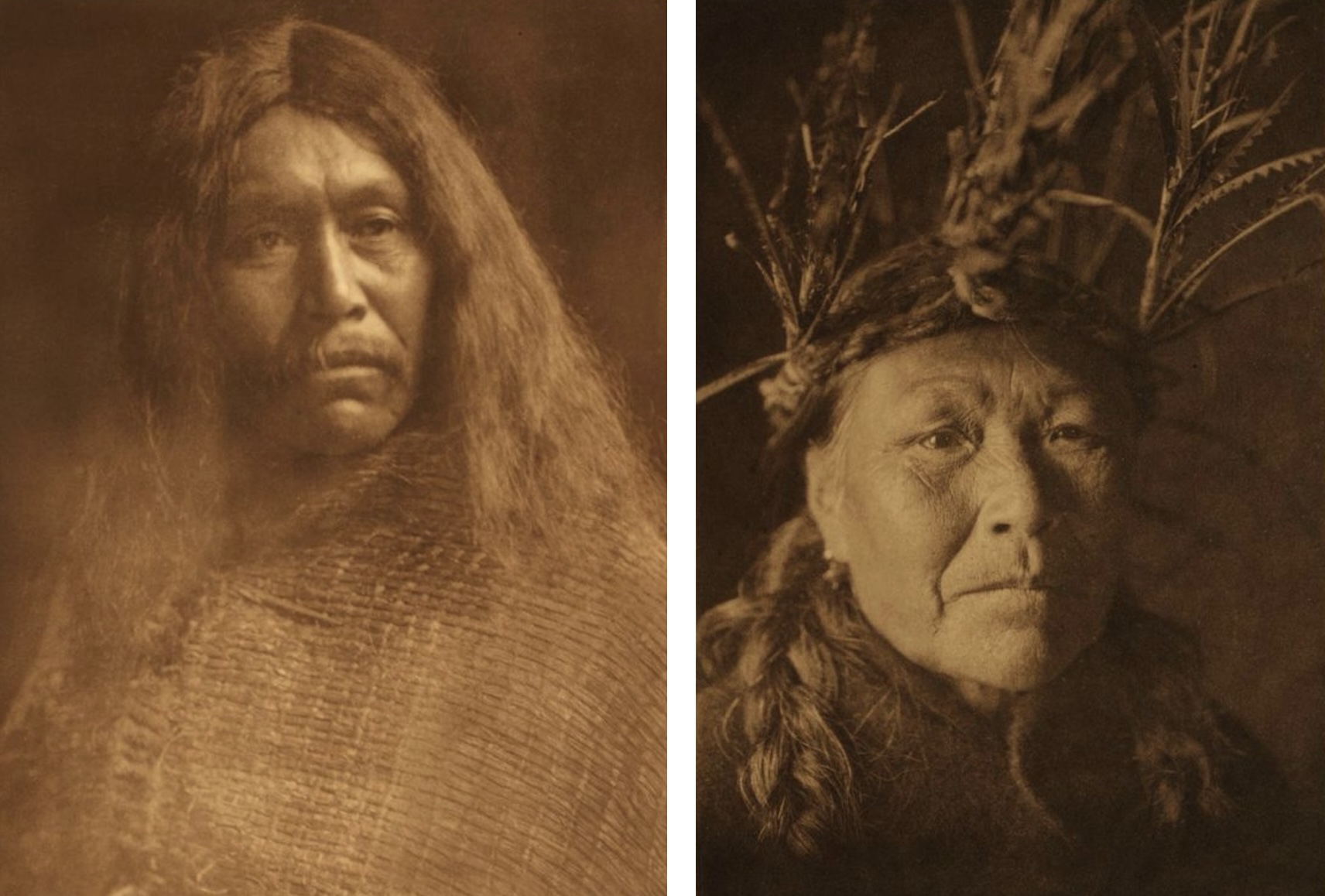
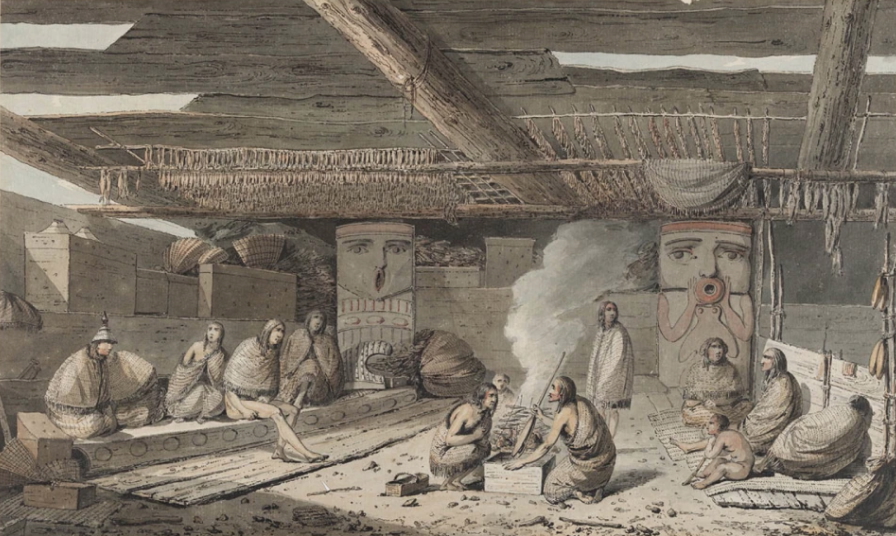
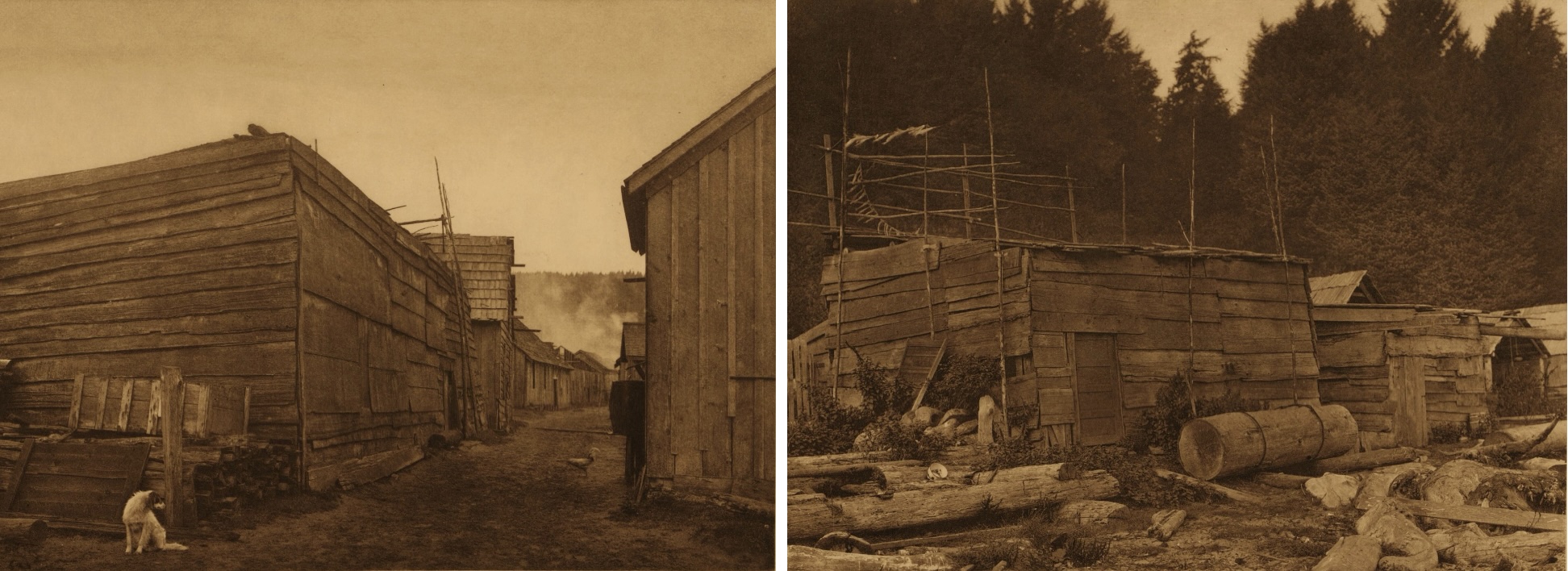
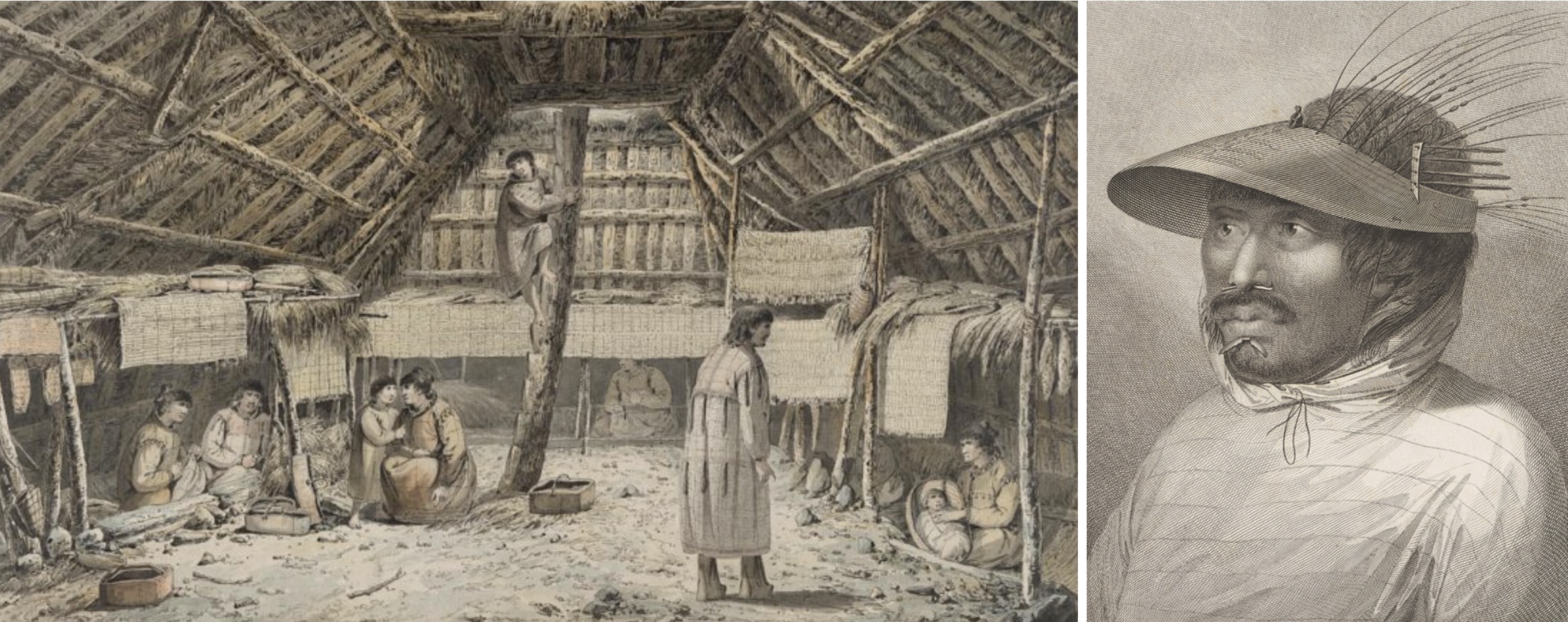
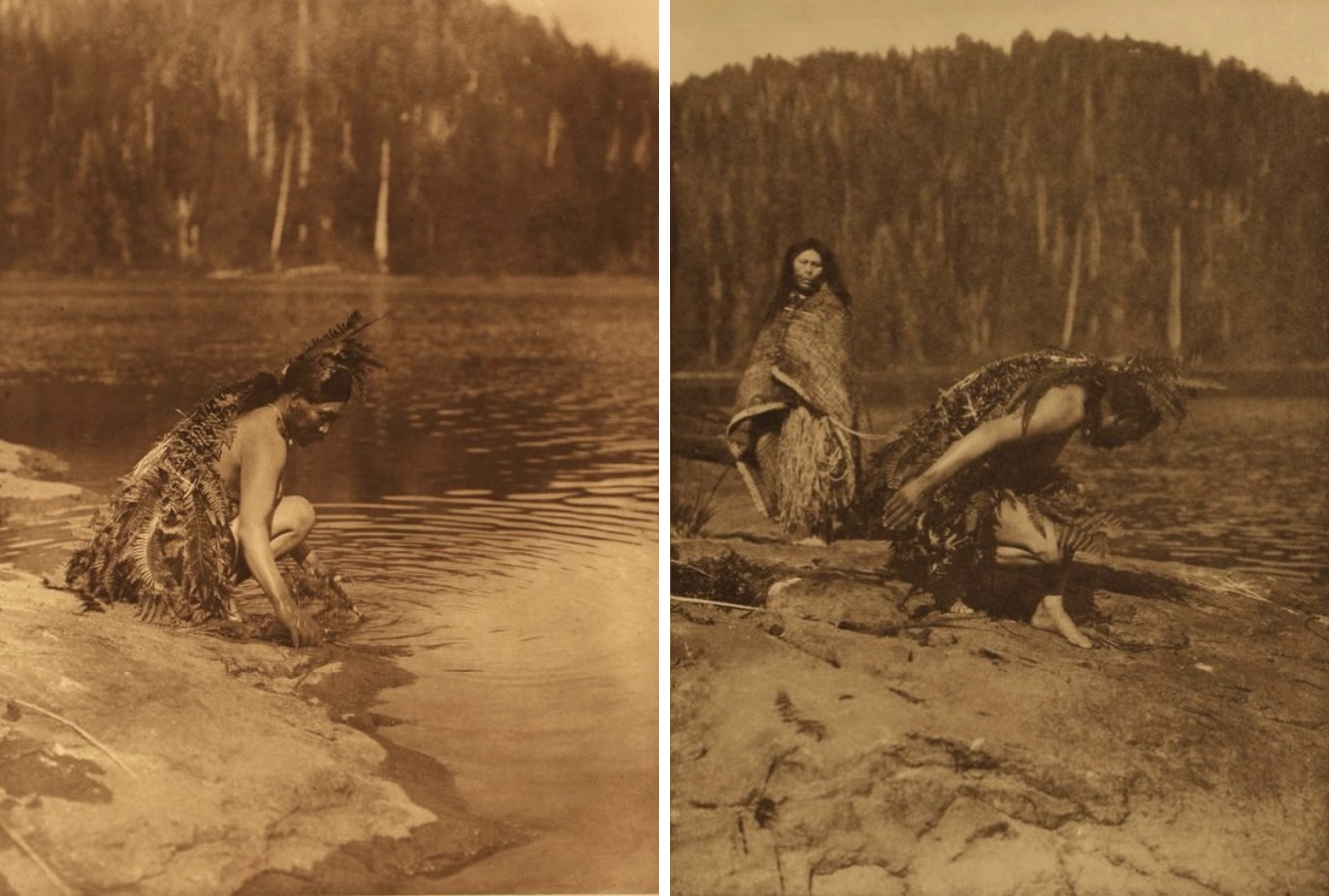
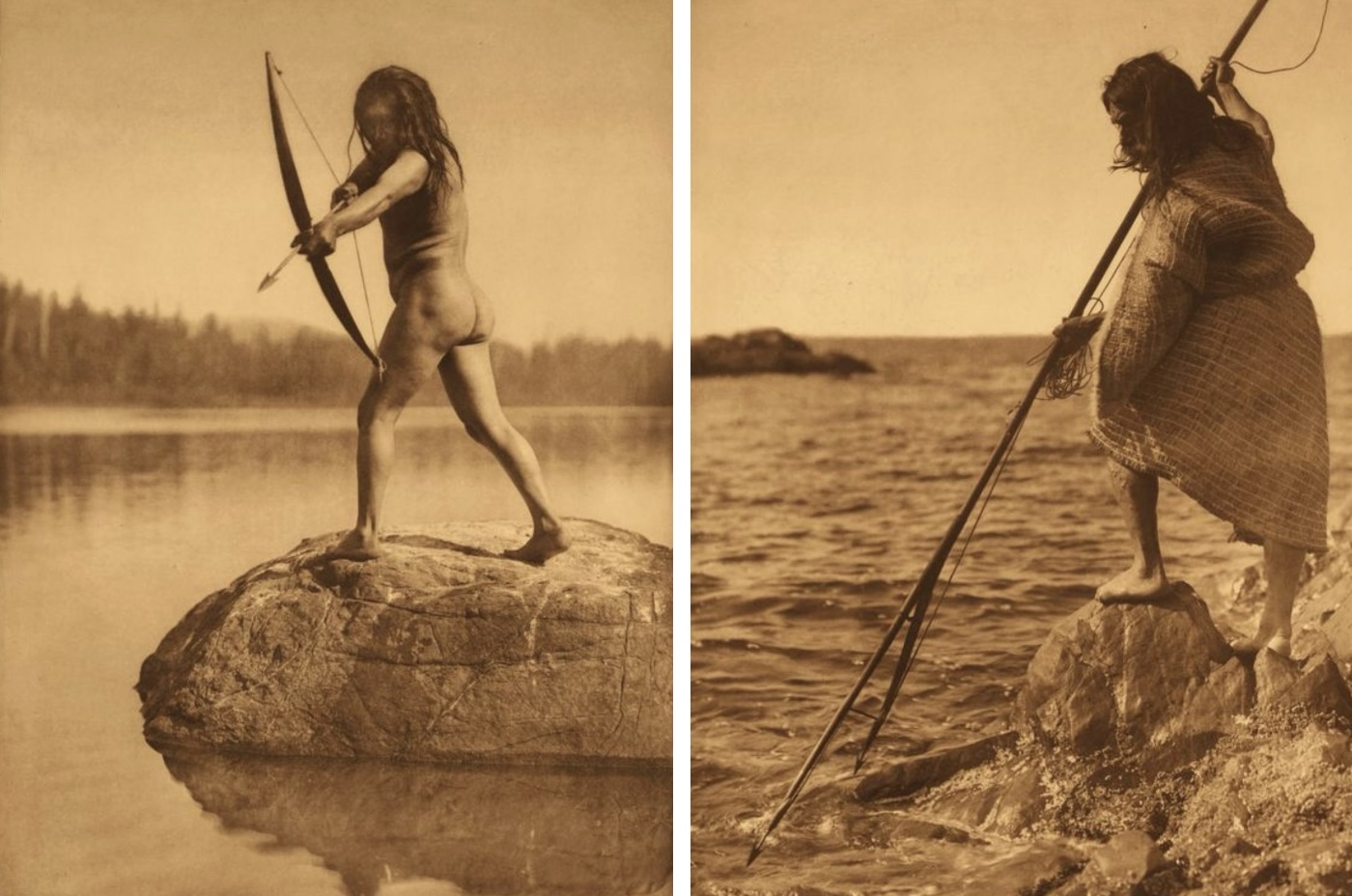
Today, Nootka’s people, the Nuu-chah-nulth, are best known for the totemic carvings which memorialise their ancestors. These they set up in their wood-planked houses, ‘the front carved into a human face, the arms and hands cut out upon the sides, and variously painted, so that the whole is a truly monstrous figure.’ The people Cook found ‘under the common stature; but not slender in proportion, being commonly pretty full or plump, though not muscular.’ They had round faces, abundant shoulder-length hair, short arms and crooked legs. The younger men plucked their beards. From the perforations in their ears and nose there hung bits of bone, quills, shells, woollen tassels and thin pieces of copper, which British beads could not supplant.
Their common dress is a flaxen garment, or mantle, ornamented on the upper edge by a narrow strip of fur, and, at the lower edge, by fringes or tassels … Over this, which reaches below the knees, is worn a small cloak of the same substance, likewise fringed at the lower part. In shape this resembles a round dish cover, being quite close, except in the middle, where there is a hole just large enough to admit the head … Their head is covered with a cap, of the figure of a truncated cone, or like a flower-pot, made of fine matting, having the top frequently ornamented with a round or pointed knob, or bunch of leathern tassels …
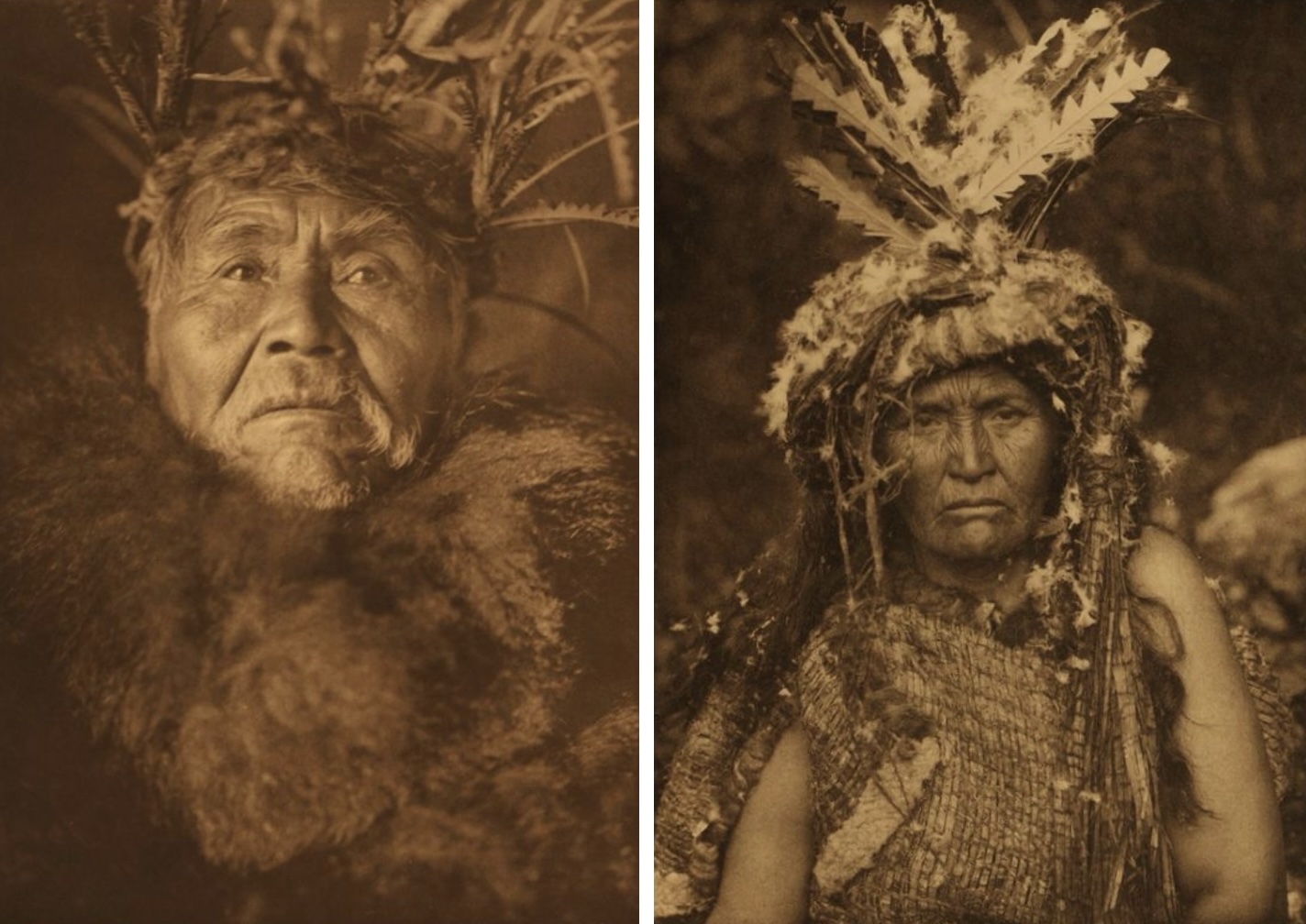
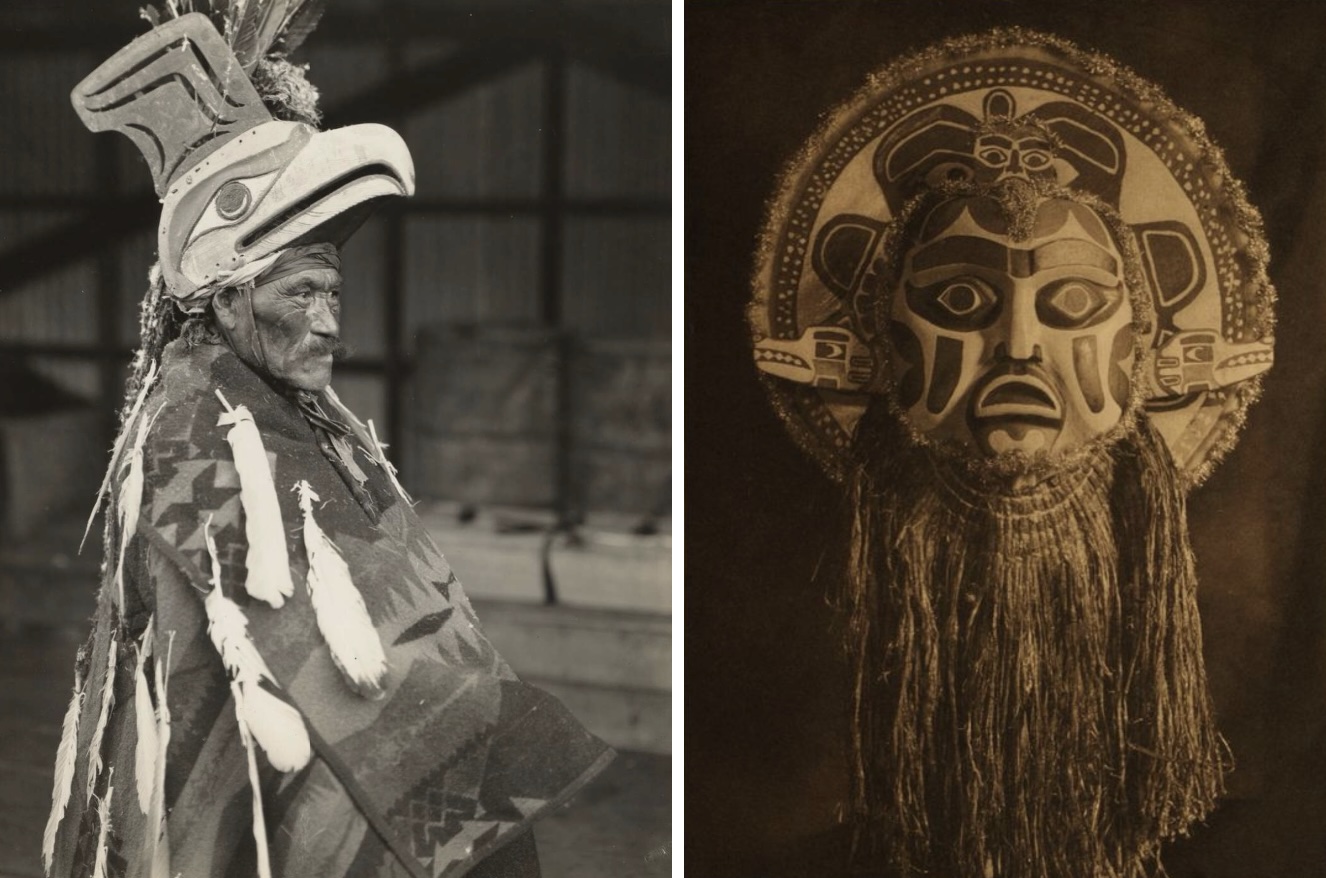
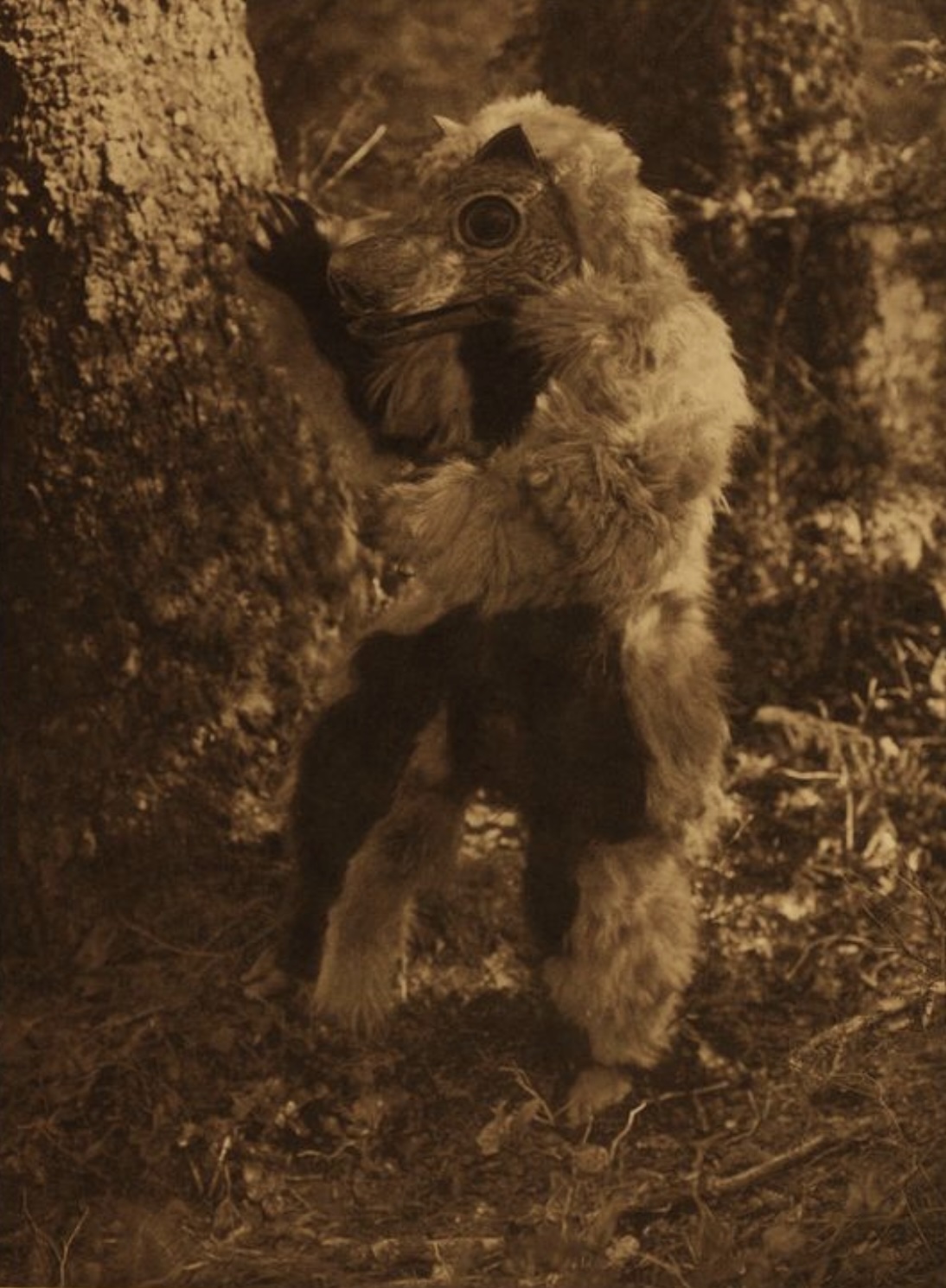
When first introducing themselves, or going to war, the Nootka adopted a headdress made from beaten bark decorated with eagle feathers. Otherwise, the effect of their animal skins and face paint was heightened by outsized wooden masks which they used to portray the features of birds, wolves, deer and porpoises. Cook commented that, such was their enthusiasm for these ‘disguises’, one Nootka was seen putting his head into a tin kettle, for want of an alternative.
Were they clean, he remarked, the Nootka’s apparel would not have been inelegant. However,
… as they rub their bodies constantly over with a red paint, of a clayey or coarse ochry substance mixed with oil, their garments, by this means, contract a rancid offensive smell and a great nastiness. So that they make a very wretched dirty appearance; and what is still worse, their heads and their garments swarm with vermin, which, so depraved is their taste for cleanliness, we used to see them pick off with great composure and eat.[5]
What did the natives offer for the metal they craved? Disconcertingly, on occasion, human skulls and ‘hands not quite stripped of the flesh.’ Cook conceded that the natives treated their enemies ‘with a degree of brutal cruelty,’ but he believed ‘almost every tribe of uncivilised man’ was alike, and that to charge the Nootka with ‘particular inhumanity’ would be unjust. On one occasion, however, John Ledyard was offered ‘a human arm roasted’ to eat:
I have heard it remarked that human flesh is the most delicious, and therefore I tasted a bit, and so did many others without swallowing the meat or the juices; but either my conscience or my taste rendered it very odious to me. We intimated to our hosts that what we had tasted was bad, and expressed as well as we could our disapprobation of eating it on account of its being part of a man like ourselves. They seemed to be sensible by the contortions of our faces that our feelings were disgusted, and apparently paddled off with equal dissatisfaction and disappointment themselves. [6]
Aside from body parts, the Nootka bartered with skins, weapons and bladders of animal oil (some of it adulterated with water). What stood out for the British sailors, however, were the beautiful pelts of the sea otter. These animals differed in certain respects from those described in accounts from Russia, most especially in the variety of the colours they presented. According to Cook, the hair of the youngest was brown, long and mostly coarse. Juveniles were blacker and softer, with faces and breasts of yellowish white, or very light brown:
After that they lose their black colour and assume a deep brown or sooty colour; but have then a greater quantity of very fine fur, and scarcely any long hairs. Others, which we suspected to be still older, were of a chestnut brown; and a few skins were seen that had even acquired a perfectly yellow colour.
The fur of these animals [he continued] … is certainly softer and finer than that of any others we know of; and therefore the discovery of this part of the continent of North America, where so valuable an article of commerce may be met with, cannot be a matter of indifference.[7]
In the first instance, however, the crews were less interested in trade than in the woeful state of their uniforms. The Resolution had been at sea for over two years and, as Ledyard explains, the men’s only thoughts were of converting the skins ‘to the purpose of clothing.’ Fixing on the best, they obtained fifteen hundred at a cost of around sixpence apiece. Only later, when they reached Kamchatka, were their eyes opened to the potential profits. Merchants engaged in the Empress Catherine’s fur trade were willing to part with bewildering quantities of cash for them. James King reports,
Our sailors … were not less astonished than delighted with the quantity of silver the merchants paid down for them; but on finding neither gin shops to resort to, nor tobacco, or any thing else that they cared for to be had for money, the roubles soon became troublesome companions, and I often observed them kicking them about the deck.
Later, King learned that even greater profits were to be made in China, or Japan:
The best sea-otter skins sell generally in Kamchatka, for about thirty roubles apiece. The Chinese merchant at Kyakhta purchases them at more than double that price and sells them again at Pekin at a great advance, where a farther profitable trade is made with some of them to Japan. If, therefore, a skin is worth thirty roubles in Kamchatka, to be transported first to Okhotsk, thence to be conveyed by land to Kyakhta, a distance of one thousand three hundred and sixty-four miles, thence on to Pekin, seven hundred and sixty miles more, and after this to be transported to Japan, what a prodigiously advantageous trade might be carried on between this place and Japan, which is but about a fortnight’s, at most, three weeks sail from it. [8]
In December 1779, King visited Canton where, after a short period of bargaining, he sold twenty skins for eight hundred Spanish dollars. In Macao, the crew encountered brisk trade at even higher values. A few well-preserved skins sold for $125 each. Altogether, the pelts raised two thousand pounds. King wrote,
When … it is remembered, that the furs were, at first, collected without our having any idea of their real value; that the greatest part had been worn by the Indians from whom we purchased them; that they were afterward preserved with little care, and frequently used for bed-clothes and other purposes during our cruise to the North; and that, probably, we had never got the full value for them in China; the advantages that might be derived from a voyage to that part of the American coast, undertaken with commercial views, appear to me of a degree of importance sufficient to call for the attention of the Public.
The effect on the Resolution’s crew was transformational. Their patched clothing became ‘mixed and eked out with the gaudiest silks and cottons of China.’ The ‘rage’ that possessed them to return to America and make their fortune, drew close to mutiny. For his part, King declared that all success required was two small vessels equipped with,
… five ton of unwrought iron, a forge, and an expert smith, with a journeyman and apprentice, who might be ready to forge such tools as it should appear the Indians were most desirous of … To this might be added a few gross of large pointed case-knives, some bales of coarse woollen cloth … and a barrel or two of copper and glass trinkets.
Still, he claimed that, on his expedition, the trading in skins would be ‘a secondary object,’ used to defray the expense of an exploratory mission to the Yellow Sea, the Kuriles and Sakhalin. From there, the expedition might sail to Cook Inlet, in Alaska, thence to explore the coast between Prince of Wales Island and the point at 50° of latitude where Cook had been driven out of sight of land by contrary winds. King was confident that, working to his itinerary, 250 pelts worth a hundred dollars each could be procured in good time for a return voyage to China, in October.[9]
The Expedition of James Strange (1786-1787)
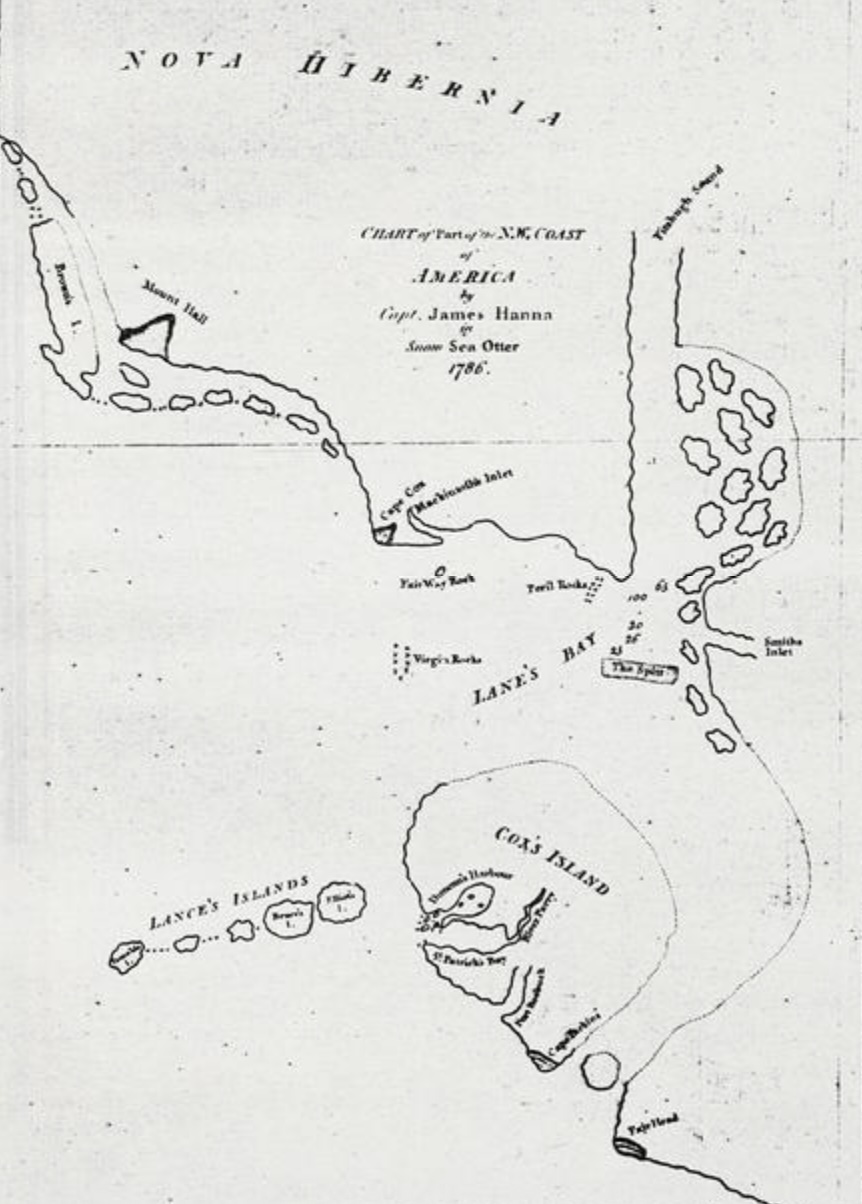
King’s scheme did not eventuate. Yet, when his journal appeared, in 1784, the otter secret became public. The first to seize the opportunity was a syndicate led by William Mackintosh, commander of the Indiaman Indostan, and two Company supercargoes in Macao, John Henry Cox and John Reid. Under their auspices, in April 1785, James Hanna sailed to Nootka Sound in the Sea Otter, a small ship, probably of fifty to sixty tons. During his stay, he was involved in a fight of a sort with the natives, possibly the result of a Nootka attack, possibly a response to the petty theft of a chisel. One report says no Nootka were killed, another twenty, and one by the Spaniard, Estaban Martinez, fifty. Martinez is partisan. His lieutenant, Estaban Mondolfia, reported that the Nootka had ‘killed and eaten’ two of Hanna’s men, but we understand from others that all returned safely. Martinez is also responsible for an account of an unlikely act of revenge by Hanna’s men on the Nootka chief. He was invited on board the Sea Otter and seated near the binnacle. There,
… they sprinkled a little powder under his chair, giving him to understand that this was an honour which they showed to chiefs. He supposed that the powder was coloured sand, but he soon felt its effect, when one of the Englishmen set off the charge. Poor Maquilla was raised from the deck by the explosion and had his buttocks scorched; he showed me the scars.
So says the account, but it is an improbable way of treating the chieftain of a people with whom one hoped to trade. It is more likely that the tale, if it is not completely imaginary, is a garbled account of a practical joke perpetrated on a humbler native. Whatever, the fact of Hanna’s having fired upon the Nootka was not forgotten. In 1807, John Jewitt, one of the survivors of an attack on the ship Boston, wrote that it was organised to avenge their killing by Hanna’s men.
At the time, they were either cowed or more forgiving. Hanna’s voyage was a success. He returned to Macao at the end of 1785, and by March the following year he had sold 550 pelts for 20,600 Spanish dollars, or more. (Reports in England, from 21 September 1786, speak ‘upwards of £30,000’ in revenue – likely an exaggeration.) Although the level of profits is unclear, they were sufficient to spawn a second voyage. Hanna sailed again for Nootka Sound, on 4 May 1786. He arrived, on 18 August, to discover that two rival ships from Bombay had departed just three weeks before.[10]
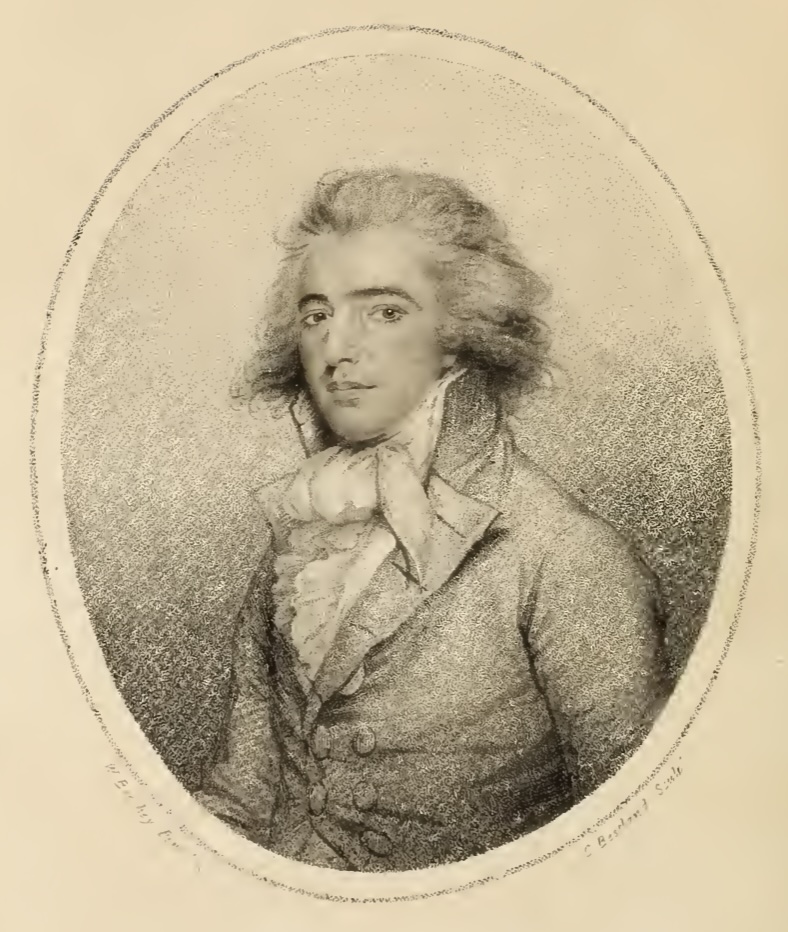
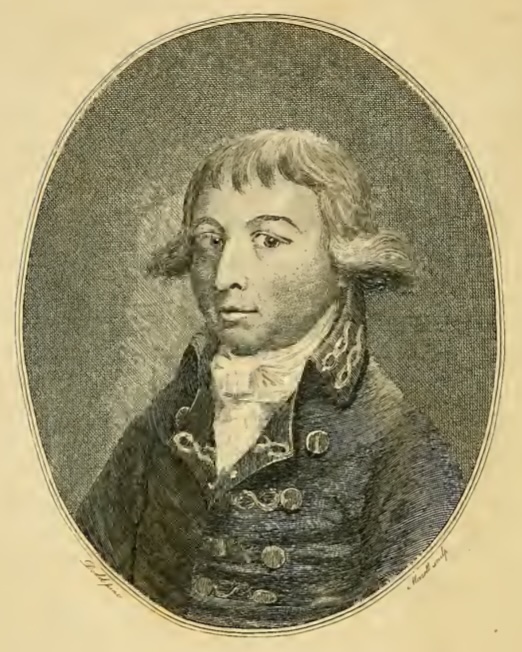
Their commander was James Strange, a Company employee who had obtained a copy of King’s journal whilst on leave in London and who, after returning to Bombay, in late 1785, had approached his patron, the merchant David Scott.
Scott was more enthusiastic even than Strange anticipated. Two snows, the Captain Cook (350 tons) and the Experiment (100 tons) were coppered, specially equipped, and manned exclusively with Europeans. As a result, Strange’s hopes that the expense of his ships might be ‘very little greater than that at which they now lay at anchor in Bombay harbour’ fell far wide of the mark. Scott had hoped that the Bombay government might act as sponsor but, although the Council approved the plan ‘in all its parts’, they granted it no patronage. They provided fifteen men under Alexander Walker to assist, and nothing more. (London was not consulted, so Strange sailed without the Company’s formal approval). Against Scott’s hopes, therefore, the effort remained privately financed. As a result, although ‘discovery’ remained its ostensible objective, Strange was instructed to ‘let no opportunity escape … of benefiting by trade.’ [11]
The original plan was to collect sandalwood on India’s Malabar coast and sell it in Macao before crossing to America. However, by the time of his departure, in January 1786, Strange judged the season too far advanced. Without a suitable cargo, he feared the provisioning of his vessels in China would be too expensive, so he sailed instead to Batavia, to obtain supplies more cheaply.
In his narrative, he openly glosses over the hair breadth ‘scapes’ of his first fortnight. Simply he states that his progress was soon ‘disagreeably interrupted … being too close in with the Telat of Ontong Point off Java.’ The Experiment had grounded on a sandbank. The Captain Cook was alerted to the danger but, as she drew the Experiment off the bottom, she lost her stream anchor when its cable parted. This was something that could not be replaced in Batavia. Strange quickly learned that the town was cheap for multiple reasons. In particular, there was just one inn at which foreigners could stay. At two dollars a night, the cost appeared reasonable, until the ‘extras’ were added. Once he was alerted to them, Strange was minded to suggest that the Batavians might have charged even for the privilege of breathing …
Worse was to follow. At breakfast, Strange met a long-term resident of the hotel visiting from Bencoolen. When he mentioned that he was staying in Room 18, he was told to vacate it immediately:
With hands and eyes uplifted to heaven … [he] informed me that, during a residence of five weeks in the house, he had, in that space, seen no less than seven bodies carried to their graves out of the very bed on which I had last night reposed, and that it had not, he believed, been aired once in all that period.
The matter was referred to the landlord, who apologised, and involved the head waiter. Carefully, the waiter ran through the alternatives, and affirmed that Strange’s room was the best. Whereupon, to Strange’s consternation, the Bencoolen gentleman agreed with him,
… for that, in one of the rooms referred to, a man had died of a putrid fever only eight and forty hours before my arrival, whereas my bed had been free from such an occurrence six or eight days at least; and that, as for the other rooms alluded to, they went by the pleasing names of the ‘Tavern Sepulchres’ …
Strange concludes with the remark that,
Having received little satisfaction in consequence of this éclairissement, I determined in my own mind not to pass another night in any [but] the best bed in the house, and accordingly took up my lodging on a good billiard table, which I continued in possession of until my departure.[12]
Unfortunately, this was delayed by the suspicions of the Dutch, who fancied the expedition was bound for the Spice Islands. They also withheld their charts. And so, a little beyond Borneo’s south-eastern corner, the Captain Cook ran aground, again. This time, the Experiment mis-interpreted the danger signal. Presuming a piratical attack, she came to the rescue, and struck also, her crew managing, in the process, to pierce her bottom by an ill-judged cast of her anchor. Strange writes,
Ill as I had been for some days past of a violent fever and ague, the state of my nerves was now so unstrung, that I confess it required every exertion of my faculties to conceal from the eyes of the bystanders the extent of the misery I felt in consequence of the accumulated misfortunes. In the momentary pause in which I permitted myself to think, I regretted less the prospect which stared me in the face of ruin to my fortune, than I dreaded the possible chance of miserable slavery that now threatened us.
Happily, the pirates missed their opportunity. When her guns and stores had been offloaded onto a raft of booms and spars, the rising tide lifted the Captain Cook clear. The Experiment was emptied of her cargo and ballast, and her holes were successfully caulked and sheathed. (Strange spent most of the twenty days expended in the effort in his sickbed.) Finally, on 10 March, he left Borneo behind.
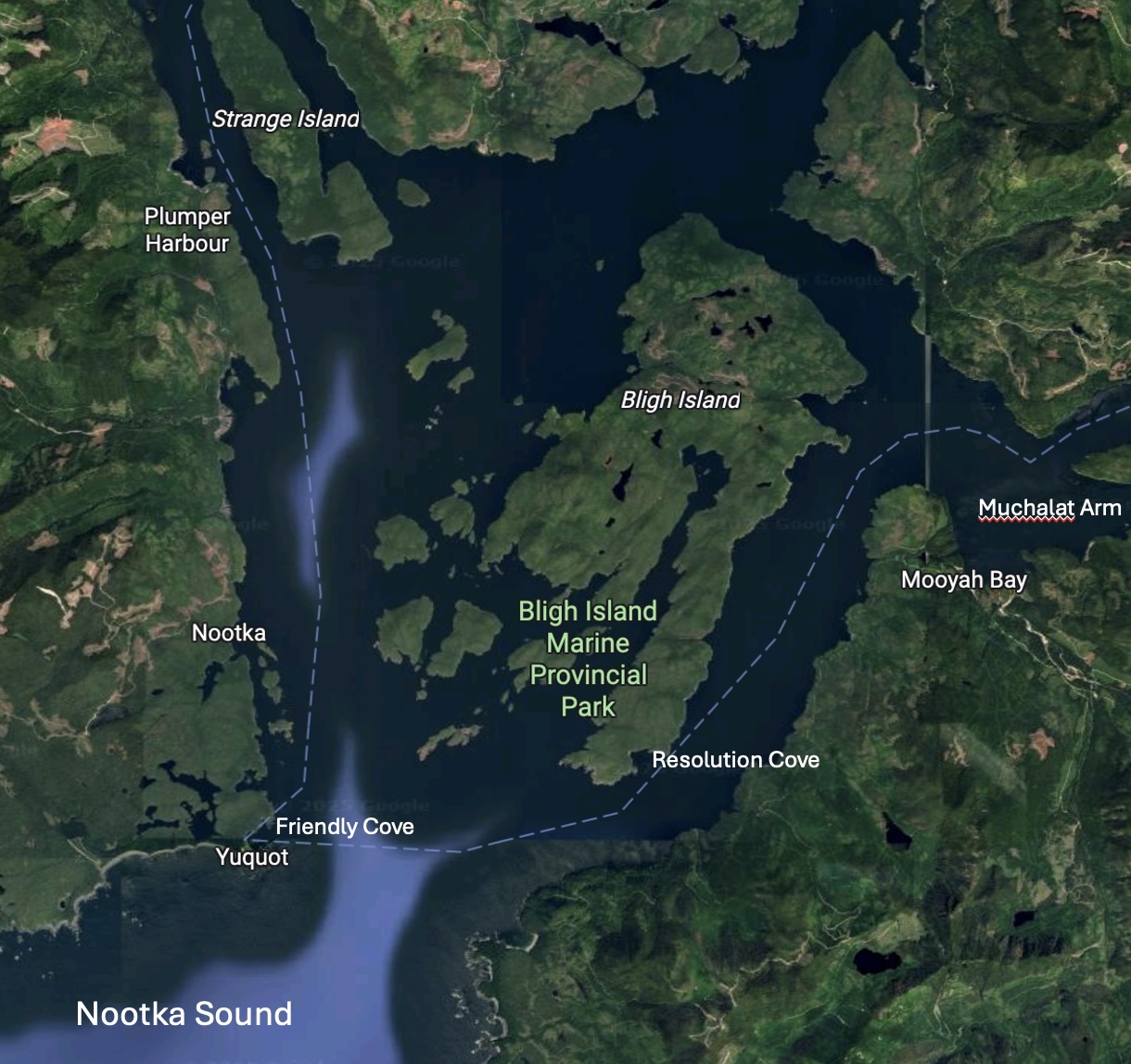
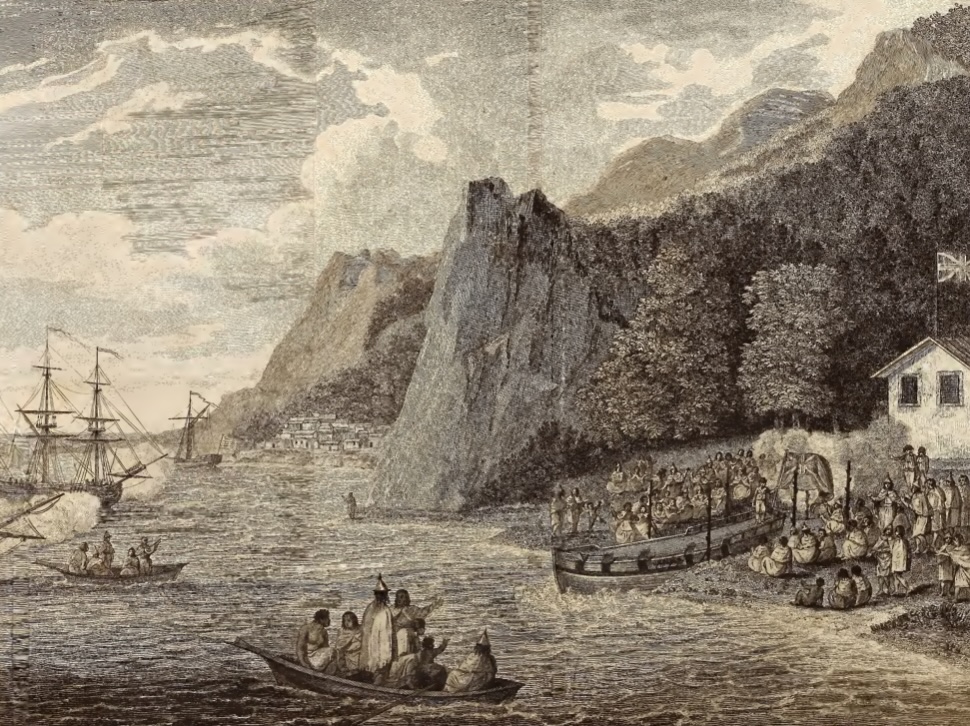
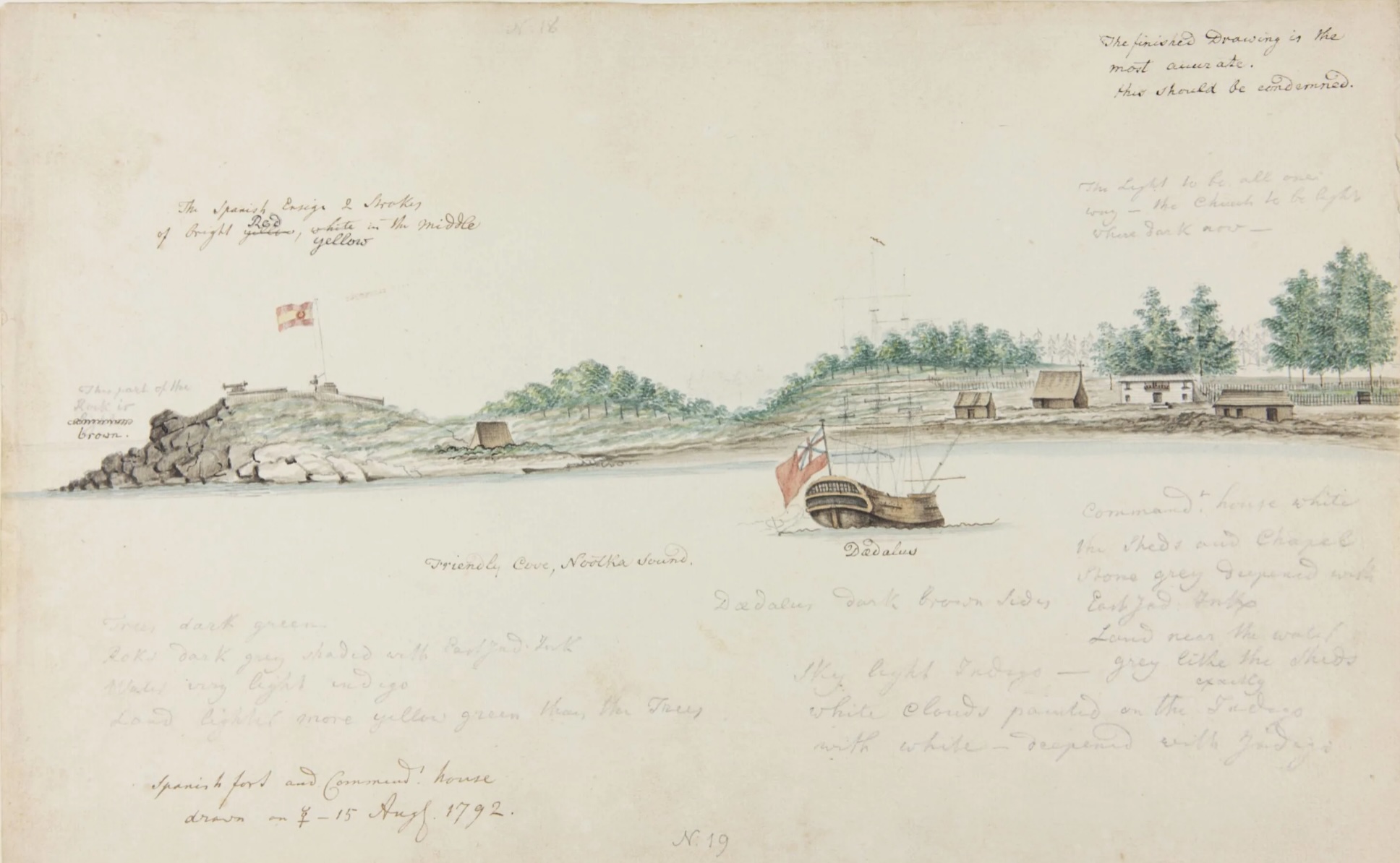
More than three months later, on 24 June, the expedition reached the American coast. Before a vista of snow-capped mountains, its men were greeted by natives offering bream and sardines. Sickness was rife, and they were gratefully received. For several days, the ships stood offshore. Soundings found no bottom, at one stage even at 180 fathoms. By stages, in squally conditions, they entered Nootka Sound, accompanied by a troupe of canoes. On 6 July, they moored in the bay which Cook had named ‘Friendly Harbour’ (Yuquot).
Strange’s priority was to obtain healthy accommodation for his invalids. First impressions were not favourable:
Words can scarcely convey to the mind of the reader an adequate idea of the beastly filth in which the natives of this part of the world pass their lives. I declare that, before I was an eye witness to it, I had a very imperfect conception of the extent of it. It was impossible to move a single step, without being up to the ankles in mud, fish, guts and maggots, and this inconvenience was alike felt within and without doors.
The immediate requirement was a building for a hospital. Strange was invited to take his choice and, at the cost of a shilling, he settled on one constructed of logs of a scale that would have served the masts of a ship of the line. Attempts were made to bring the building to order before the putrid atmosphere forced an abandonment. The crews decamped to a tent, with a raised floor, at some remove from the ‘Corrupted Air of the Village.’
After that, Strange spent little time onshore. The Nootka he judged, simply, as barbarous. Alexander Walker was more forgiving. He wrote of their helpfulness, that the English mixed with them ‘with the highest degree of intimacy,’ that the men ashore slept ‘with as much security, as if we had been on the banks of the Thames.’ He later decided that ‘their civility proceeded more from fear than from … their honourable disposition,’ but still he regretted the ‘ill-managed’ corporal punishment of one for the theft of a kettle. This, he declared, ‘had neither justice, nor policy, to recommend it.’ It excited the fears of all, ‘nor were we ever afterwards able to regain their confidence.’[13]
No doubt Strange’s opinion was coloured by the daily routine. Before he reached Macao, there were not two days in which he was not employed for eight hours dressing otter skins. Amidst Yuquot’s filth, it was a burdensome task:
If so early as in the month of April, Captain Cook found the inhabitants to be swarming with vermin, to what degree may they not be supposed to be covered with them, by the end of July [?] … The furs indeed seemed to me to be a sort of sanctuary for that vermin, to which they resorted from persecution. I have often seen the privilege of eating the livestock of a very lousy head the subject of much serious altercation between three of four different persons, whereas I at no time perceived them to be objects of pursuit or contention when once they had taken refuge to the fur.
There remained the issue of the Nootka’s ‘savage and barbarous practice of devouring human flesh.’ During one of his rare excursions on shore, Strange was accosted by the celebrated warrior, Clamata:
Having beckoned me aside to the most retired part of the walk, he took from under his garment a basket, from whence he drew three hands and a head, which he desired me to buy … I represented to Clamata that I was ignorant what use I should make of them if I purchased them. On which he informed me they were good to eat. I seemed to discredit the assertion, with a view to urge him to the commission of that act which, on any other occasion than the present, I should have shunned the sight of with abhorrence. My hero now gave me ocular demonstration, and very composedly put one of the hands in his mouth, and stripping it through his teeth, tore off a considerable piece of the flesh, which he immediately devoured with much apparent relish.
Strange fought to disguise his horror, but Clamata told him to be unconcerned. None of the English, if they died, would be eaten. The treatment was meted out to enemies only. Anyway, the gods approved of it. Was he quite sure he would not like to buy something?
The question of the Nootka’s cannibalism became a matter of debate. Strange noted that the traffic in flesh was always conducted in secrecy. He hoped this was because it ‘was considered among themselves as dishonourable,’ but he conceded it might have been a tactic designed to raise the selling price. (Body parts were never purchased ‘but at a most exorbitant rate.’) John Mackay, who stayed at Nootka for fourteen months after the voyage, took several dried hands to India when he returned there. His view was that the Nootka ‘did not actually devour their captives and slain enemies.’ Rather, they washed their hands in their blood and tasted it, preserving the dried hands as trophies and charms. Walker’s opinion was that human flesh was not used for food. The ‘disgusting practice,’ he wrote, was ‘confined to the devouring [of] their enemies and probably some choice bits only were selected.’[14]
If opinions differed on this, there were some aspects of Nootka society which impressed even Strange. For instance, their strong family bonds, and the position held by their women:
In the married state, they appeared exemplary in love and attachment to each other. Their parental tenderness was no less striking. I was present at the ceremony of dressing the scabby legs and hands of the chief’s child, and while Mr. Mackay was busied in doing it, the operation was watched by both father and mother with, seemingly, the tenderest anxiety for the recovery of their little darling, while the big tear stood trembling in the eye of the mother, who looked up to Mr. Mackay with respect bordering on adoration.
The women’s virtue was proof against the intrigues of the British seamen, even when they were offered substantial amounts for their services. Walker found their behaviour ‘uniformly exemplary:’
The men indeed never made any scruple of bartering for their women … and that with much obscenity, but they could never be prevailed upon to bring the affair to a conclusion. It evidently appeared that all they designed was to raise a laugh against us (or to get something from us). After a great deal of art was used … three or four poor wretches were produced for prostitution. These were the dirtiest drabs in the village and appeared neither to be the wives or daughters of any of our acquaintances. It is probable, from the unusual contempt with which they were treated … that these women were captives, taken in war, and reduced to a state of slavery.
According to Strange,
Virtue has its own reward, and indeed the deserved ascendency which the females have over the minds and actions of their husbands appeared accordingly in several instances to be very considerable. For my part, in my mercantile capacity, I confess I dreaded the sight of a woman; for whenever any were present, they were sure to preside over and direct all commercial transactions, and as often as that was the case, I was obliged to pay three times the price.[15]
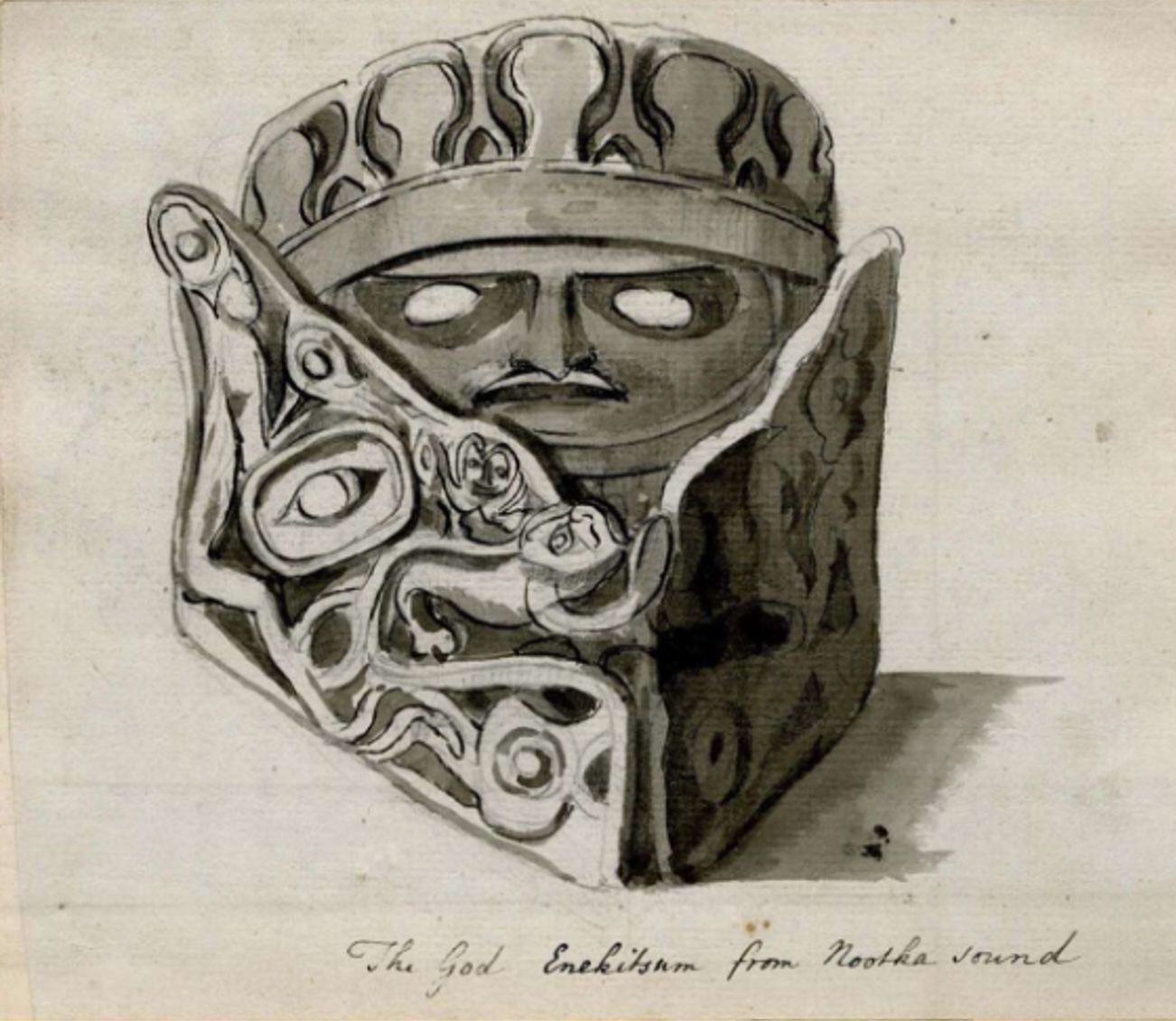
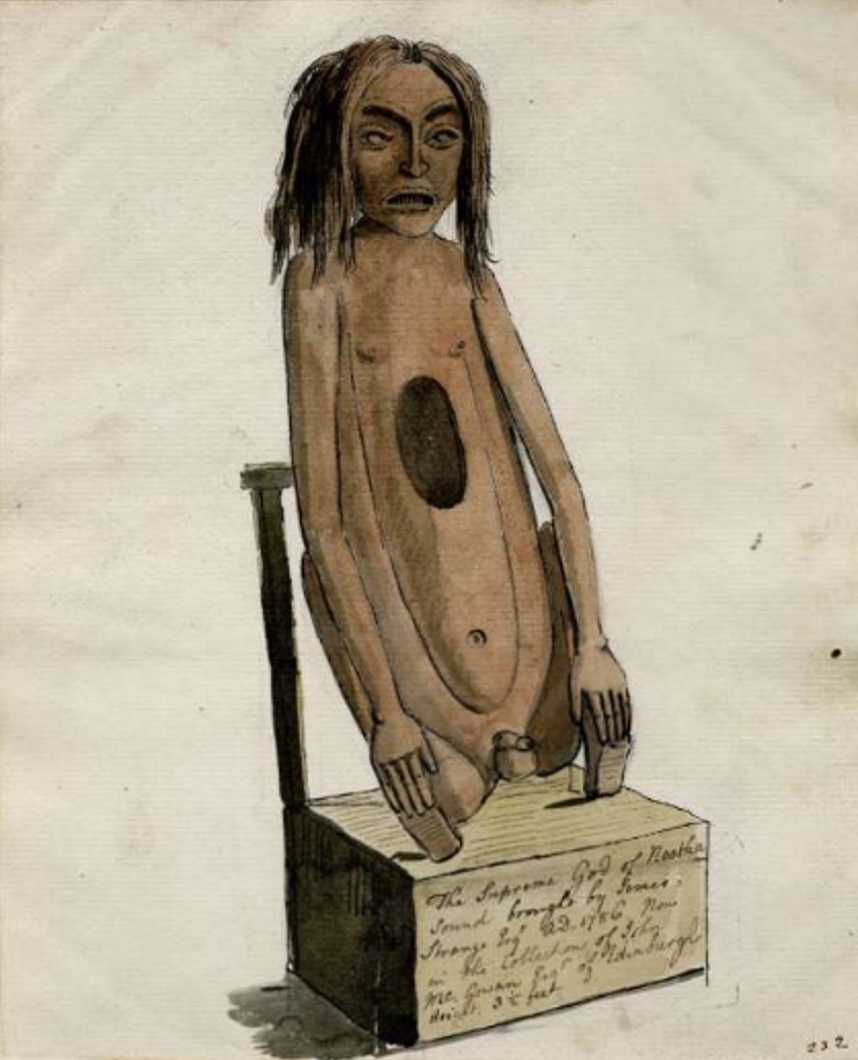
Strange was also impressed by the Nootka’s respect for their god, Enkitsum, whom they invoked for protection from snow and frost. On first entering their chief Maquilla’s house, he writes,
My notice was particularly attracted by the appearance of a very pretty canopy, fancifully and not inelegantly decorated with bits of fur of various sorts, and from which hung a curtain, richer than any I had hitherto seen, being composed of four very beautiful sea otter skins. Behind this was placed, on a sort of pedestal, the god Enkitsum, and on each side of him was burning a lamp.
The Nootka stopped every crevice in the building and piled wood onto the fire. Then, sitting around the flames, a company of about a hundred sang a song ‘by no means unmusical.’
After singing a considerable time, they began a dance in which Maquilla and some of his principal people joined, having first besmeared their faces with red ochre, and put on their war jackets. The music which accompanied this dance was both vocal and instrumental: the latter consisted simply of a wooden mallet, which was struck with considerable violence (keeping time) against a three inch plank from which appended innumerable mussel and cockle shells … In this dance they united the voice and action of the bear, the wolf, and various other animals.
Next, as the dancers recovered their breath, Maquilla picked up the fetish of Enkitsum and placed it before the fire.
A large shell was now presented to Maquilla, filled with oil, which he sprinkled on the fire. This naturally occasioned a considerable smoke, which was suffered to get vent by means of removing two or three planks in the ceiling of the building … and from this aperture was scattered … several handfuls of the finest down, which was intended to represent a fall of snow … The smoke aided by the action of the fire naturally resisted the fall of this light body, which together with itself escaped at the opening above.
Reverentially, Enkitsum was returned to his station and the formalities were concluded with a feast of pine bark, fish roe and dried salmon. Yet, the next day, Strange was surprised to receive the venerable image of the god, together with the curtain of otter pelts on which, he confesses, he had set his heart.[16]
After a month, Strange was ready to depart. He believed he had ‘got possession of every rag of fur within the sound, and for a degree to the northward and southward of it.’ However, it was intended that a crewman should remain behind to prepare for a return voyage. John Mackay, the Experiment’s acting surgeon, volunteered for the role. Happily, he had secured the trust of Maquilla by curing his child of its ailment. The grateful chieftain promised that Mackay ‘should sleep next to him and his wife’ (with his wife kept at a distance), that his bed would be of the finest fur, and that the choicest fish would make him ‘as fat as Klumma.’ [17]
Strange gave him some warm clothing, a musket and pistols, plenty of beef, biscuit, tea and tobacco, some seeds for planting, and a pair of goats. In addition, a ‘warlike’ red coat and cap, with which to intimidate the Nootkas’ enemies, and some pens and paper on which to write his experiences. There is no journal. As Mackay later told Walker, he was making some notes when an old chief …
… laid hold, but without any expression of anger, of his paper, and tearing it into small pieces, scattered the fragments by throwing them about in the air. This he did with great solemnity, singing and dancing all the time. In the same manner the rest of his writing apparatus was seized and flung to the wind.
The musket fared little better. When, after a short while, some Nootka asked for a demonstration,
Mackay had the folly to satisfy their curiosity … by shewing the whole arcana of the instrument. The screws and springs were handed from one to the other. They were soon carried out of sight, and it was impossible to recover them. The savages could not be prevailed upon to restore any part of the lock, and although it was of no value to them, they probably imagined that they possessed some mystery or secret, which would prove to their advantage … Be that as it may, Mackay, by an act of the greatest indiscretion, in this manner disarmed himself.
In fact, once he had surrendered his weapon and his utility, Mackay was treated with neglect. The more so when he made the mistake of stepping over the chief’s favourite child, who was sleeping in the doorway of his house. (The child died shortly afterwards.)
The unhappy offender was seized, and although yet in ignorance of any crime, expected from the aspect of the savages to be put to death. They proceeded however no further than to beat him and abuse him in the most outrageous manner … Exposed to the inclemency of the weather, he was in danger of starving (with hunger and cold.) In this forlorn condition he remained several days when, at last, the resentment of the savages seemed to relent. They assigned him a hut and again supplied him with food, but Maquilla never afterwards shewed him any cordiality, nor admitted him to live in his house.
The timing of Mackay’s misadventures was unfortunate as, shortly beforehand, James Hanna had offered to take him away. He wrote that, already, the Irishman had adopted the natives’ dress and ‘filthiness of manners,’ and was ‘a perfect master of their language.’ About the latter point, Richard Etches (whom we shall encounter shortly) was doubtful. He judged Mackay ‘a very ignorant young fellow, and frequently contradicting himself,’ but he agreed with Hanna that ‘he was equally slovenly and dirty with the filthiest of them all’.
In fact, a few weeks after Strange’s departure, Mackay had succumbed to three weeks of the flux, then (for a period he was unable to measure) a ‘putrid fever’, which had deprived him for his senses. For part of the winter, he was left to subsist on a diet of dried herring heads, train oil, blubber, and the few peas that he managed to secrete into his pockets. Walker’s subsequent encounters with Mackay in Bombay suggest he may have suffered a complete nervous collapse. His ‘habits of drinking’ and ‘natural incapacity,’ he wrote, in large measure defeated his attempts at obtaining an intelligible account of Mackay’s experiences. No doubt, he had been delighted when Captain Barkley of the Imperial Eagle fetched him away, in the summer of 1787.[18]
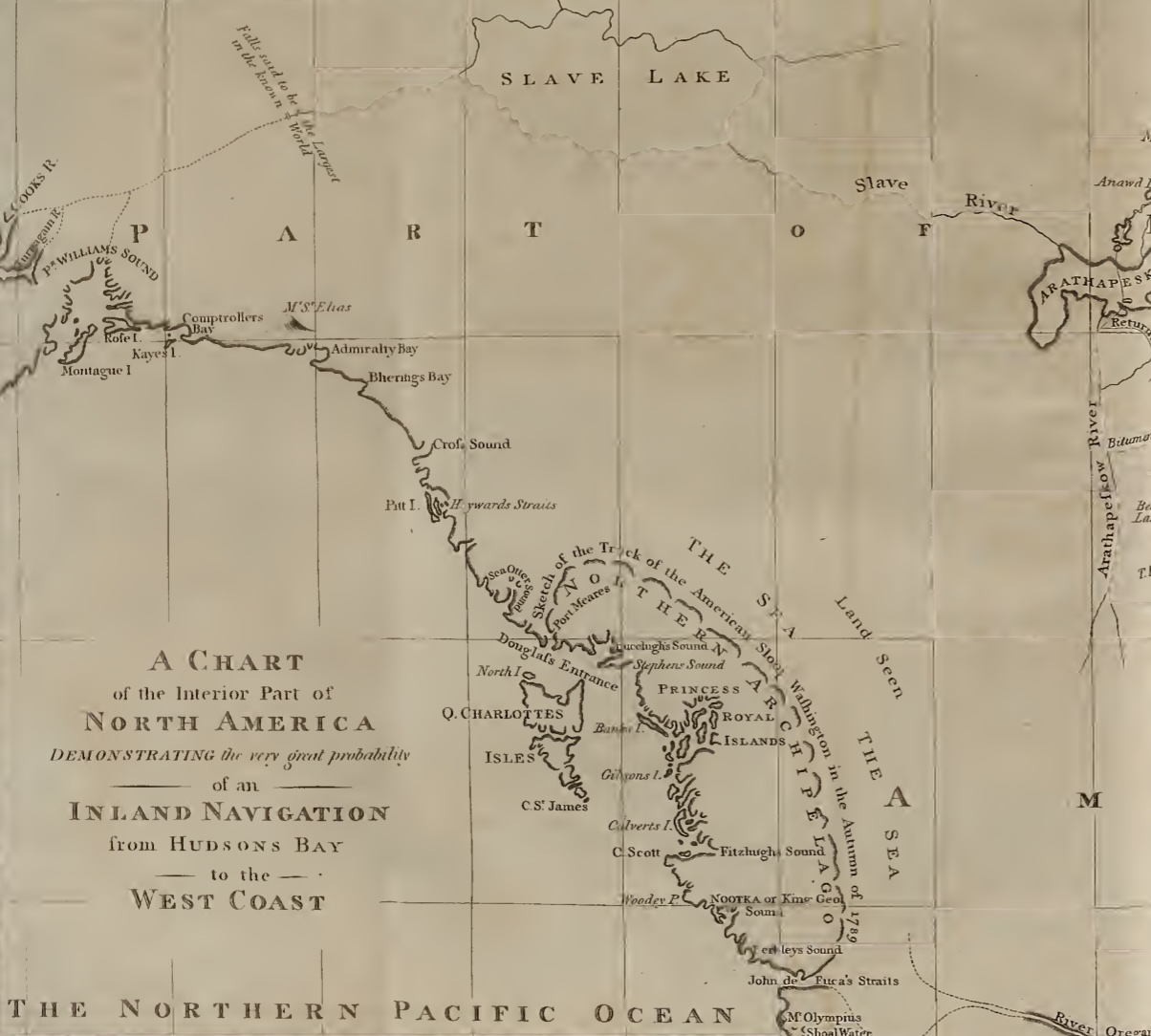
On 28 July 1786, Strange left Nootka. To the northward, he encountered some islands which he named after his patron, Scott; to their south-east, a large body of water which he named after Queen Charlotte. He was tempted to explore the strait further, but decided the season was too far advanced. And so, after leaving in a hollow tree, as tokens of possession, the names of his vessels and some copper, iron and beads, he steered for Prince William’s Sound.
On 29 August, he anchored in Captain Cook’s Snug Corner Bay. Unfortunately, its inhabitants had little to offer:
In the article of furs, whether good or bad, they were almost destitute compared with our Nootka friends. These appeared little versed in the art of traffic and never hesitated a moment accepting any offer that was made to them. They as readily concluded the bargain for one bead as they would have done for twenty. Colour alone constituted the value of the offer, and none other than sky blue would have been received, although the number offered had been ten times multiplied.
The bay was most notable for its abundance of salmon, which filled its shallow rivers in a state of decomposition. ‘If we had not seen them,’ Strange wrote, ‘our sense of smelling would have directed us to them.’
[They] became an easy prey both to beast and bird, and accordingly the havoc which each had made was great indeed; not greater, however, than what was now made by that animal called man, who for many days afterward substituted them in the place of salt beef.
Already Strange had realised that future expeditions to America would have to be much less expensive than his, if they were to be successful. He busied himself with cleaning his skins of vermin, and consoled himself with the thought that his failure would at least deter others until after he had secured the support of the natives. Then, on 5 September [he wrote],
An event happened … which was so unlooked for and which in its consequences would I feared give so decidedly the Coup de Grace to my future prospect of success in this line of life, that I confess it required every exertion of my philosophy to conceal from the eye of the indifferent beholders the painful sensation with which the occurrence operated on my mind.
Another vessel, the Sea Otter, entered the bay. At her helm was Captain Tipping, who had sailed to Alaska from Bengal. A companion vessel, the Nootka, commanded by John Meares, was following, but Strange did not wait for her. The Englishmen viewed each other with a jealous eye, and their encounter was brief. Tipping removed himself to another part of the Sound, where the draw of the larger Captain Cook was less powerfully felt and, on 14 September, Strange departed for Asia. The Captain Cook was sent to explore a source of copper in the Aleutians but abandoned the effort after encountering storms. The Experiment reached Macao on 15 November; the Captain Cook joined her the following month.
Strange realised $24,000 for 604 pelts but, as he later explained to Sir Archibald Campbell, Governor of Madras, ‘the object of [the] undertaking most unfortunately failed, in as far as related to the advantages of the individuals concerned.’ Bombay’s primary interest had been ‘exploring for the benefit of navigation’ but, there too, the value of Strange’s efforts was limited. The return voyage, which Mackay was awaiting, was abandoned.[19]
In February 1788, Strange wrote again to Sir Archibald, arguing that the trade might work if a factory was established at Nootka and if, instead of haphazard voyages, vessels sailed according to a pre-agreed schedule, to avoid beggaring one another. He referred to solid prospects for a whale fishery, and to the need to exclude from the North-west the Kamchatkan Russians, who had eliminated the otters in the Aleutians. His thoughts were forwarded to London, where they died. The idea that Company-owned, Indian-built ships might compete with the shipping interest of London’s Directors was the cause.[20]
James Meares’ First Expedition, 1786-1787
Strange believed that, from Snug Corner Bay, Tipping had shaped a course for Cook’s Inlet as, despite his best efforts, he knew he had failed to convince his competitor he had been there first. Evidently, Tipping did not tarry long: Meares arrived at Prince William Sound shortly after 20 September and missed him. He concluded that Tipping had sailed for China. Later, he reported that he had perished on the way.[21]
Meares was a Navy lieutenant who, after the American Revolutionary War, had travelled to Calcutta to seek his fortune. He had little money and no more experience in exploration but, like Strange, he had read Cook’s voyages, and he was inspired by them to try his hand. He writes little of his expedition’s origins, mentioning simply the patriotic spirit of the ‘distinguished persons at Bengal’ who supported it, and of the arts employed to frustrate it. Drawing on a natural reserve of chutzpah, he persuaded a consortium of merchants assembled by John Henry Cox, the sponsor of Hanna, to finance an effort, under the banner of the ‘Bengal Fur Society.’[22]
Later, in evidence to the Privy Council, Meares claimed he had the blessing of the Governor-General, and that he was permitted to take two gentlemen of the Bengal establishment as surveyors. Certainly, by naming his vessels the Sea Otter and the Nootka, he made his intentions explicit. However, Meares has a poor reputation for veracity, and it is likely he had even less claim to be operating under a Company licence than had Strange.[23]
From Madras, where she collected supplies, the Nootka had travelled via Malacca and the Babuyan (‘Bashee’) Islands, to the Aleutians. Meares wrote,
The Russians in these isles came from Okhotsk and Kamchatka … They hunt the sea-otters and other animals whom nature has clothed in furs. The natives of the different districts are also employed in the same occupations and are obliged to give the fruits of their toil, as a tribute to the Empress of Russia, to whom this trade exclusively belongs. In return, they receive small quantities of snuff, of which they are immoderately fond; and, obtaining that favourite article, they are content with their wretched condition, from whence as far as respects any exertion of their own, they will never emerge.
Russians and natives alike lived in subterranean caverns to protect them from the weather. This the British discovered when two of the Nootka’s officers disappeared suddenly through one of their roofs, as into a hole in the ground. The fright, at first, ‘was mutual’, and the inhabitants fled for help against invasion. However, their distress was quickly assuaged with gifts of tobacco.
There was little, in fact, to choose between the two sets of inhabitants’ habits, except that the Russians boiled their fish, and the natives ate theirs raw. The Russians, Meares opined, had produced ‘no kind of cultivation whatever.’ All that was unclear was whether ‘their want of comforts and conveniences … arose from local barrenness, or their own indolence.’
Since they had no interest in trading furs, Meares chose to give them a wide berth. This was easier said than done. At Cook’s Inlet, the Nootka encountered two Russian boats. Each was equipped with a fieldpiece and an armed crew. They were quitting their summer residence for winter quarters on Kodiak. Two others had recently departed. With the weather turning ‘extremely boisterous,’ Meares took a leaf out of their book. And so he had sailed for Snug Corner Bay, and his rendezvous with Tipping.
Finding the bay deserted, he was presented with ‘a situation pregnant with difficulties.’ There was no prospect of obtaining supplies and he was unlikely to find better shelter, except in the Sandwich Isles. The problem was that his crew were ‘extremely dissatisfied.’ If they grew used to Hawaii’s comforts, they might refuse to return. Meares remained where he was. Then, after four days, some friendly natives appeared. They mentioned a vessel, which had sailed away a few days before with plenty of skins. They muttered some English-sounding names. Perhaps they referred to Tipping. ‘Pointing to the number of the hairs of their heads,’ they indicated they had plenty of furs to sell.
On 7 October, the Nootka was unrigged, and her crew started building a log-house. As they did so, the natives demonstrated their remarkable talent for thievery. Meares writes,
It has often been observed when the head of a nail in the ship or boats stood a little without the wood, that they would apply their teeth in order to pull it out.
By 25 October, the assembly of natives was such that Meares withdrew his working parties to the Nootka. It was time for a demonstration of power. A ‘twelve-pound cannonade’ was fired with grape shot. It inspired ‘a state of no uncommon apprehension.’ Then Meares clarified. He wished no harm; he wanted to trade. Before long, he had exchanged a few nails and coloured beads for sixty fine skins.
Still, Meares distrusted the people, suspecting an intention to cut off his men. He called a halt to operations on shore and ordered that the ship be covered and fortified (a task that was only half completed). In preparing provisions, the sailors clubbed more of the salmon. Ducks and geese, now beginning their southerly migration, bolstered the stores. So did the natives, who contributed some mountain ‘sheep’.
By 2 November, the ice surrounding the ship was thick enough to permit skating, a welcome recreation. For a few weeks, the thermometer held at 26°F to 28°F (-2°C to -3°C) but, in early December, it fell to 20°F (-7°C). The sun became obscured by hills to the south. The men remained healthy, but the loss of the sun’s rays and the depth of the snow, which precluded exercise, caused spirits to drop. By New Year, the lower decks were covered in an inch of frost. One of the forges was used to sustain a perpetual fire, but it gave off troublesome smoke which made the men ill. By the end of January, twenty-three crew, including the surgeon, were in bed with scurvy. Four had died.
[Meares wrote], The first officer on finding himself slightly affected in the breast, a symptom which generally foreboded a fatal determination in a very few days, got rid of it by continually chewing young pine branches, and swallowing the juice; but, from the unpleasant taste of this medicine, few of the sick could be prevailed upon to persist in taking it.
The temperature fell to between 14°F and 15°F (-10°C). In February, there were four more deaths, and, by month’s end, thirty crewmen were confined to their hammocks.
Notwithstanding this extreme cold, we were visited as usual by the natives who had no other clothing but their frocks, made of the skins of sea-otters and seals, though chiefly the latter, with the fur on the outside. But whatever protection these dresses gave to their bodies, their legs remained uncovered, and without any apparent inconvenience.
By now, the unruly weather had brought an end to the hunting of whales. The natives became as short of food as the English and, since there were several casks of blubber on board, Meares shared them around. He did so out of humanity, but it had not escaped his notice that spies had located the graves of his dead. Might they dig up the bodies ‘for a banquet’? Meares suspected they were cannibals, but he was persuaded later that their watchfulness aimed at preventing others from coming to trade, or at least from doing so without surrendering a share of their profits.
March brought no relief. The sick increased in number. Funeral rites were paid to the surgeon and pilot, in trepidation for the future. Meanwhile, the first officer, finding a return of his complaint,
… made a decoction which was extremely nauseous, and very difficult, though very much diluted, to keep on the stomach. It operated repeatedly as an emetic, before it became a progressive remedy, and perhaps this very effect, by cleaning the stomach, aided the future salutary operations of this anti-scorbutic medicine.
A few others profited from his potion, but the deaths continued, and a stream of bodies was borne away across the ice, on a sledge originally purposed for firewood. Only a little fish or fowl remained to eat and, although salt beef and pork were plentiful, most were so weary of it that it bestowed little benefit.
In April, the wind switched to the south, a sign of a turn in the season, but those who refused the pine juice grew sicker. Four Europeans and three Lascars died. Finally, some natives bearing fresh herring and some unspecified ‘sea-fowl’ for food, promised the cold would be gone. The sun appeared above the hills, and spirits revived. Progressively, the sick made their way above deck. Many fainted upon reacquaintance with the fresh air.
By mid-May, there was evidence everywhere of ‘astonishing change’. Those taking the decoction ‘recovered miraculously’. The Nootka swung free at her anchors. With the thaw, there came shoals of fish and flights of geese and duck. They were not the only visitors:
… a company of the natives, with the King of the Sound, named Shenoway, came on board with great form, to congratulate us on the return of summer. They also informed us that they had seen two vessels at sea, an article of intelligence which we scarce knew how to believe … but, on the 19th, this doubtful account was verified by two canoes conducting a boat, in which was Captain Dixon of the Queen Charlotte from London, which, with her consort the King George, Captain Portlock, he had left at Montagu Isle, to come in quest of us, on the information of the Indians.[24]
It might be imagined that the Nootka’s survivors will have welcomed Dixon as cordially as Strange had welcomed Tipping. After all, relations with Shenoway’s people were reasonably friendly and, having endured the privations of winter, they were uniquely placed to reap the harvest. Yet this was not how they responded. Meares writes,
… when the horrid situation of the Nootka and her crew is called into reflection, their desolate situation so long continued, and the chilling apprehensions that, from the state of the crew and the state of the ship, even when the weather relaxed and the season became favourable, they might not possess the means of quitting it; when all these items of misfortune are brought to one aggregate of evil, it is not a matter of surprise that Captain Dixon should be welcomed as a guardian angel with tears of joy.
There was a problem, however. Dixon was mightily displeased to discover an unauthorised interloper on his patch. He came neither from Canton, nor Bombay, nor Calcutta, but from London, with the backing of the recently constituted King George’s Sound Company. Sponsored by the family of Richard Cadman Etches, the KGSC had approval from the East India Company to sell furs in Japan and along the Asian coast from Korea to Canton. Moreover, it possessed a five-year licence from the South Sea Company, which controlled the monopoly on trade west of Cape Horn.[25]
Nor was Dixon impressed by Meares. He was astonished by the grip of scurvy on his men. Clearly, Meares had understocked on antiscorbutics. In addition, he had been lax on discipline:
… we were informed that a free and unrestrained use of spirits had been indiscriminately allowed among them during the extreme cold weather, which they had drank to such excess about Christmas, that numbers of them kept their hammocks for a fortnight together; and to this their liquor was of a very pernicious kind, so that there is reason to suppose its effects, when drank to such an extreme, were not less fatal than the scurvy itself.
John Nicol, who sailed with Portlock, agreed that the Nootka’s men ‘had caused their own distress, by their inordinate use of spirits on Christmas eve.’
They could not bury their own dead; they were only dragged a short distance from the ship and left upon the ice. They had muskets fixed upon the capstan, and manropes that went down to the cabin, that when any of the natives attempted to come on board, they might fire them off to scare them. They had a large Newfoundland dog, whose name was Towser, who alone kept the ship clear of Indians. He lay day and night upon the ice before the cabin window and would not allow the Indians to go into the ship. When the natives came to barter, they would cry ‘Lally Towser’, and make him a present of a skin, before they began to trade with Captain Meares, who lowered from the window his barter, and in the same way received their furs. [26]
Unsuspecting, Meares crossed to the Queen Charlotte for provisions. According to Dixon,
They were supplied with what flour, sugar, molasses, brandy, &c. we could possibly spare. And, in order to render them every assistance in our power, Captain Portlock spared Captain Meares two seamen, to assist in carrying his vessel to the Sandwich Islands, where he proposed going as soon as the weather permitted.
Almost immediately, Dixon left for Nootka, where he expected the supply of furs to be greater. Subsequently, Meares complained that the help he received was less than generous. In Dixon’s presence, he wrote, Portlock had claimed ‘it was entirely out of his power to assist me with men,’ a remark that had been aimed ‘to enhance the value of the favour.’ (Meares ended by paying them £4 per month.) There was an exchange of supplies, Meares offering to Portlock some items which he thought he desired, though he wrote that ‘he did not pay by any means an adequate attention to my wants by his boats.’ At one point during a dispute over the consideration Meares was to give for the caulking performed on the Nootka by the Queen Charlotte’s carpenter, Portlock recalled his man, even though he had declared the Nootka was unsafe, ‘her seams being open everywhere, and the pumps not finished.’ [27]
Portlock might have been more generous, but the point was that Meares was an interloper, a British subject, trading in a British vessel, without a licence, in the monopoly territory of the South Sea Company. Portlock’s backers had government support, the necessary licences, and the stated objective of establishing factories on the coast, on an exclusive basis. It was for these causes that, for a time, Strange later believed that Portlock forcibly deported John Mackay from Nootka to Canton.[28]
On 9 June, Portlock wrote to Meares to explain that, instead of departing immediately, like Dixon, he had decided to remain in Prince William Sound, ‘and purchase every skin, of every kind, that [came] his way.’
[He continued] … as your remaining in the sound and trading must, of course, stop a considerable part of the trade that I might get, I find myself in duty bound … to propose the following conditions … That you bind yourself in a bond of five hundred pounds, ‘that no trade be carried on for skins of any kind by yourself, or any of your crew, during your stay in this sound this season.’
On 18 June, Portlock added, as a proviso for Meares’ retention of his men, that he affirm he would sail directly to the Sandwich Isles. Earlier, he had understood this to have been Meares’ intention. Now he was less sure. Indeed, he suspected that Meares planned ‘to put into some ports on the coast of America.’ Meares did his best to suggest that Portlock was unnecessarily harsh; that he was taking advantage of his situation to eliminate a legitimate competitor. In fact, according to the rules of the day, Meares’ position was anything but proper.
On Midsummer’s Day, with just twenty-two of his starting crew of fifty-five remaining, he weighed anchor and steered to the south. Ten days later, he had a last encounter with the American natives. They approached in canoes made from whole tree trunks, a style very different to those of Snug Corner Bay. The appearance of the women was different also:
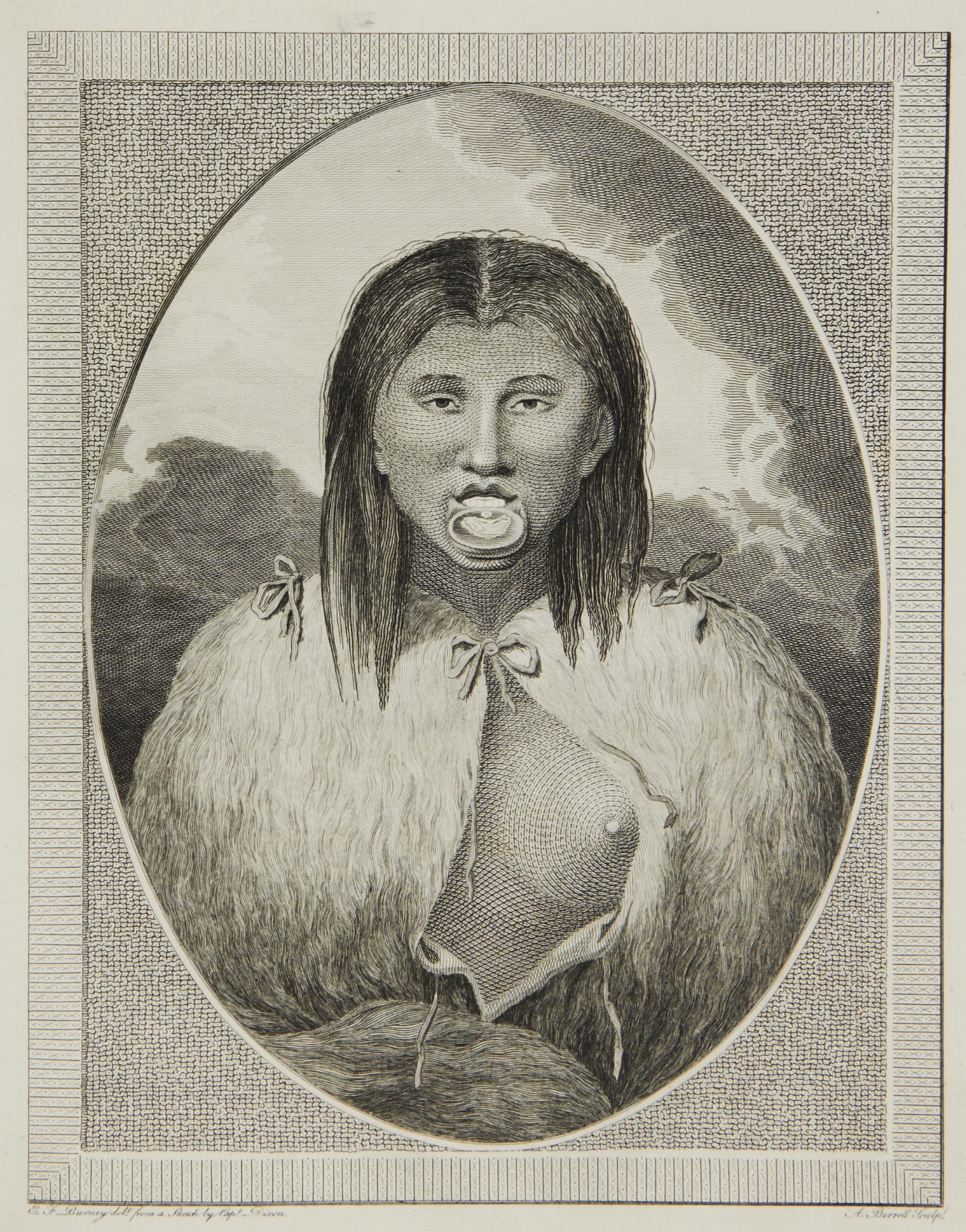
They have all a cut in their under-lip, similar to the men of Prince William’s Sound, but much larger, it being a full inch further in the cheek on either side. In this aperture they have a piece of wood of at least seven inches in circumference, of an oval shape, of about half an inch thick, which has a groove round the edges, that keeps it steady in the orifice. This unaccountable contrivance distends the lips from the teeth and gives the countenance the most disgusting appearance which we believe the human face to be capable of receiving.
Another crewman died before Hawaii (‘Owhyhee’) was attained, but the breeze was favourable, the debilitated ship held together, and every sign of scurvy quickly disappeared. On 2 September, after taking on board Tianna (Ka’iana), ‘a chief of Atooi (Kaua’i),’ who had shown ‘inexpressible eagerness’ to visit ‘Britannee’, Meares sailed for Macao. He arrived, on 20 October 1787, and sold about 350 pelts for $14,000 ($40 each). Portlock and Dixon arrived a few weeks later. They realised $50,000 for 2,552 skins, just $20 apiece.
In good measure, this was because their licence required them to sell their furs through the East India Company, which took a profit. Shortly afterwards, Captain Charles Barkley, of the Imperial Eagle, sold 700 furs for about $29,000 ($41 each). He had had sailed under Austrian colours precisely in order to shield his promoters, who were supercargoes and directors of the Company, from the need to obtain the requisite licences. Nevertheless, Meares argued that the arrival of so many ships had glutted the market; that cooperation was needed to keep the monopolists at bay and obtain value from the trade. He secured John Henry Cox’s support, as well as that of Daniel Beale, the manager of Barkley’s sale. They formed a new consortium, which they called the Merchant Proprietors. On 24 December 1787, Meares received his second set of instructions. [29]
Meares’ Second Expedition, 1787-1788
These instructions affirmed that,
… the situation of China, both for the outfit of vessels for the fur trade, as well as for the disposal of cargoes, is such as must shortly destroy all competition, and give us an exclusive possession of this valuable branch of trade …
Yet speed was of the essence if the Proprietors were to reach Nootka and secure ‘the prize of the first ship that arrives there.’ Two vessels were fitted out. In the faster, the Felice, Meares was to make for the Sound with all despatch and explore the coast ‘as far as the Spanish settlements.’ In the Iphigenia, William Douglas would sail to the Cook Inlet and explore the coast southwards. They would reunite in early September, overwinter in the Sandwich Islands, and return to Nootka the following March, after advising the natives to expect them. The key paragraphs are the following:
Should you, in the course of your voyage, meet with any Russian, English, or Spanish vessels, you will treat them with civility and friendship; and allow them, if authorized, to examine your papers, which will shew the object of your voyage. But you must, at the same time, guard against surprise. Should they attempt to seize you, or even carry you out of your way, you will prevent it by every means in your power, and repel force by force. You will, on your arrival in the first port, protest before a proper officer against such illegal procedure; and ascertain, as nearly as you can, the value of your vessel and cargo; sending such protest, with a full account of the transaction, to us at China.
Should you, in such conflict, have the superiority, you will then take possession of the vessel that attacked you, as also her cargo; and bring both, with the officers and crew, to China, that they may be condemned as legal prizes, and their crews punished as pirates.[30]
This was bold language for an unrecognised, unlicenced trading association to use. If put to the test, they might hope for Company or government support, but they had no right to expect it.
The Felice and Iphigenia left Canton, in January 1788. On board were several Chinese. Shipped ‘as an experiment,’ they were ‘hardy’, ‘industrious’, ‘ingenious’, and cheap. If the consortium succeeded in establishing factories, they might be ‘a very important acquisition.’ With them also were Winee, a Hawaiian companion of Frances Barkley, the wife of the Imperial Eagle’s captain, and Tianna, the Hawaiian prince, who, it was hoped, might provide a conduit to a treaty giving the British a right of access to the islands. Another passenger was Comekela, brother of the Nootka chieftain, Maquilla. According to Alexander Walker, he had sailed to China on James Hanna’s Sea Otter, ‘secretly, but with the lad’s own consent.’ [31]
The Felice reached the coast, on 13 May. Immediately, Comekela’s efforts at obtaining accoutrements worthy of exciting the envy of his countrymen (and the desire of Nootka’s women) led to an altercation with the ship’s cook.
[Meares writes] At least half a sheet of copper formed his breast-plate; from his ears copper ornaments were suspended, and he contrived to hang from his hair, which was dressed en queue, so many handles of copper saucepans, that his head was kept back by the weight of them, in such a stiff and upright position, as very much to heighten the singularity of his appearance.
In his hand, by way of a spear, Comekela bore the Felice’s roasting spit.
On 16 July, Maquilla and Callicum, who had been visiting their neighbours, the Wickaninnish, returned in a grand parade of canoes:
There was also something for the eye as well as the ear; and the action which accompanied their voices added very much to the impression which the chaunting made upon us all. Every one beat time with undeviating regularity against the gunwale of the boat, with their paddles; and at the end of every verse or stanza, they pointed with extended arms to the North and the South, gradually sinking their voices in such a solemn manner, as to produce an effect not often attained by the orchestras in our quarter of the globe.
The chiefs climbed on board the Felice and there was an exchange of gifts. Meares offered copper, iron, and ‘other gratifying articles,’ whereupon they,
… took off their sea-otter garments, [and] threw them, in the most graceful manner, at our feet, and remained in the unattired garb of nature on the deck. They were each of them in return presented with a blanket, when with every mark of the highest satisfaction, they descended into their canoes.
Meares explains,
The manner in which these people give and receive presents is … peculiar to themselves. However costly the gift may be in their own eyes, they wish to take away all idea of conferring any obligation on the receiver of it. We have seen two chiefs meet on a visit of ceremony provided with presents of the richest furs, which they flung before each other with an air that marked the most generous friendship, and rivalled that amiable interchange of kindness which distinguishes the more polished nations of the world.
The business of the expedition commenced. Meares wrote that Maquilla granted him ground for a factory, assisted in taking the work forward, and agreed to protect the party left behind. For this he was presented with a pair of pistols. By 28 May, the building was finished. It was constructed on two floors, and comprised lodgings, workshops, storerooms, even a ropewalk. According to Meares,
A strong breastwork was thrown up round the house, enclosing a considerable area of ground, which, with one piece of cannon, placed in such a manner as to command the cove and village of Nootka, formed a fortification sufficient to secure the party from any intrusion.[32]
He prepared the Felice for her surveying voyage. At the same time, work began on a schooner which, in an emergency, might take those remaining to the Sandwich Islands. The effect was to put in place a shipyard for future use.
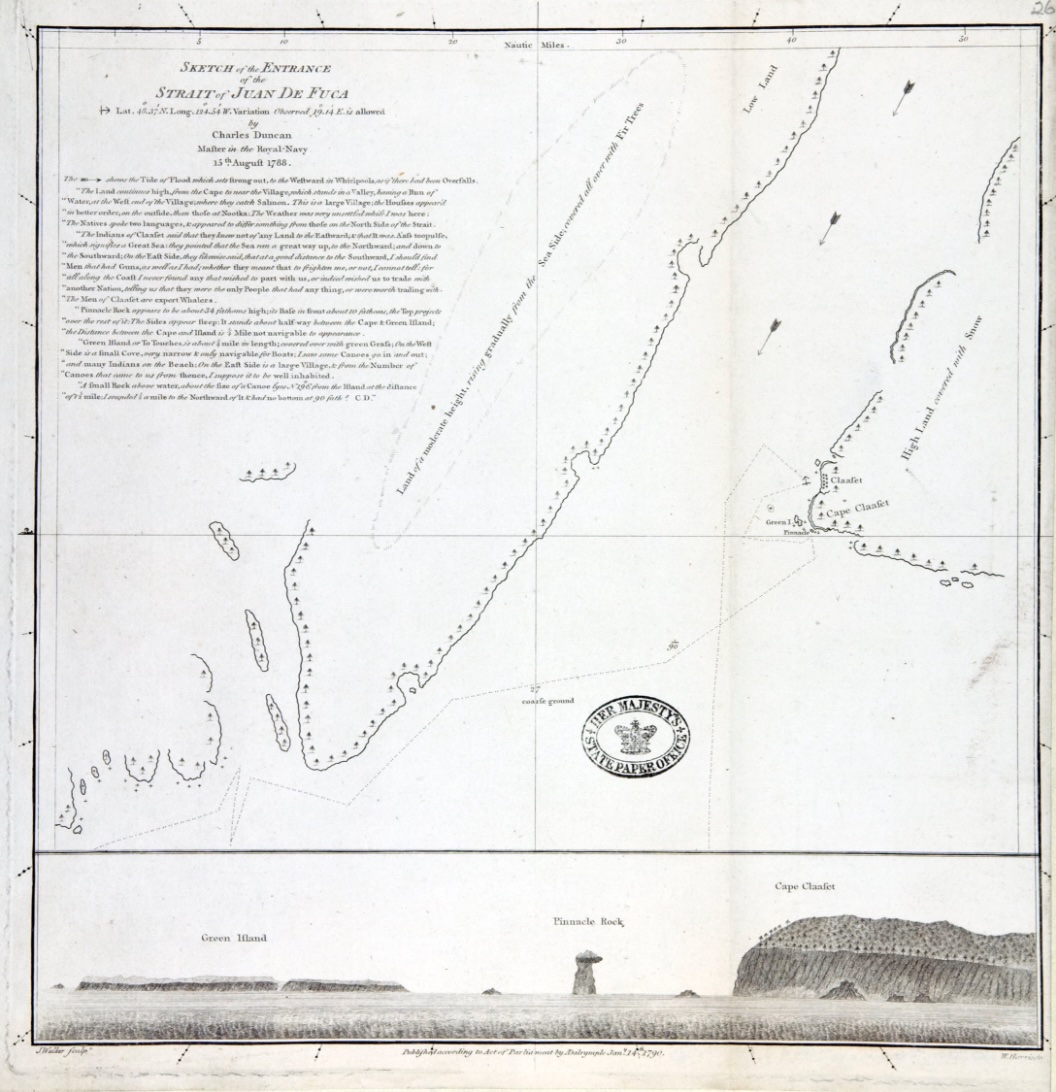
Meares’ aimed to sail as far south as 45°N. At Tillamook Bay, in Oregon (45.5°N), he turned back. The event most worthy of note on this expedition is Robert Duffin’s exploration of the Strait of Juan de Fuca, south of Vancouver Island, in which his longboat was attacked by natives. None were killed, but Duffin was wounded in the head by an arrow. (He might have died, but for his stout hat.) There was a duel between a sailor, armed with a cutlass, and a native equipped with a stone bludgeon. The sailor was saved by an intervening oar before a strike of the cutlass removed the native’s arm. He escaped.[33]
When Meares returned to Nootka, there was a mutiny among his crew. Their fear of the cannibalistic tendencies of the natives made the ‘voluptuous abodes’ of Hawaii especially alluring. At the rebellion’s end, the mutineers were offered the alternative of being put in irons or sent ashore. They chose the latter and built for themselves a hut, in which they became increasingly unhappy. Maquilla offered to execute them, which Meares refused, and so Callicum suggested they move in with him. This was ideal. Meares declared, ‘the best hospitality even of a Nootka chief, would be a very severe punishment to a British sailor.’ [34]
The Iphigenia was shortly expected, but the first sails to appear belonged to the Princess Royal, a ship of the King George’s Sound Company, commanded by Charles Duncan, which had sailed from London, in September 1786, in the company of James Colnett’s Prince of Wales. A vessel of around fifty tons, with just fifteen crew, the Princess had rounded the Horn in a cruise of nearly twenty months. Meares was full of admiration: rather than shun a competitor, he says that he did what he could to assist. Together, they explored Clayoquot Sound (‘Port Cox’), where they secured a good supply of pelts from the Wickaninnish. Then they separated. After the Felice returned to Nootka, the Iphigenia arrived.[35]
Then, as Meares’ schooner was approaching completion, another ship, the Lady Washington, entered the harbour, from Boston. Her commander, Robert Gray, was surprised to see others on the coast; still more to see a vessel a-building. So Meares was especially gratified when Gray, Maquilla and the Nootka witnessed her launch, on 20 September. Named the North-West America, she was the first ship to be built on the coast. With English ensigns flying, and a delighted Tianna aboard, immediately she almost disappeared out of the harbour, her builders having failed to place on board an anchor and cable.[36]
The season was now advanced, and a considerable number of furs had been collected. Meares took them in the Felice to Macao. The Iphigenia, with Tianna and the schooner, departed for the Sandwich Islands for the winter.
Robert Gray was advised to be gone also. According to Robert Haswell,
… [the British] fully employed themselves fabricating and rehearsing vague and improvable tales relative to the coast of the vast danger attending its navigation, of the monstrous savage disposition of its inhabitants, adding it would be madness in us so weak as we were to stay a winter among them.
But Gray had little choice: the Washington required repairs, her crew respite from scurvy. She was joined by John Kendrick’s Columbia, and wintered at Nootka, trading there and, later, at Clayoquot Sound.
Meares wrote that, before his departure,
We made [Maquilla and Callicum] sensible in how many moons we should return to them; and that we should then be accompanied by others of our countrymen, and build more houses, and endeavour to introduce our manners and mode of living to the practice of our Nootka friends. This information seemed to delight them beyond measure; and they not only promised us great plenty of furs on our return, but Maquilla thought proper, on the instant, to do obedience to us as his lords and sovereigns. He took off his tiara of feathers and placed it on my head; he then dressed me in his robe of otter skins; and, thus arrayed, he made me sit down on one of his chests filled with human bones, and then placed himself on the ground.
There was an exchange of gifts, and, on 24 September, Meares sailed. Since the Nootka spent the winter in the interior, it was resolved to reprieve the mutineers, except their leader, upon forfeit of nine months’ pay. He escaped confinement and ended serving Gray on the Lady Washington.[37]
The Nootka Sound Crisis
Meares reached Macao full of confidence. His encounter with Duncan had been friendly, but he had secured the advantage over the KGSC. He joined with Cox and Beale and met with John Etches, who had been supercargo on Colnett’s Prince of Wales. They made the case for cooperation. A new association was formed, to which the Merchant Proprietors provided their connections with China, India and the Nootkans, the Etches their official authorisation. Together, they aimed to exclude British rivals and, by rationalising competition, to generate positive returns. No doubt the appearance of American ships on the coast had crystallised minds.[38]
The Etches contributed the Princess Royal, and Colnett transferred from the Prince of Wales to a fresh ship, the Argonaut. They would join the Iphigenia and the North-West America, in 1789. However, the association fell short of a full merger (the Etches operated other ships separately) and, from the first, there was tension between the members. Colnett mentions a disagreement after Meares refitted the Sea Otter at a cost comparable to the Argonaut’s value, when the Sea Otter was clearly inferior.[39]
In other respects, the status of the association was dubious. The agreement bound the parties ‘to carry on the joint commerce to the North-West Coast of America … agreeable to the South Sea Charter and permission obtained from the Honourable East India Company,’ yet the Etches’ agreement with the South Sea Company required them to obtain a licence for each voyage separately. For 1789, only the Princess Royal was covered.
What applied to one company applied to the other. Meares, Cox and Beale sought to avoid the East India Company’s restrictions by having their ships sail under Portuguese colours. But that option was not open to the Etches, and it sat uneasily not only with the instructions to Captain Douglas of the Iphigenia, that he represented a ‘united company of merchants trading under the sanction of the South Sea and Honourable East India Company’s charters,’ but also with Meares’ later claim that he was defending the wronged interests of British merchants.[40]
The association’s intentions were clear. Colnett was to agree a treaty with the Nootka chiefs, and the Argonaut took a party of Chinese craftsmen to construct ‘a solid establishment, and not … one that is to be abandoned at pleasure.’ It was to be called Fort Pitt.[41]
Meanwhile, in London, Richard Etches made the case for another establishment in the Queen Charlotte Islands. He explained to Joseph Banks that this had been his intention at the time of Portlock and Dixon’s expedition. Now he realised that, absent the ‘powers to form any real government for the regulating the people,’ the KGSC could not make it prosper. But Etches knew of Banks’ interest in the penal colony in Australia’s Botany Bay. He made the case for a second, in America. If the government bore the cost of sending the settlers and an armed vessel, the merchants would provide supplies and four shallops to explore the coast, in exchange for a trading monopoly. ‘All we would wish [he said] is to have the forming the foundation … and a short and partial claim to its commercial part.’ Quite what he meant by ‘short’ and ‘partial’ is not clear. He wrote, ‘protection from government is what we presume to hope for,’ but what he meant was ‘protection from competitors.’ [42]
Etches’ proposals were predicated on unrealistic expectations for the trade in Japan and Korea, alongside China, and Banks was unpersuaded. Nonetheless, in March 1790, when news of subsequent events reached London, the Home Secretary, William Grenville, wrote to Governor Phillip in Australia, instructing him to select ‘from among the people with you’ a number to join HMS Discovery and HMS Gorgon. These were being sent under Henry Roberts and George Vancouver to ‘form a settlement on the nor-west coast of America.’
In the event, the effort was cancelled. Other events supervened.[43]
On 20 April 1789, the Iphigenia returned Nootka from Hawaii. There, Captain Douglas found the Lady Washington under the command of John Kendrick. She moved further up the sound to Marvinas Bay (‘Moweena’) when the North-West America arrived a few days later. The British schooner was immediately sent to explore trading opportunities in the Queen Charlotte Islands.
On 6 May, a Spanish Commodore, Estaban José Martínez, appeared. He had sailed from the Mexican port of San Blas, in the Princessa, of twenty-six guns. The Spanish had been alerted to a British presence on the coast, and to reports of the prices their furs had fetched in Macao. There was word that Catherine the Great had authorised an expedition, under Captain Grigory Mulovsky, to protect her rights, because of ‘the attempt on the part of English merchants to trade and hunt in the Eastern Sea.’ Worse, in July 1788, Martínez had visited the island of Unalaska, where Potap Zaikov, the head of the settlement, had told him that the Russians intended to block English trade at Nootka. As it happened, war clouds in Europe meant Mulovsky never sailed. Nonetheless, Spain decided to defend her rights on the coast under the ancient Treaty of Tordesillas.[44]
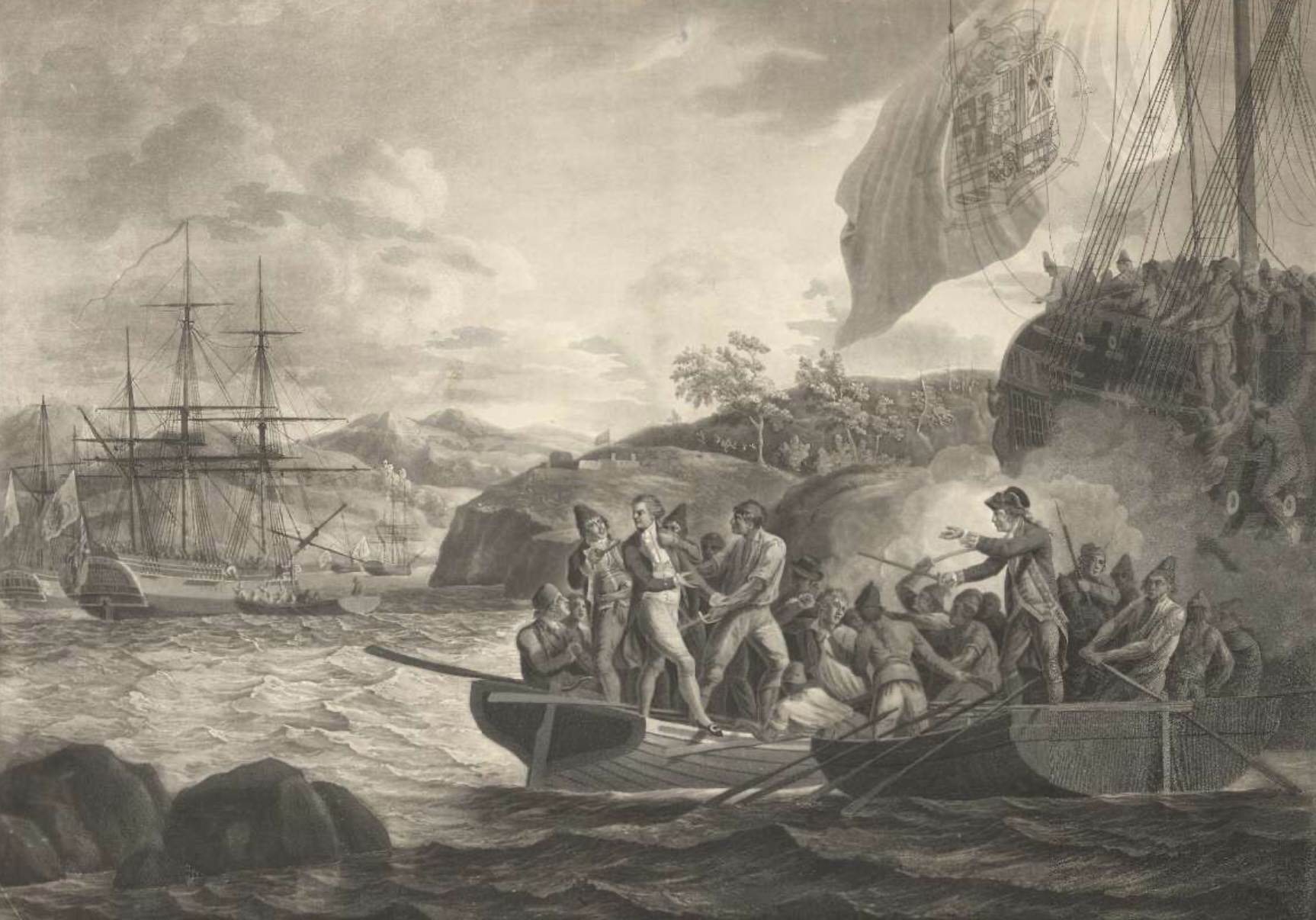
Relations between Douglas and Martínez began cordially. The Iphigenia was flying Portuguese colours, which helped. But once Martínez was joined by his consort vessel, the San Carlos, and by the American, Kendrick, his attitude changed. On 14 May, he seized the Iphigenia. He told Douglas his instructions were ‘bad’,
… that they mentioned [Douglas] was to take all English, Russian and Spanish vessels that were of inferior force to the Iphigenia, and send their crews to Macao, there to be tried for their lives as pirates.
This was certainly a misinterpretation. Yet determining the precise course of events is rendered difficult by the accounts on which we depend, which were drafted in an international crisis, with propaganda in mind. Douglas says that he and his servant (who was put in the stocks), were sorely treated, that the Spanish refused to accept that the Iphigenia needed urgent repairs, and that they seized everything which they took a liking to, including his watch, sextant and stove. He claims,
… if I had steered for any port in South America, the Spaniards would not have seized my vessel, but supplied me with the necessaries I was in want of, agreeable to the laws of nations; to take me a prisoner in a foreign port that the King of Spain had never laid claim to, was a piece of injustice that no nation had ever attempted before.
This was denied by the Americans present, but they were interested to exclude the English. (Douglas says Kendrick assisted Martínez by supplying him with leg irons.) The treatment meted out by the Spanish caused Maquilla to exclaim that the British had the look of slaves. He moved the Nootka away, four miles to the northward.[45]
On 30 May, Martínez signalled a change of policy when he offered Douglas such stores as he could spare: Douglas says he charged ‘five times the quantity, and at five times the sum they cost.’ On 1 June, the Iphigenia was permitted to depart, after Douglas had signed a bond declaring he would leave the coast and that he would deliver her up at Macao, if her papers were ‘bad’. He had claimed she was unseaworthy; that to tarry on the coast would be ‘to throw away the lives of [his] people.’ Yet, he overstated his case. Before sailing for China, he spent a month trading in furs.
On 9 June, the North-West America returned to Nootka for badly needed supplies. Immediately, she was seized. Quite why she was not subsequently released is unclear. Martínez had pressured Douglas to persuade her master, Robert Funter, to sell her, and Meares says that Martínez acted when he learned that a letter which Douglas left behind included no such instruction. The Americans said that she was taken as security, when Martínez learned that her titular Portuguese owner was bankrupt. Martínez says nothing, although he might conceivably have argued that, given his limited resources, it was easier to take the schooner to San Blas than the larger Iphigenia.
The deposition of Funter and his crew (not prepared until December) contains claims of a sort that might be expected; that, alongside 215 skins on board the schooner, the potential for a further thousand on the Queen Charlotte Islands was surrendered. Additionally, that,
… Funter and his crew were removed prisoners on board the [Spanish] ships of war, to their vexation, detriment, and loss; and that the said schooner North-West America was taken out of his care, and given up to the plunder of the subjects of His Catholic Majesty; that the colours of Spain were hoisted aboard the said North-West America; that every formality was used by the Spaniards, by sprinkling holy-water, &c. on the above vessel, in order to cover their unjust and cruel proceedings.
On 15 June, sixteen weeks after leaving Macao, William Hudson brought the Princess Royal into Nootka. He was met by two launches. He asked whether they were armed and was told that they were, but with a bottle of brandy only. Over two days, he entertained Martínez, Kendrick and Funter on board. Then he moved into the sound. He promised that, once his ship had been repaired and resupplied, he would depart. This was accepted. Martínez had most of the skins taken from the North-West America transferred and, on 2 July, she sailed. Unfortunately, Hudson believed the Spanish intended to leave also. He returned to Nootka two weeks later, and his true purpose was revealed. The Princess Royal was retaken, on pain of her crew being hanged from the yard arm if they resisted.[46]
This brings us to the climactic moment, the seizure of the Argonaut. She arrived on 2 July 1789, as the Princess Royal was leaving. (They missed each other in a fog.) Maquilla sent warning of the goings on, but Colnett says the Nootkas’ explanations were too confused to be helpful. He was put on the alert, but no more. His nervousness increased when the Argonaut was greeted by a launch sent by Martínez. This made it clear who commanded the harbour. Yet Colnett says he was told the Spanish were ‘in distress for provisions.’ He was handed a letter from Hudson, assuring him that, if he went inside, ‘the Commodore would order you every assistance in his power as he has done me.’ He was half convinced. He retired to his cabin, but warned his first mate, Robert Duffin, ‘not to enter the cove where the Spanish and Americans lay, but to anchor close to the mouth of it.’ This instruction, he says, “was either misunderstood … or wilfully disobeyed”. (Colnett came to believe the latter, and that Duffin was bent on private trade.) When he returned on deck, he discovered that the Argonaut had anchored ‘in the centre of the cove which was guarded in the entrance by the S. Carlos of 20 guns.’
Even so, it took time for the atmosphere to become properly heated. There was, apparently, a misunderstanding between the commanders, triggered, perhaps, by a change in thinking by Martínez. Colnett claims that Martínez had tricked him by pleading for help, and that he promised he might take the Argonaut away when he pleased. He adds that Martínez was interested in expelling only the Russians from the coast. But for him to plead that his ‘chief cause’ for entering the sound was to succour Martínez, and that Martínez’s objective was the obtaining of loot, is unfair. Once he appreciated Colnett’s purpose, Martínez will have realised that, if he suffered him to depart, ‘it was entirely practicable for him to carry out his designs at some point up or down the coast, wherever it would be the most convenient.’
According to Martínez, Colnett declared that ‘he brought orders from his sovereign … to take possession of the port of Nootka and its coast, to fortify it and make an establishment.’ This was more than Colnett could claim in terms of authority, but it matches his instructions. He refused to produce his papers and threatened immediately to report Martínez’s actions to his government. Martínez, in turn, reasoned that, if he allowed Colnett to do so, Britain would be placed at an advantage, allowing her to ‘adopt measures before our court could do so.’ [47]
No doubt, the fact that the Americans were being treated more leniently contributed to Colnett’s anger. (‘I soon learnt the cause,’ he wrote. ‘They had nothing worth plundering.’) So, perhaps, did a sense of Duffin’s disloyalty, or negligence. In any event, for a while, he lost his head. Martínez writes,
I was informed by pilot Don Jose Tovar … that Captain Colnett, from the effects of despair or madness, had thrown himself into the water through one of the portholes or windows of his cabin. However, on hearing the noise which he made when he struck the water, he was discovered from the quarter-deck, and was picked up by the packet’s launch, which went to him at once. When it reached him, he was half drowned, but they turned him on his stomach and relieved him of much of the water which he had swallowed. I immediately ordered that he be shut up in a stateroom to prevent him from suffering harm in this way.[48]
Duffin’s suggests that if Colnett had been less highly strung, Martínez would have treated him differently. Unquestionably, their encounter became febrile. Colnett was threatened with a musket ‘cocked to his breast,’ and with the stocks, before he was confined in his cabin. But Martínez could never have released Colnett. He did not even refer the matters at hand to his viceroy. The Englishman, his crew and the Chinese were arrested and sent, with the three ships, to San Blas. There, eight Britons died, one of them by slitting his own throat. The Spanish flag was raised over Meares’ establishment, and Martínez declared the entire coast, from the Horn to Cook’s Inlet, a possession of the Spanish crown.[49]
When the news reached England, there was an outcry. It was stoked efficiently by Meares, who appeared in April 1790 and, in his Memorial, broadcast his exaggerated account to the House of Commons and public. The Cabinet decided that a demand should be issued for ‘immediate and adequate satisfaction for the outrages committed,’ and that a squadron of ships should be prepared for sea. The press gang set to work, on 4 May. Spain also made naval preparations, and both sides approached their allies for support.[50]
The Spanish declared that they had reached Nootka four years before Cook, in 1774, when Juan Perez had named the sound ‘San Lorenzo’. Additional expeditions, in 1775 and in 1779, meant that the coast from California to Prince William Sound had been thoroughly explored. They argued that this legitimised Spain’s claim, even though her activity had ceased after 1780, and although she had published very little about her discoveries. The Spanish also claimed that, when Martínez reached Nootka in 1789, nothing remained of Meares’ earlier settlement. In this, they were supported by Robert Gray, who asserted the construction was ‘pulled to pieces’ by Douglas before he left, in 1788. To the British, whether anything remained, or not, was irrelevant. That a factory had existed was undeniable, and British intentions in 1788, 1789 and after, had been crystal clear.[51]
William Pitt was little interested in the details. He decided that the time had come to lance Spain’s ‘chimerical claims of exclusive sovereignty over the American continent and seas adjacent.’ It was essential to establish Britain’s …
… unquestioned right to a free and undisturbed enjoyment of the benefits of commerce, navigation, and fishery, and also the possession of such establishments as they may form, with the consent of the natives, in places unoccupied by other nations.
It is a sentiment with which, two hundred years before, Elizabeth I would have wholly concurred. But Pitt was less inclined to involve Britain in war than his colleagues, or his people. He bought time and secured the support of Prussia and Holland. When Spain learned that France, Russia and Austria were unwilling to succour her, a Convention was agreed. Spain agreed to ‘restore’ a tract of land, of which the British merchants had been ‘dispossessed’, and so threw open to all nations the Pacific coast between Monterey and Cook’s Inlet.[52]
The End of the Tale
Although the Convention gave the Meares-Etches consortium much of what it hoped for, their dividend was meagre. The Spanish promised monetary compensation and Meares was not shy to stake his claim. In demanding 153,433 Spanish dollars for ‘actual’ and 500,000 for ‘probable’ losses, he assumed that, in 1789, the Argonaut would have sold two thousand skins at $100 apiece, and the Iphigenia, North-West America and the Princess Royal one thousand each at the same price.[53]
This was surely an overstatement. It was torpedoed when George Dixon, using data supplied by Meares’ own partner, John Cox, established that, altogether, Britons had sold just 5,033 otter skins in China before the seizures. They realised $146,862 – an average per skin of $29. To suggest, therefore, that the Merchant Proprietors would have sold five thousand more was bold. To argue that they would have realised $100 per skin, was quite unrealistic.
Meares countered with his experience from 1788 when, operating under the Portuguese flag, he had ‘possessed a free, independent power’ over his cargo. Then, he had sold 750 skins at an average price of $50, eight of which were sold to the Chinese Hoppo for $250 apiece. Even so, $50 is just half of $100, and Meares told the Committee for Trade that the highest price he had obtained for ‘a good sea otter skin’ was $95. Moreover, in 1789, Meares was meant to be operating under an East India Company licence. By his own admission, in 1788, the Company had paid just $20 for $95-equivalent skins. The idea that he might have attained an average of $100 by selling super-premium skins to the Hoppo, or others, is quite unconvincing.[54]
The argument became extremely bitter. At one point, Meares complained of Dixon,
You state with an infatuated kind of triumph, that your 2,552 sea-otter skins, &c, fetched no more than 54,857 Spanish dollars at the Chinese market; and your statement is made in such a manner, as to infer it was the common market price of that valuable commodity; and that, of course, what has been said by myself and others on the advantages of that commerce, is a deception on the public. At the moment you were writing that curious piece of information, or instructing others to write it, you knew it was founded on falsehood.
Meares had become entangled by the threads of his argument. He sought to maximise the value of his claim by denigrating the ability of Dixon’s employers to obtain a fair price for their skins. Yet Dixon’s employers were the Etches, his own associates. One can see why they came to dispute their respective shares of the Spanish compensation. Yet all became irrelevant. Spain prevaricated, and the value of Meares’ claim progressively declined, until the First Coalition against revolutionary France was formed, and the matter was dropped.[55]
The Convention also failed to entrench British dominance in the trade. The American ships of 1789 were followed by others. Within a few years, they outnumbered the British. The war with France was a factor, but the principal issue was the East India Company, for the Americans escaped the restrictions it imposed on British merchants. They paid no licence fee, and they sold their furs for tea and other Chinese goods, on which they made a profit at home. With this, the British could not compete.[56]
Meares abandoned the trade and returned to duty with the Royal Navy. When he died, in Bath, in 1809, there remained in his estate a claim against Daniel Beale & Co. ‘under an arbitration’, for £21,600.[57]
By then, the fur trade had fallen into the lap of American land-based operators. Ironically, their advancement began when Hanna, Duncan and Colnett revived the claims of the Spaniards de Fuca and de Fonte, that there existed behind the islands near Nootka a large watercourse that merged with the Atlantic.[58]
North of Vancouver Island, James Hanna discovered the entrance of a ‘Great Sound’, which he named after an associate in China, William Fitzhugh. He tried to explore it, but he was driven back by the current, about which he commented, ‘I never in the mouth of any river or inlet found such large quantities of timber, and rubbish, as continually came down here with the stream.’ Alexander Dalrymple thought this strongly indicated ‘the reality of de Fonte’s account.’
Duncan reported that the natives at the southern entrance to the Strait of Juan de Fuca (‘Cape Classet’), ‘knew not of any land to the eastward; and that it was ‘aass toopulse’, which signifies a great sea.’
Commenting on the Queen Charlotte Islands in his Prince of Wales journal, James Colnett doubted ‘I have ever seen the Coast of America at all.’ He referred to,
… the inland navigation which might not improperly be conjectured to run to Hudson’s Bay from the depth of water, width of the channel and tending to the NE as far as the eye could reach.[59]
John Meares, after describing Duffin’s battle with the natives in the de Fuca Strait, wrote that he sailed nearly thirty leagues into it. There, he wrote, it was fifteen leagues broad, and the eastern horizon was clear for fifteen leagues more:
Such an extraordinary circumstance filled us with strange conjectures as to the extremity of this strait, which we concluded, at all events, could not be at any great distance from Hudson’s Bay.
In fact, Hudson Bay was some thousand miles away. In his critique of Meares, Dixon argued, inter alia, that he adjusted the latitudes and longitudes of coasts, rivers and lakes to suit his arguments. Still, he proposed that an expedition should be mounted to determine, once and for all, how far the waters behind Nootka extended to the north and east.[60]
The traders’ reports were collected in England by Alexander Dalrymple, who became convinced both that a North-west Passage might exist, and that Britain was at risk of losing its pre-eminent position in the fur trade. He advocated an arrangement whereby the Hudson Bay Company would deliver its furs to a factory on the coast, from where the East India Company would ship them to China. In the summer of 1789, he and Dixon pressed the government to send an expedition to the North-west Coast. And indeed, preparations were made for a mission under Henry Roberts, before the crisis with Spain supervened. Within two weeks of the signing of the Nootka Convention, in October 1790, the ships Discovery and Chatham were made ready under Roberts’ lieutenant, George Vancouver.[61]
At that time, Alexander Mackenzie, of the Canadian North-West Company, was visiting London. Previously, he had traced his great, eponymous river from the Great Slave Lake to its outlet on the Arctic Ocean. Now he learned of Vancouver’s expedition. Seeking to connect with it, he returned to Fort Chipewyan, on Lake Athabasca. From there, he followed the Peace River westwards to its source in the Rocky Mountains. Finally, he reached Bella Coola on the Pacific Ocean, where he was greeted by Indians bearing ‘a very few sea-otter skins, with some pieces of raw seal’s flesh.’ The date was 22 July 1793. Bella Coola is situated in the upper reaches of the sound named by James Hanna after William Fitzhugh. It is just three hundred miles from Nootka. Mackenzie had missed Vancouver by just a few weeks.[62]
As he marked his diary for the day, he could not resist taking a swipe at Meares’ assertions:
Mr. Meares was undoubtedly wrong in the idea, so earnestly insisted on by him, in his voyage, that there was a North-West practicable passage to the southward of sixty-nine degrees and a half of latitude, as I flatter myself has been proved by my former voyage. Nor can I refrain from expressing my surprise at his assertion, that there was an inland sea or archipelago of great extent between the islands of Nootka and the main, about the latitude where I was at this time.[63]
Nonetheless, Mackenzie had shown that the North-West and Hudson Bay Companies might extend their trade overland to where Meares and the Etches had concentrated their efforts. He wrote,
By opening this intercourse between the Atlantic and Pacific Oceans, and forming regular establishments through the interior, and at both extremes, as well as along the coasts and islands, the entire command of the fur trade of North America might be obtained, from latitude 48° North to the pole, except that portion of it which the Russians have in the Pacific. To this may be added the fishing in both seas, and the markets of the four quarters of the globe. Such would be the field for commercial enterprise, and incalculable would be the produce of it, when supported by the operations which Great Britain so pre-eminently possesses.
So it was to prove. As the network of connections grew, and the hidden resources of the hinterland were revealed, the foundations became established upon which the Dominion of Canada was built. John Meares was not involved in that process, but it may be legitimately argued that he and James Strange set in motion the events that first opened the Pacific Ocean to free commerce.