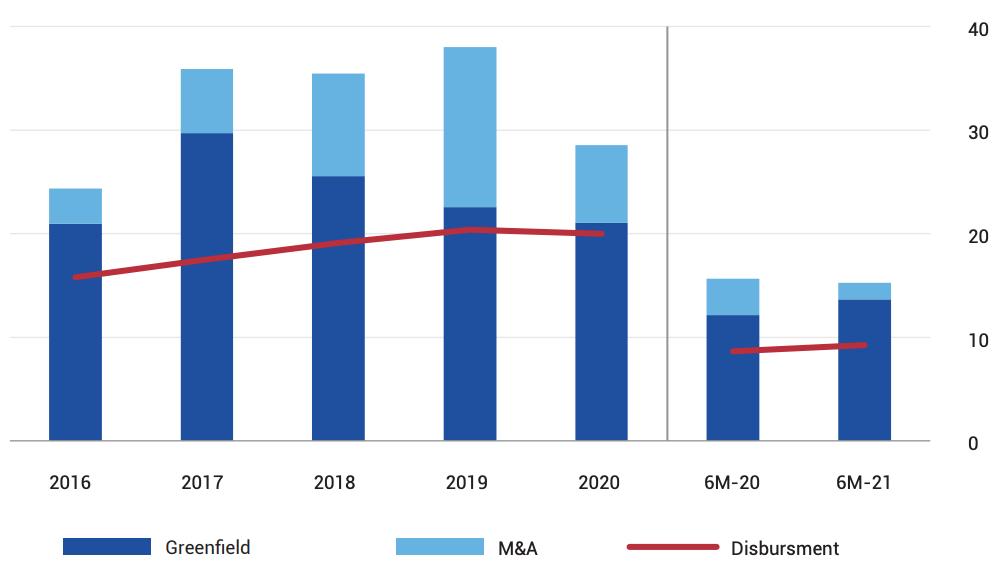
Vietnam – FDI Commitments and Disbursements ($bn)
Credit and Inflation
The Central Bank has maintained an accommodative policy stance. The refinancing interest rate remains 4% (following earlier reductions equating to 2%) and commercial banks have been directed to assist businesses affected by the pandemic through loan restructuring, interest exemptions/reductions etc. (They are required to set aside additional provisions in these instances within three years.)
Credit growth has accelerated from 10% to 12% in the latter part of 2020, to over 15% YoY in July. Liquidity in the financial system has also risen over the same period, even though it has declined again since May.
Vietnam – Credit and Liquidity (% YoY, EOP, NSA)
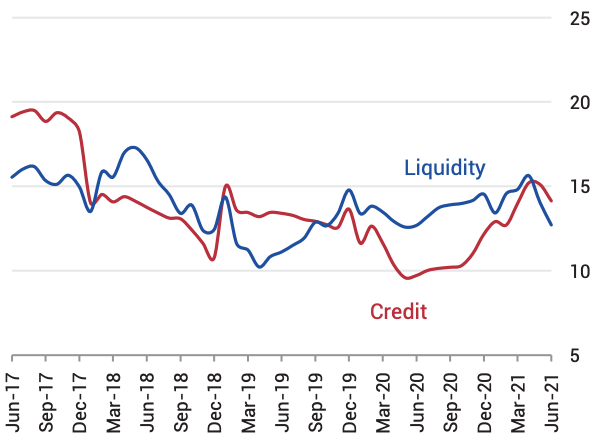
Monetary and credit growth have exceeded nominal GDP growth since the beginning of the COVID pandemic.
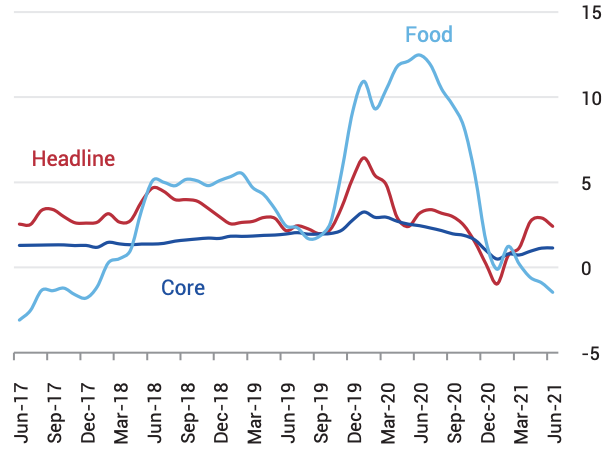
Nonetheless, inflation has increased only slightly to 2.4% YoY in June. Core inflation, excluding administered prices, rose by 1.1% YoY.
Vietnam – Consumer Price Index (%, YoY, NSA)
Credit to GDP rose from 136% at the end of 2019 to 146% at the end of 2020 and the World Bank is signalling some concern that risks in the financial sector are rising.
They suggest that the economic rationale for certain loans, including those provided to SOEs and national champions, is not as clear as they would wish, and they highlight that the State Bank has not published data on NPLs since September 2020.
It also notes that capital adequacy for the banking sector has fallen from 12% at the end of 2019 to 11.1% in June 2021, and that certain undercapitalised banks are currently unable to meet their Basel II requirements.
Fiscal Policy
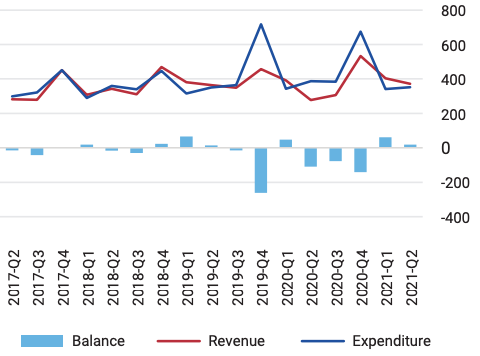
Following an accommodative fiscal policy in H2 2020, the authorities switched to a neutral stance in H1 2021.
In terms of fund raising, in H1 the government has taken advantage of ample liquidity and relatively low borrowing costs to draw more on the domestic market, where its borrowings rose by 63% YoY to VND 141.5trn (2.2% GDP).
At the end of June, 10-year bond yields were 2.2%. The authorities have mostly issued 10-year and 15-year paper in order to lengthen the maturity of their portfolio.
Tax revenues rose by 15.7% YoY in H1, whereas planned expenditures of $5.8bn were $1.3bn lower than in the same period in 2020.
However, because of the deterioration in the economic picture since April, the authorities have announced the resumption of some reliefs to support business. These include delayed payments of corporate tax, income tax, value added tax and land rent to the end of the year, to assist financing for working capital. The package is estimated to equate to 1.9% GDP.
The government has also announced an intention to accelerate the disbursement of its investment programme in the second half of the year, although the Bank observes the timing of this will need to be coordinated with relaxations in mobility restrictions if it is to be fully effective.
Vietnam – Government Budget (VND bn, NSA)
The government has also announced a second social support package, worth $1.1bn, for workers and businesses affected by the pandemic.
With debt/GDP standing at 55.3% at the end of 2020, the World Bank believes Vietnam continues to enjoy fiscal space, but it suggests that the authorities need to watch out for fiscal risks, as experience in the pandemic elsewhere has shown how quickly fiscal pressures can increase if circumstances prove averse.
Short to Medium Term Prospects
The World Bank has cut its growth forecast for the current year from 6.8% to 4.8%, but it expects real GDP growth to return to its pre-pandemic rate of 6.5% to 7% from 2022 onward.
Near-term risks are thought to lie to the downside, depending on the pace of the roll-out of vaccinations and the evolution of the pandemic both domestically and internationally. The recovery in the United States, Europe and China is underway but is considered to be fragile.
Nevertheless, even in a low case scenario, the World Bank is suggesting real GDP growth of 3.2% in 2021 and 5.5% in 2022 is achievable.
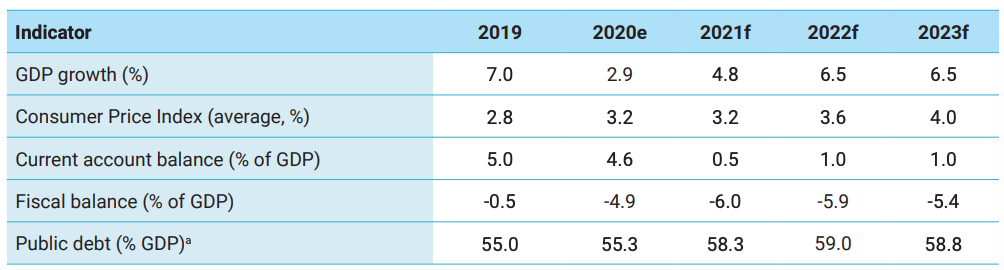
As growth normalises, monetary policy is expected to return to a neutral stance, in order to stabilise inflation. This is expected to remain below the 4% policy rate set by the Central Bank.
The authorities are expected to resume their policy of fiscal consolidation and, as a result, the deficit is expected to drop from 6% of GDP in 2021 to 5.9% in 2022 and 5.4% in 2023.
The current account is expected to remain in surplus, although this is expected to decline from 4.6% GDP in 2020 to about 0.5% GDP in 2021.
Vietnam’s international competitiveness should ensure that exports continue to expand and this trend should be reinforced by the decision to continue the policy of diversifying trading partners through initiatives such as the Regional Comprehensive Economic Partnership. Revenues from tourism are expected to recover as the country re-opens to international visitors in 2022-2023.
FDI flows are expected to recover to pre-COVID levels as Vietnam revamps its integration with global value chains and as, internationally, governments and MNCs seek to diversify their sources of production.
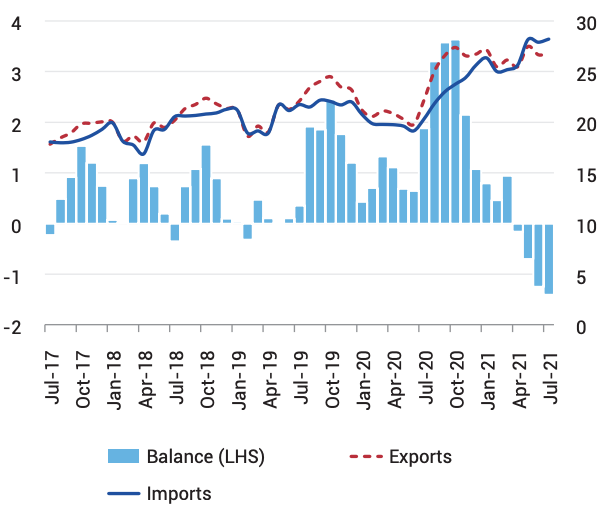
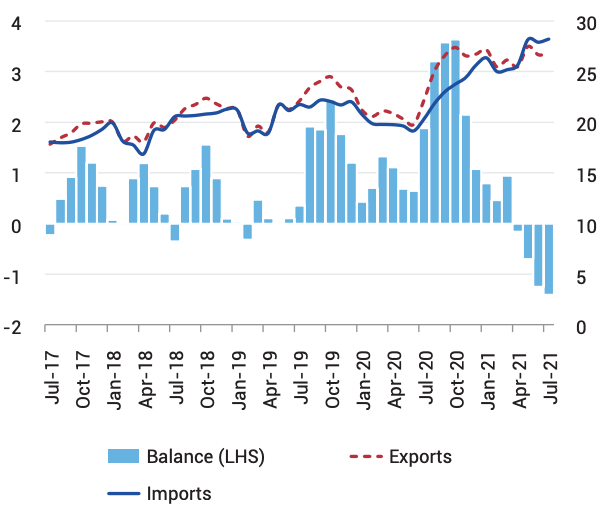
Vietnam – Merchandise Trade Balance ($bn, 3mma, NSA)
Risks
The World Bank cautions that the authorities need to monitor carefully the rise in financial sector NPLs, whilst pushing for the adoption of Basel II capital rules for all operating banks. It believes that a robust warning system is required to identify potential risks at individual banks and for the system, and that a clear exit strategy for loan forbearance measures needs to be established. It is in favour of adopting an early resolution plan for nonperforming loans, which avoids the risk of bad loans burdening the system and stifling growth over the longer term.
It also recommends that administrative reforms are required to enhance the efficiency of tax revenues and that efforts need to be made to ensure these are used to finance infrastructure and social services that will make the economy more sustainable, digitally transformed and productive.
To read the World Bank’s full report, please use the following link:
https://www.worldbank.org/en/news/press-release/2021/08/24/vietnam-s-economy-is-forecast-to-grow-by-about-4-8-percent-in-2021