


At the end of March, the IMF issued its annual report for the Article IV consultation process with Myanmar. This is based on work done in Myanmar in December 2019 and is based on data available up until mid-February. It therefore predates the COVID-19 global pandemic which, the IMF warns, has greatly amplified uncertainty and heightened downside risks to the outlook.

Myanmar - Economic Update
IMF Article IV Consultation, March 2020
Economic Developments in 2018/19
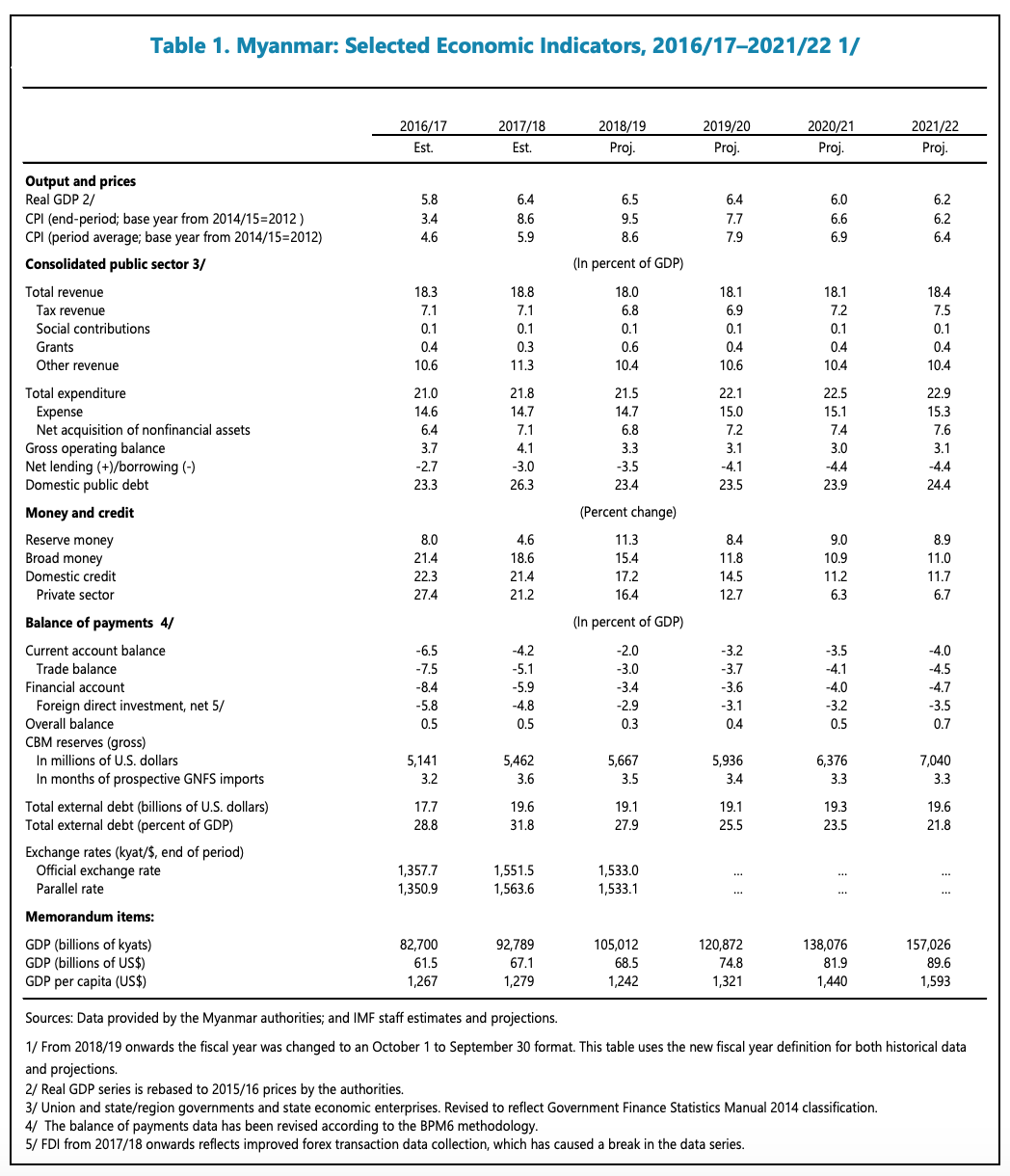
Growth in 2018/19 remained below the levels seen in the last decade. Real GDP growth is estimated to be a “subdued” 6.5%, albeit up slightly from 6.4% in 2017/18 as a result of modest fiscal stimulus (the deficit has risen from 3% in 2017/18 to 3.5% GDP) and a one-off increase in gas exports.
Weaker domestic demand has fed into slower credit growth (albeit to a still “robust” 16% in the year to September), a correction in real estate prices (aided also by an increase in supply) and declining investments.
The current account deficit has narrowed from 3% of GDP to 2% as imports of construction goods and autos fell and exports, especially textiles, have held up better. The narrower deficit offset weaker FDI (despite a modest improvement in approvals) and other inflows which has permitted reserves to rise (to about 3.5 months of imports in September) and the Kyat to stabilise.
Headline inflation in September stood at 8.6%, reflecting one-off factors such as higher electricity tariffs (contributing 2%), and food and fuel prices.
Outlook and Risks
Growth in 2019/20 is expected to moderate slightly to 6.4%, as uncertainty weighs on investor sentiment in the run-up to November’s elections. This is expected to offset the fiscal stimulus envisaged in the budget, which is judged appropriate given cyclical weaknesses.
In 2020/21, bank deleveraging is expected to slow credit and GDP growth, as legacy problems are addressed. Inflation is expected to average 6% to 7% in the medium term, as one-off factors abate.
Although long-terms prospects remain favourable, risks to the outlook are judged to have shifted to the downside. Medium term growth is now expected to be lower than previously envisaged given delayed restructuring and the weaker property market.
- Dividends from the first wave of reforms are waning and legacy issues (declining revenues from natural gas extraction, weaknesses in the banking system, long term under-investment in human capital) are coming to the fore
- Domestic growth could slow if fiscal spending does not pick-up, and rising NPLs and undercapitalisation risks in some banks could precipitate systemwide distress.
- Renewed conflict and the refugee crisis could limit donor financing and dampen investor sentiment.
- External risks include the impact of global trade tensions, higher oil prices, a slowdown in China and natural disasters.
The IMF Staff note that progress in addressing the refugee crisis in Rakhine State has “stalled” as a result of renewed conflict, refugees’ reluctance to return and rising nationalist sentiment ahead of the elections. In the UN’s judgement, the security situation in border areas has deteriorated.
On the upside, growth may be boosted by the planned scaling up of infrastructure and human capital investment and by the implementation of the Myanmar Sustainable Development Plan (MSDP). The IMF estimates increased investment could amount to 3% of GDP over 5 years, and could raise GDP growth by 1.5% to 2% over the medium to long term. However, it needs to be managed carefully to contain fiscal risks.
In their assessment, the IMF’s Directors have commended the Myanmar authorities on the successful transition to a market-determined reference exchange rate mechanism and on their plans to introduce interest payments on excess reserves. They judge that the current monetary policy stance has helped to keep market rates at positive real levels and broad monetary growth on a declining trend. They also believe a mildly expansionary fiscal stance has been appropriate in the conditions applicable pre-COVID-19.
In addition, they have made some further policy recommendations:
- There is scope to improve the monetary transmission mechanism with further upgrades in the monetary framework and through interest rate liberalisation
- It is critical to enhance revenue mobilisation and public financial management if increases in SDG spending are to be sustainable
- Improvements in cash management and proactive steps in debt issuance are required if the spike in central bank financing of the end of last year is not to be repeated. (CBM financing, at 8.4% of reserve money, was above the 1% target for last year).
- Capacity development remains a priority, in order to support structural and policy reforms
Key Policy Recommendations
Financial Sector
There has been progress in addressing asset quality problems, but vulnerabilities remain.
Banks appear to have met the CBM’s target for switching overdrafts to term loans (30%), but there has been a rise in NPLs which have weakened capital positions. In addition, large bullet payments pose challenges in some instances and provisioning has been unevenly enforced.
Some banks have successfully raised capital through subordinated debt and foreign minority stakes, but the uneven distribution of recapitalisation needs makes a purely private sector solution unviable, necessitating public support.
Financial reporting by banks is below international standards, putting an extra onus on sector surveillance and supervision.
CBM has extended the period for banks’ compliance with capital adequacy and large exposure limit requirements to August 2020, but needs to ensure they restructure viable loans, maximise recoveries, book losses and adequately provision and rebuild capital in this period.
Monetary Policy Framework
The time is now judged right to move to a more active and credible monetary policy framework. Steps envisaged include:
- A firm commitment to phasing out monetary financing of the deficit in 2020/21 or 2021/22 at the latest
- Establishing an interest rate corridor to guide interest rates, with the lower end of the band being guided by the introduction of interest rates on excess reserves
- Establishing a broad inflation objective and a monetary policy committee, with regular reviews and communication of the policy stance
- Gradually liberalising banks’ deposit and lending rates: the 8% deposit floor is high by regional standards and NIMs remain moderate
- Supporting FX market development by addressing gaps in the FX Management Law, encouraging the availability of hedging instruments and improving timely information.
Fiscal Framework
To respond to weak cyclical conditions and rapidly increasing demand for energy, the fiscal deficit for 2019/20 should increase to about 4% GDP. It should remain at 4%-4.5% of GDP to support growth while preserving debt sustainability.
Policy should focus on achieving the SDGs by prirotising investments in energy, infrastructure and social spending. As revenue/GDP is declining, a medium-term strategy should be developed with specific targets to meet spending needs in a more sustainable way
- Modernising the tax system to raise revenues.
- Improving budget execution and efficiency
- Moving to a defined contribution pension system through a Central Provident Fund to provide security for public sector employees
Progress has been made in improving governance at the SEEs (eg. through the recent adjustment to electricity tariffs, which should reduce losses from power generation by c.1% GDP). Bringing oversight of the SEEs under the Ministry of Planning is judged timely. However, further work is needed on assessing/centralising PPAs and in adopting competitive bidding in petroleum production sharing contracts.
A framework for monitoring PPPs and their associated fiscal risks should be established
Structural Reforms and Governance
Priority for enhancing the business environment are the provision of a more reliable power supply, contract enforcement, and improved access to finance and logistics.
The new energy masterplan through the “Project Bank” should help secure energy security at least cost. The new insolvency law should help to ensure healthy investment in the economy.
The authorities should press ahead with important financial infrastructure such as a credit bureau, a secured transactions framework and regulatory oversight of payments.
On logistics, the East-West Corridor and CMEC should be developed through competitive bidding and transparent reporting of fiscal risks.
The IMF notes that the number of complaints to the anti-corruption commission has increased. This needs to be addressed, as do gaps in the AML/CFT framework identified by the Asia Pacific Group. Fiscal transparency, including EITI reporting, should help to mobilise tax and natural resource revenues, while reducing the costs of doing business.
The full IMF Staff report may be read using the following link to the IMF’s website: