Vietnam - Economic Update

World Bank's Assessment - October 2020


Summary

On 12th October, the World Bank published a summary of findings from its most recent analysis of developments in the Vietnamese economy.

At the time of writing, the COVID-19 pandemic remained well-controlled, with 1,100 registered infections and just 35 deaths reported since early February.

Overall, the World Bank believes the economic recovery is becoming more broadly based, and that Vietnam’s GDP growth is on track to reach the 2.5% to 3% expected of it in 2020.

Growth

According to the Bank, economic growth recovered from just 0.4% YoY in Q2 to 2.6% YoY in Q3.  Growth was led by the industrial sector (+3.1%), but both agriculture (+1.8%) and services (+1.4%) put in a positive performance.  This improved performance has occurred despite the recent COVID-19 outbreak in and around Danang.

The most severely impacted sectors of the economy this year have been tourism and transport. Foreign tourist arrivals were down 70% in the first nine months of the year compared to the same period in 2019.

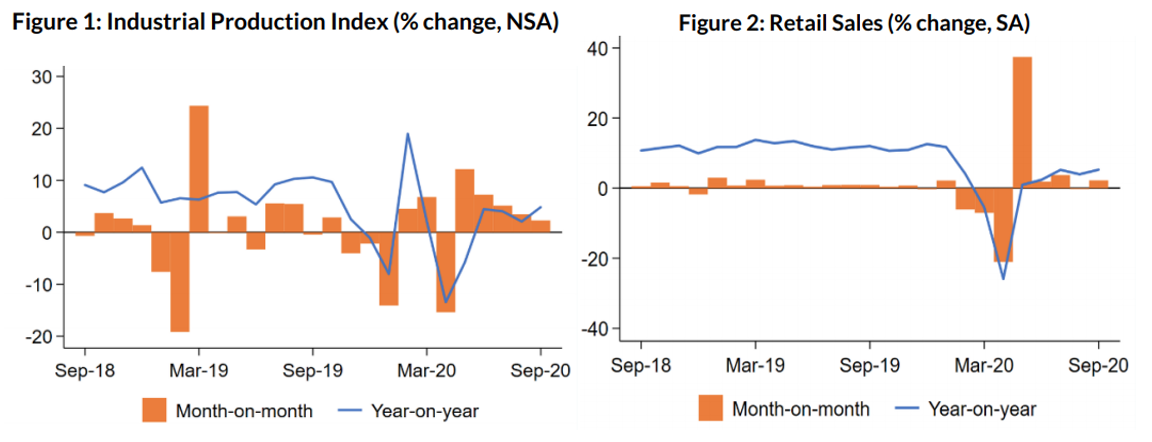
The following charts show how both industrial production and retail sales have performed since the worst of the crisis in April.  For both there was an acceleration in year-on-year growth in September compared to August.   Growth in industrial production in September was 4.8% YoY and growth in retail sales was 5.3%.  In both cases, growth was similar to that enjoyed in July.

Trade and FDI

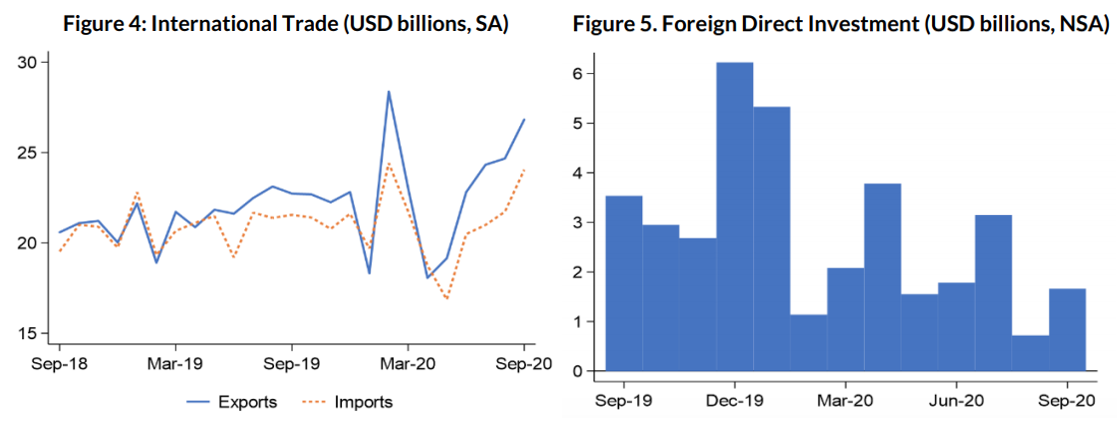
In the first nine months of 2020, Vietnam’s trade surplus reached USD16.8bn.  This followed a USD2.8bn surplus in September.

Over this period, exports by domestically-owned firms rose by 20.2% YoY, while exports by foreign-owned firmed fell by 2.9% YoY. 

Exports to the USA and China have increased, but exports to the EU have fallen a little.  Imports from China rose by 2.7% YoY but decreased from all other main partners.

After a sharp drop in August, FDI flows picked up again in September to about USD1.65bn, broadly in line with the level that applied in April and May.  

For the first nine months of the year, FDI commitments were down by about 19% YoY.  They are forecast to decline by 30% to 40% YoY in the full year, according to UNCTAD’s latest projections.

Inflation and Credit

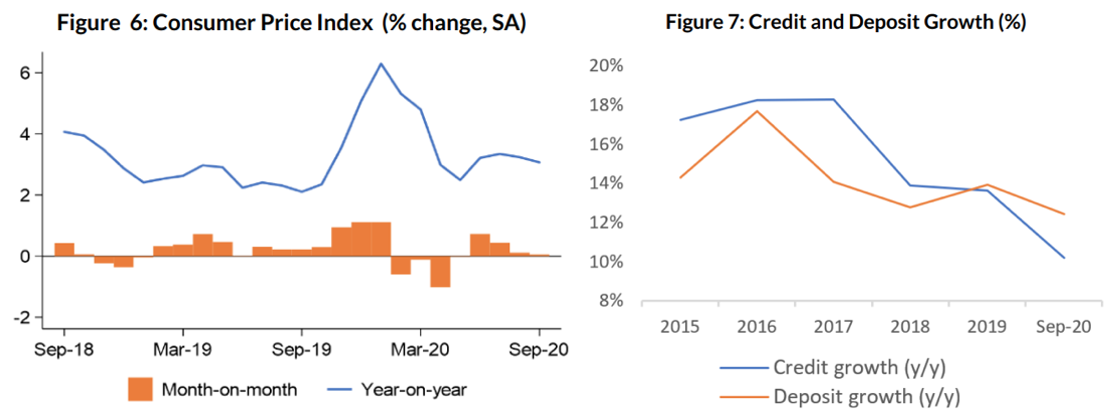
Consumer prices rose by 3% YoY in September, in line with the performance in July and August.  Stable prices in food, energy and transport have helped to bring the overall rate of inflation down from the levels that applied at the end of 2019.

The rate of growth in credit has continued to moderate.  In September, growth in credit was 10.2% YoY, significantly below the rate of growth in the last five years (16.2%).  Liquidity in the domestic financial market has been well supported by the growth in deposits which has been faster than for that in credit.

As of September, reported NPLs were c.1.6% of banks’ assets, although this reflects in part the temporary forbearance measures enacted by the State Bank of Vietnam.  The World Bank has noted that partial information from the listed banks indicates both NPLs and net margins have been under increasing pressure in recent months.
Fiscal Balance and Employment

With fiscal policy having shifted to a counter-cyclical basis in response to the COVID-19 epidemic, there have been both a fall in government revenue and an increase in government spending.

In the first nine months of the year, government expenditure has risen by 40% YoY, and total revenue has decreased by 11.5%.

On the other hand, whilst fiscal space has narrowed, ample liquidity in the domestic market has enabled the government to borrow for its needs at attractive rates.  Terms for the last auction in October averaged 2.7% for maturities between 15 and 30 years.

Unemployment rose significantly, albeit from a low base, as a result of the April lockdown.  Urban workers were affected more, as they were more exposed to mobility restrictions. 

Employment conditions have improved in recent months, but still remain at levels higher than applied before the pandemic struck.   The labour force participation rate in the third quarter was 74%, 2.4% lower than in the same period last year.  Since the crisis, a significant number of people have left the workforce.

Please use the following link to the World Bank’s Vietnam website to read the report in full:

https://documents.worldbank.org/en/publication/documents-reports/documentdetail/863411602831593569/vietnam-macro-monitoring