Vietnam - Economic Update

World Bank's report on recent developments, June 2021

At the beginning of June, the World Bank issued the most recent of its regular updates on the Vietnamese economy.  

In May, Vietnam experienced a fourth outbreak of coronavirus, and this has led to the sharpest rise in new cases since the beginning of the pandemic.  Although the data contained in the report points to economic resilience, the World Bank has indicated that, looking ahead, it will be paying close attention to developments in industrial production and retail sales for their COVID-19 impact.    

The World Bank has suggested that, if the outbreak is not contained quickly, the government may wish to consider a more accommodative fiscal stance to support affected people and businesses, and to stimulate domestic demand.   In the first five months of the year, the government has consolidated its fiscal space, so that, in the World Bank’s judgement, it is better positioned than it otherwise might have been, should a more accommodative stance become necessary.

Fourth COVID-19 outbreak impact mobility and retail sales

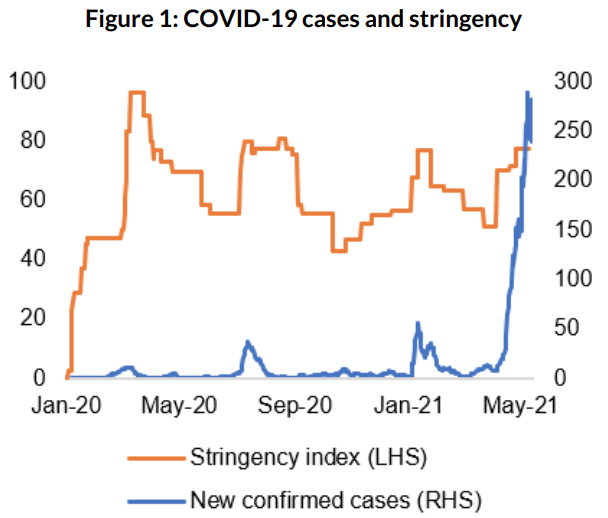
Although the number of cases remains low by international standards, a fresh outbreak of coronavirus in Vietnam in May – a new highly contagious variant – resulted in hundreds of fresh infections per day by the end of the month.  As of 5 June, the cumulative number of infections and deaths since the beginning of the pandemic had risen to 8,580 and 53, with 4,504 infections and 12 deaths occurring in May itself.

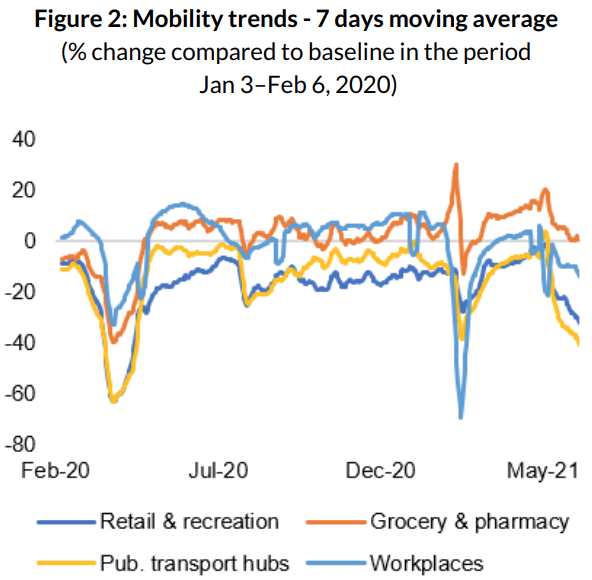
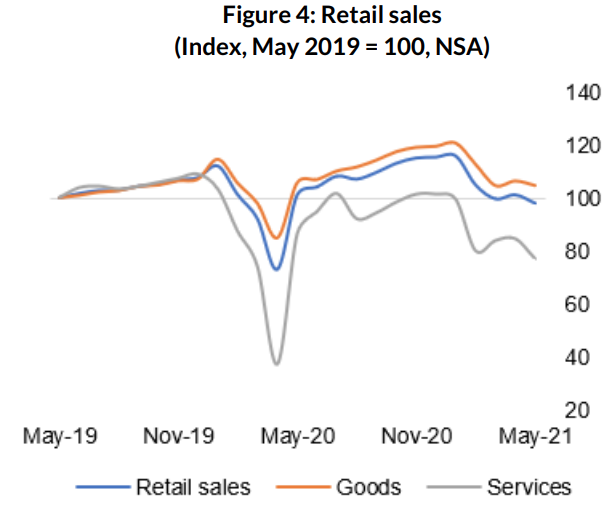
The government has responded by imposing stringent mobility restrictions in the affected provinces, which include the three major cities of HCMC, Hanoi and Danang.   Several factories in two industrial hubs in the north of the country, Bac Giang and Bac Ninh, have also been shut down.   As a result, there has been a sharp decline in the World Bank’s mobility indicators since the beginning of May, with retail and restaurant outlets experiencing a drop in visitors.  After something of a rebound in April, retail sales declined by 3.1% MoM in May, with sales of goods declining by 1.7% MoM and sales of services declining by a larger 8.9% MoM.

Vietnam lags most countries in its vaccination drive, with just 0.03% of the population having received two jabs by 5 June.   The government has therefore stepped up its efforts to obtain vaccine supplies, and it is considering partnerships with foreign companies on vaccine production.

Industrial production resilient

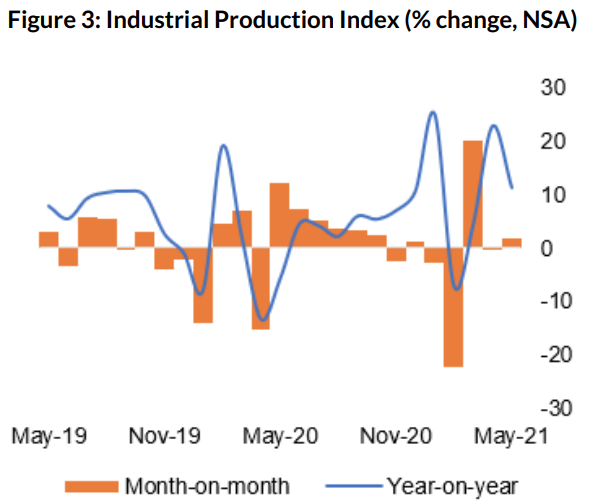
In the face of the above, industrial production thus far has proven to be resilient.  Output in May rose by an estimated 1.6% MoM and by 11.2% YoY.   The PMI remained comfortably in positive territory at 53.1 in May, although this was slightly lower than April’s reading of 54.7.

On the other hand, in the coming months, the World Bank is expecting some knock-on effect from the closure of the Bac Giang and Bac Ninh factories on the supply of some electronic product supplies.  Indeed, in May, the industrial production reading for electronics manufacturing in Bac Giang fell by 53.6% MoM and by 46.9% YoY.

Decline in merchandise trade flows in May, from a high base

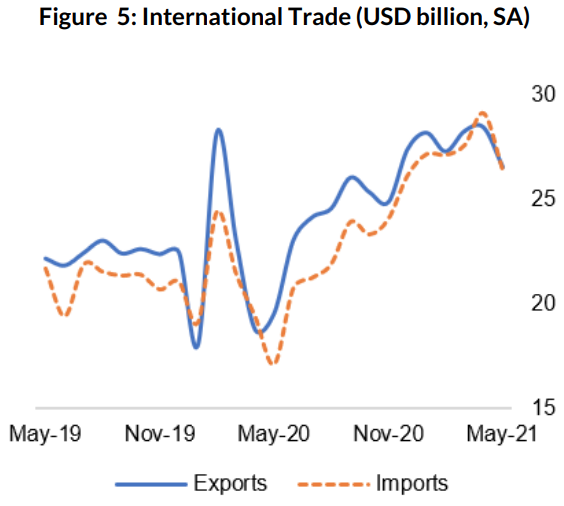
Goods exports fell by 6.7% MoM in May, and goods imports fell by 9.4% MoM.   These are the steepest rates of decline seen since June 2020, but data for the first five months remain very robust, with merchandise exports rising by 29.1% YoY and imports by 35.4% YoY.


The strength in exports in the period to the end of May has been the result of a sharp recovery in demand for a broad range of goods, from phones (+19.5%), to textiles and garments (+16.1%) and footwear (+27%).  Demand from the USA and China has been strong, and demand from ASEAN and the EU has also been recovering.

FDI declined in April and May, but remains flat YoY in the first five months

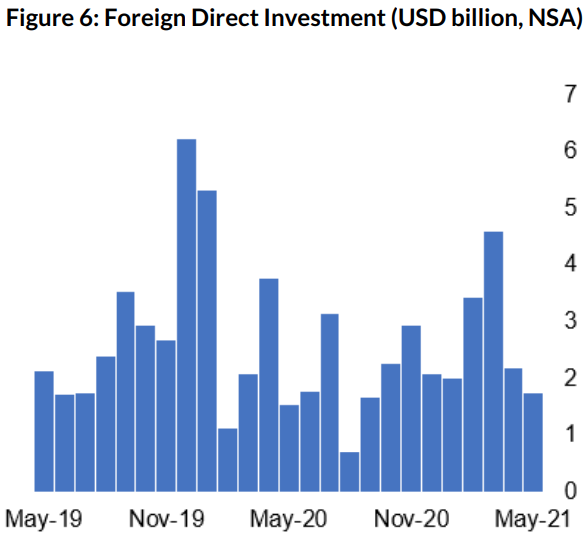
FDI in May fell by 20% MoM to $1.7bn.   In the opinion of the World Bank, this may reflect seasonal factors, but it is possible it also reflects hesitancy by foreign investors consequent to the continuing coronavirus pandemic.

For the first five months of 2021, FDI commitments stood at $14bn, a comparable level to the same period in 2020.
Inflation higher at 2.9% in May.   Credit growth +1.1% MoM

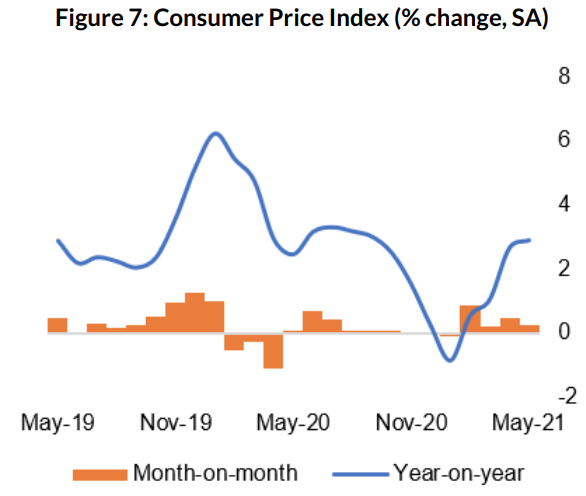
The consumer price index (CPI) rose by 0.3% in May.   This reflects administered price increases in fuel from the end of April, as well as higher prices for inputs used in metal production and in housing and construction.   Nevertheless, the YoY rise in the CPI in May (+2.9%) remains below the level targeted by the National Assembly.
Credit continued to expand in May, but at a slower rate (+1.1% MoM) than in April (+2.0% MoM).  The World Bank believes this could reflect the imposition of tighter mobility restrictions and social distancing measures.
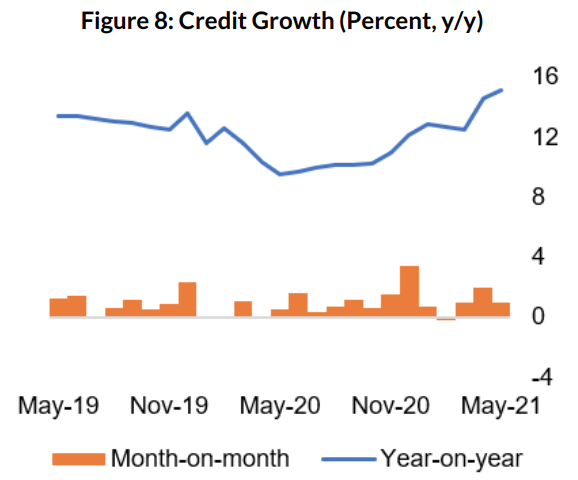
Average one-month interbank interest rates rose from 0.9% in April to 1.5% in May, as the drop in deposit growth in May was sharper than the drop in credit growth.   Nonetheless, the stock market index rose by 7.2% in May.

Government budget surplus, as expenditure declines YoY with slower public investment

In the first five months of 2021, the government budget registered a surplus of $3.7bn.  Revenue rose by 15.2% YoY, while expenditure fell by 3.7% YoY.   Execution of the public investment programme fell 16.5% YoY – a phenomenon that was common at both the central and sub-national government level.   According to the World Bank, one of the contributory factors has been a shortage of inputs used in public investment projects.

At the end of May, the yield on 10-year government bonds was 2.27%, 9bps below the level that applied at the end of April.  Cumulative government borrowing over the first five months of the year has been $4.7bn, 31% of the target for the full year.

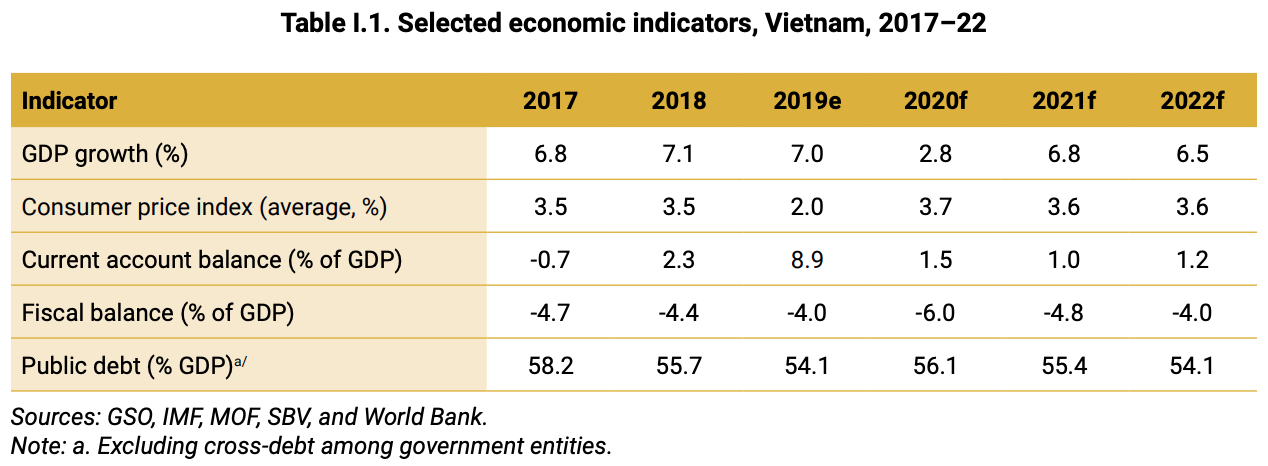
The following is the summary table of select economic indicators published by the World Bank in its “Taking Stock” report in December 2020.
For the full text of the June 2021 edition of the World Bank’s “Vietnam Macro Monitoring” report, please click here.