In mid-April 2021, the World Bank issued an updated assessment of the Vietnamese economy. It believes that the COVID crisis continues to be managed well, with a cumulative total of 2,705 cases only, and 35 deaths, and with over 60mn doses of vaccine secured for 2021. 55,000 doses have so far been administered.

Vietnam - Economic Update
World Bank Review - Q1 2021
Real GDP growth measured 4.5% YoY in Q1 2021, a comparable rate of growth to Q4 2020. This was achieved despite a fresh outbreak of infections in North Vietnam in February. Growth, however, remains below the rate that applied in the pre-pandemic period, largely as a result of slower growth in services. Sectors connected to tourism remain understandably depressed: accommodation and catering activity was 4.5% lower than in the same period of 2020.
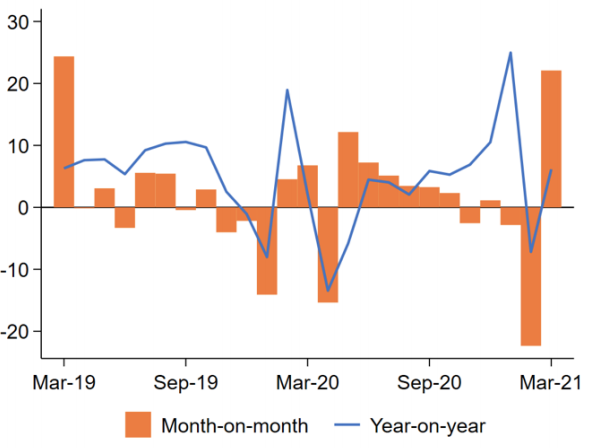
Agriculture has been enjoying steady growth (3.2% YoY in Q1) and growth in industry and construction accelerated from 5.6% YoY in Q4 2020 to 6.3% in Q1 2021. In March, industrial production rose by 6.1% YoY, as factories resumed their activities after the Tet holiday. The PMI index rose from 51.3 in February to 51.6 in March 2021.
Vietnam – Industrial Production Index (% change, NSA)
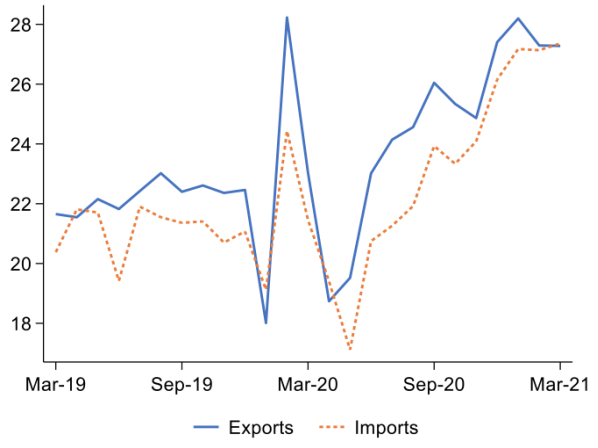
The data for merchandise trade continues to impress. Exports in March grew by 18.4% YoY, and imports by 27.5% YoY. Computers, electronics and machinery comprise about a third of total trade by value and these have been in the vanguard of growth, with exports up by 45% and imports rising by 26%. Exports of textiles and garments, and footwear have also rebounded, rising by 15.5% YoY and 19.2% YoY respectively, but exports of mobile phones fell by 19.2% YoY.
These data, however, mask a sharp difference in the performance of foreign and domestic exporters. While exports by foreign-owned firms rose by 32.1% YoY in March, exports by domestic firms fell by 10.8% YoY.
Vietnam – International Trade (USD bn, SA)
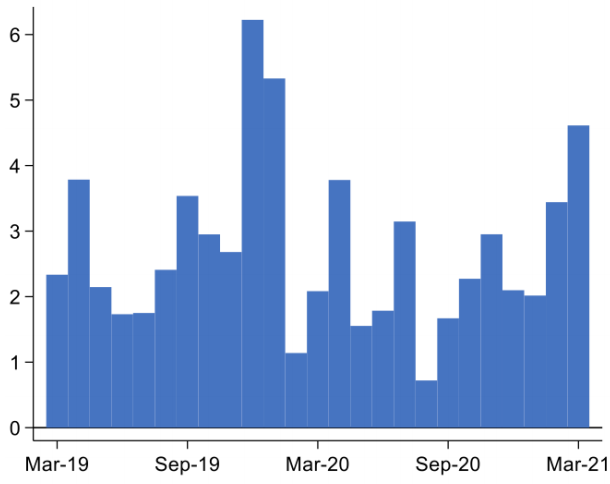
Foreign domestic investment flows have been recovering sharply. FDI in March 2021 was 34% higher than in February, which had of itself been a much stronger month. The $4.6bn total was boosted by a large investment of $3.1bn in a 3,000MW LNG power plan at Long An.
Vietnam – Foreign Direct Investment (USD bn, NSA)
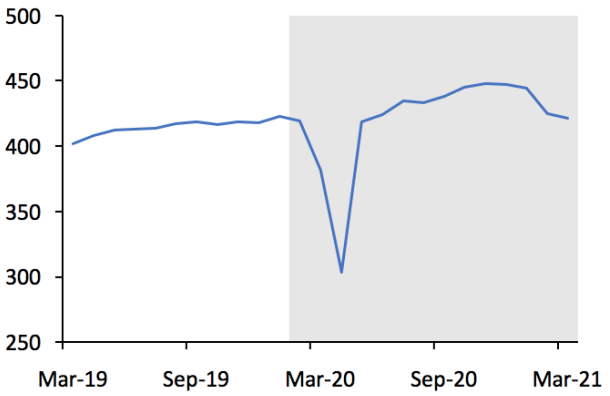
Whilst the externally oriented sectors of the economy have been performing well in response to stronger demand from the US, China and the EU, the domestic economy has been rebounding more slowly. Spending over the Tet holiday is usually strong, but this year it was impacted by February’s COVID outbreak in the north and by the measures taken to curtail its spread. Retail sales in February fell by 4.4% MoM, and they fell by a further 0.4% MoM in March. This was 10.5% higher than the level of retail sales in March 2020, but that is mostly a measure of the sharp drop in retail sales in March 2020, when the COVID pandemic first started to bite. The impact of the pandemic on tourism and domestic demand is also being reflected in slower mobility data in transport hubs and restaurants.
Vietnam – Retail Sales (VNDtrn, SA)
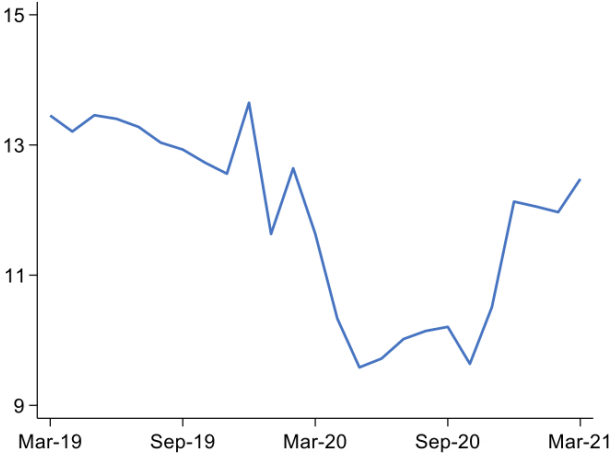
Nonetheless, as a result of the accommodative policies of the Central Bank, the growth of credit has now returned almost to the pace of growth that applied in the period before the pandemic. Credit to the economy grew by 12.5% YoY in March.
Vietnam – Credit Growth (%, YoY)
Consumer prices rose by 0.2% MoM and by 1.1% YoY, mostly as a result of the 6.9% upward adjustment in fuel prices, which reflects the rise in the cost of oil since the autumn of 2020.
With the recovery in the economy, the government now seems to have shifted policy towards a more neutral stance. In Q1 2021, collections rose by 3.2% YoY, and spending decreased by 0.4% YoY. The fiscal surplus of VND60trn, was 29% higher than in Q1 2020 and represented the first surplus since the onset of the pandemic. According to the World Bank, the implementation of public investment was in line with target. Borrowing, however, was just 39% of the expected level. Bonds were issued mostly with maturities of 10 and 15 years. The yield on 10-year bonds rose by 10bps from February’s level, to 2.3%.
In sum, according to the World Bank, the recovery in the economy is strong, but uneven, with some service sectors still being severely affected by the pandemic. As a result, domestic demand is still subdued. The World Bank has suggested that, whilst it is right for the authorities to adopt a more neutral policy stance as the recovery takes hold, they may also wish to consider additional fiscal and monetary measures to cater for the possibility that domestic demand disappoints expectations. (It mentioned that the government has been considering a tax deferral package that might be used to assist companies with working capital.)
In particular, the Bank has indicated that private demand could be strengthened by more support for individuals and families active in areas such as tourism, who are still most affected by the onset of the COVID shock. It has also suggested that the health of the financial sector needs to be carefully monitored.
The full report issued by the World Bank may be read using the following link:
http://documents1.worldbank.org/curated/en/552481618494695577/pdf/Vietnam-Macro-Monitoring.pdf
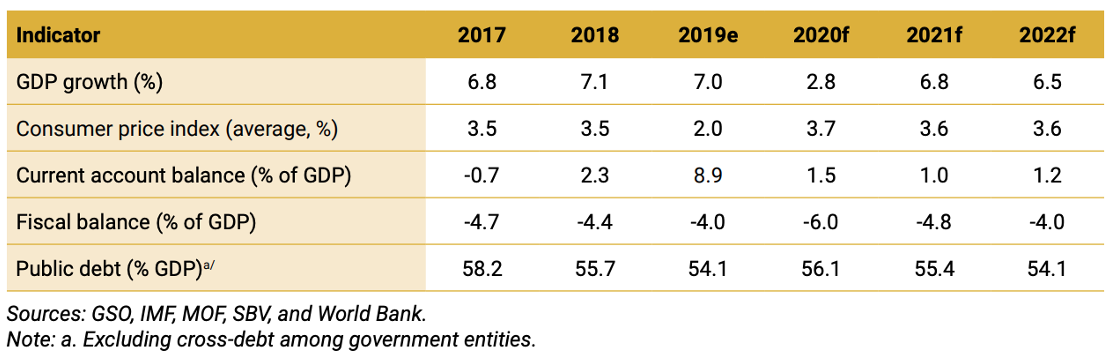
The following table is a summary of economic indicators, taken from the World Bank’s “Taking Stock” report, which was published in December 2020.
Vietnam – Selected Economic Indicators (2017-2022)