


Honoured and Dear Sir,
The spirit of enterprise which has existed for ten years past in Bengal has produced an expedition towards the southern mountains of Tartary pernicious to our influence in those parts and ruinous to ourselves. The circumstance that gave rise to it was an application for relief from the Rajah of Nepal who has been severely distressed and even shut up in his capital from time to time by his hill neighbours for these seven years past.
The force destined for the expedition was 2,400 sepoys commanded by Captain Kinloch, a Scotch gentleman entirely ignorant of the country and people. The number of officers on an expedition of this nature I suppose ought rather to have been increased than diminished; nevertheless, through Captain Kinloch’s influence the officers were reduced to the lowest number possible, and that number all Scotch and all possessed with the idea of making their fortunes in the course of the expedition.
Before the troops entered the passes, the officers were informed of the absolute necessity there was for supplying their bazar grain from the low country, and in consequence took with them, I do suppose, an ample quantity of provisions, the major part of which on the second or third day’s march was unhappily destroyed by a sudden torrent from the hills. Yet in despite of such misfortune the troops continued their march and penetrated to the last difficult pass in the enemy’s country; but, as no means had been used to introduce provisions to the camp from the low country, – at least no provisions had been introduced –, the soldiers here experienced all the extremity of want.
Four entire companies deserted to the enemy in consequence, whilst the parties straggling about in search of provisions were in general cut off. A retreat was therefore determined on and effected without opposition from the enemy. The troops returned are in number about 800.
The miscarriage of this expedition may be assigned to one cause, the too great confidence of overcoming difficulties as soon as encountered, grounded on a mean opinion of the courage of the nations to which our arms are opposed.
(Richard Barwell to his father, 28 February 1768.)[1]
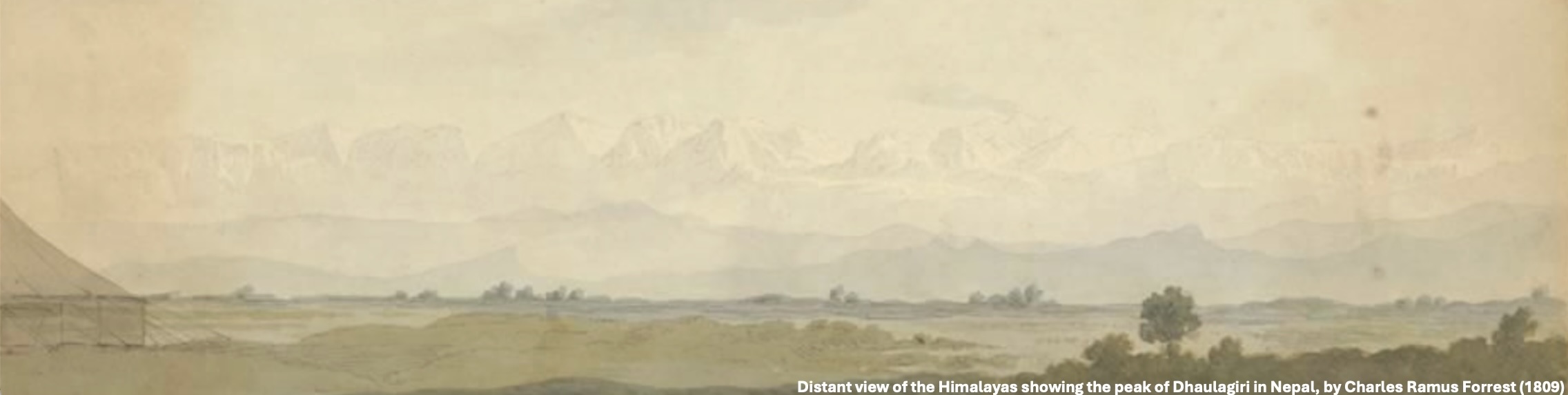
The Expedition to Nepal of Captain George Kinloch
The East India Company and Prithvi Narayan Shah (1760-1775)
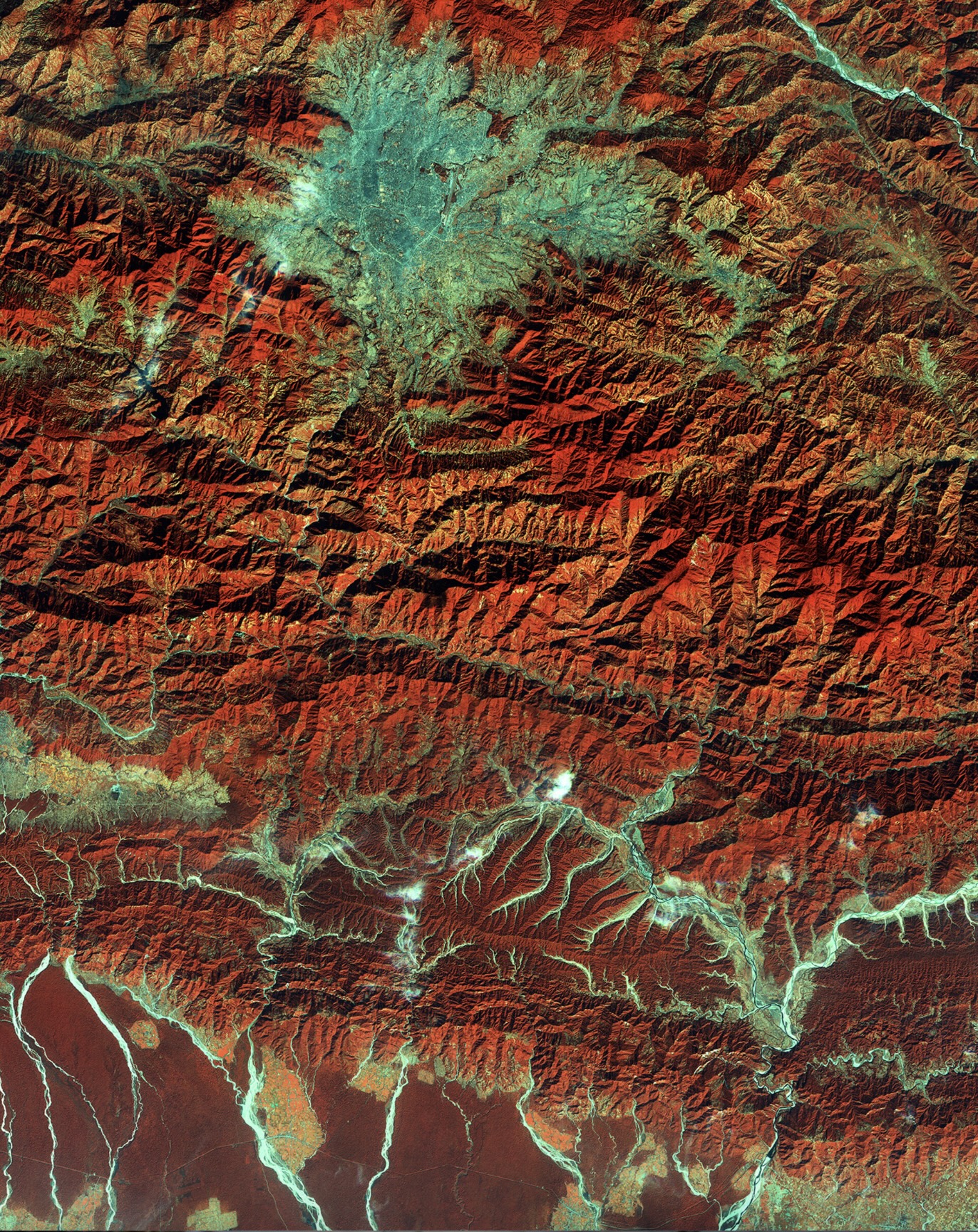 A satellite photograph of Nepal. Kathmandu shows as the large area in blue.
Fissures in the valleys and river systems cutting through the east-west strike of the mountains make travel difficult, and helped to ensure that Nepal was politically fragmented for most of its history before the emergence of the Gorkha Raja, Prithvi Narayan Shah (r.1768-1775).
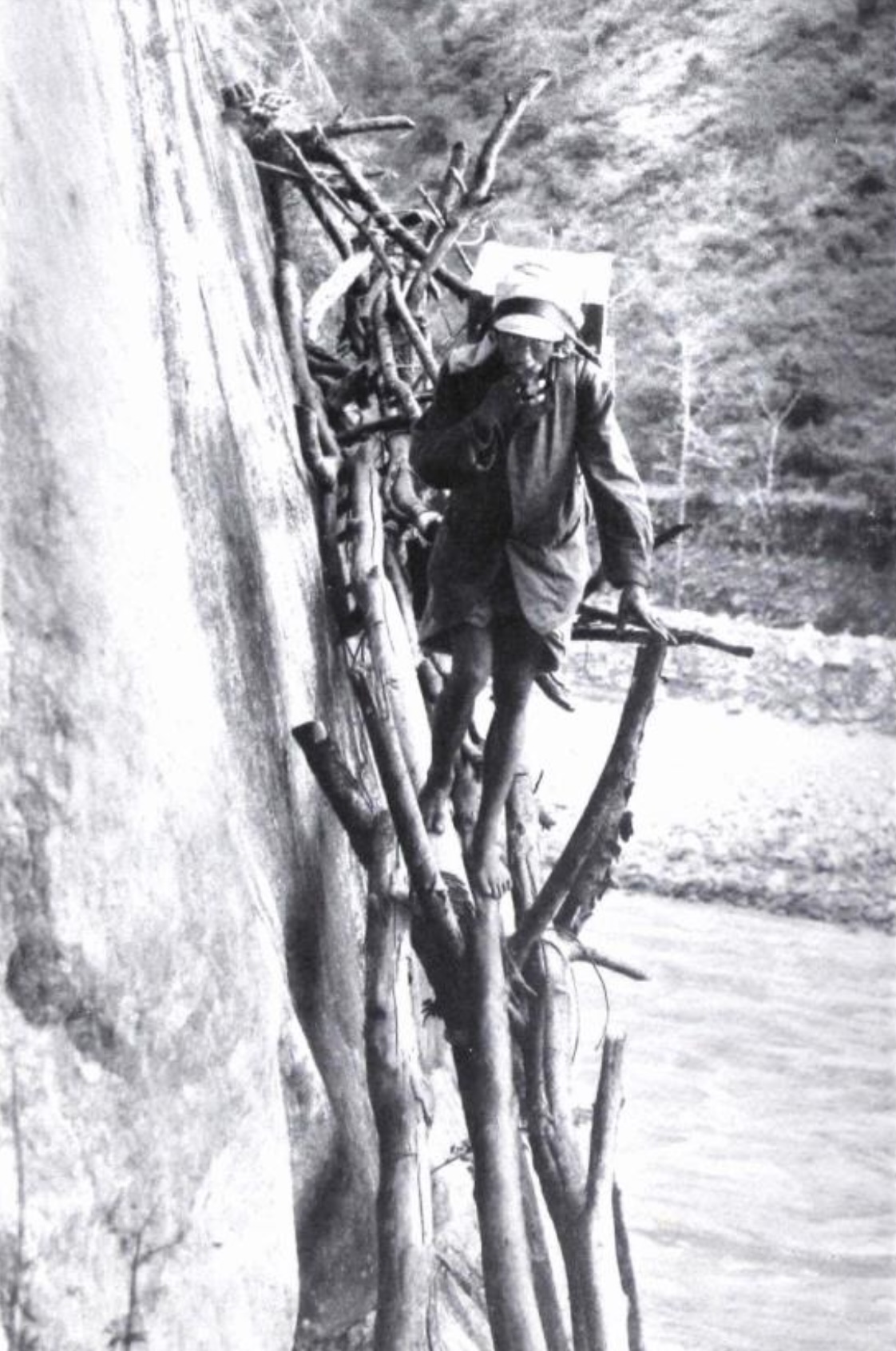 An indication of the difficulties of travel away from Nepal’s central valleys.
This picture, from Toni Hagen, Nepal, The Kingdom in the Himalayas (Oxford, 1961), shows a villager in a ‘much-frequented’ eastern trade route in the Arun Valley.
Hagen writes, ‘For a distance of about 100km, this valley provides the only possibility to cross the highest barrier of the Himalayas. The condition of the roads, however, beggars all description. Only thin tree-trunks leaning against the bare face of the rock make it possible to pass along the sheer, smooth, water-worn walls. The ‘footbridge’ consists of planks laid loosely upon the forks of trees and branches, which lean against the wall of rock so steeply, and without being fastened in any way, that it is touch and go whether the whole flimsy structure can keep its balance.’
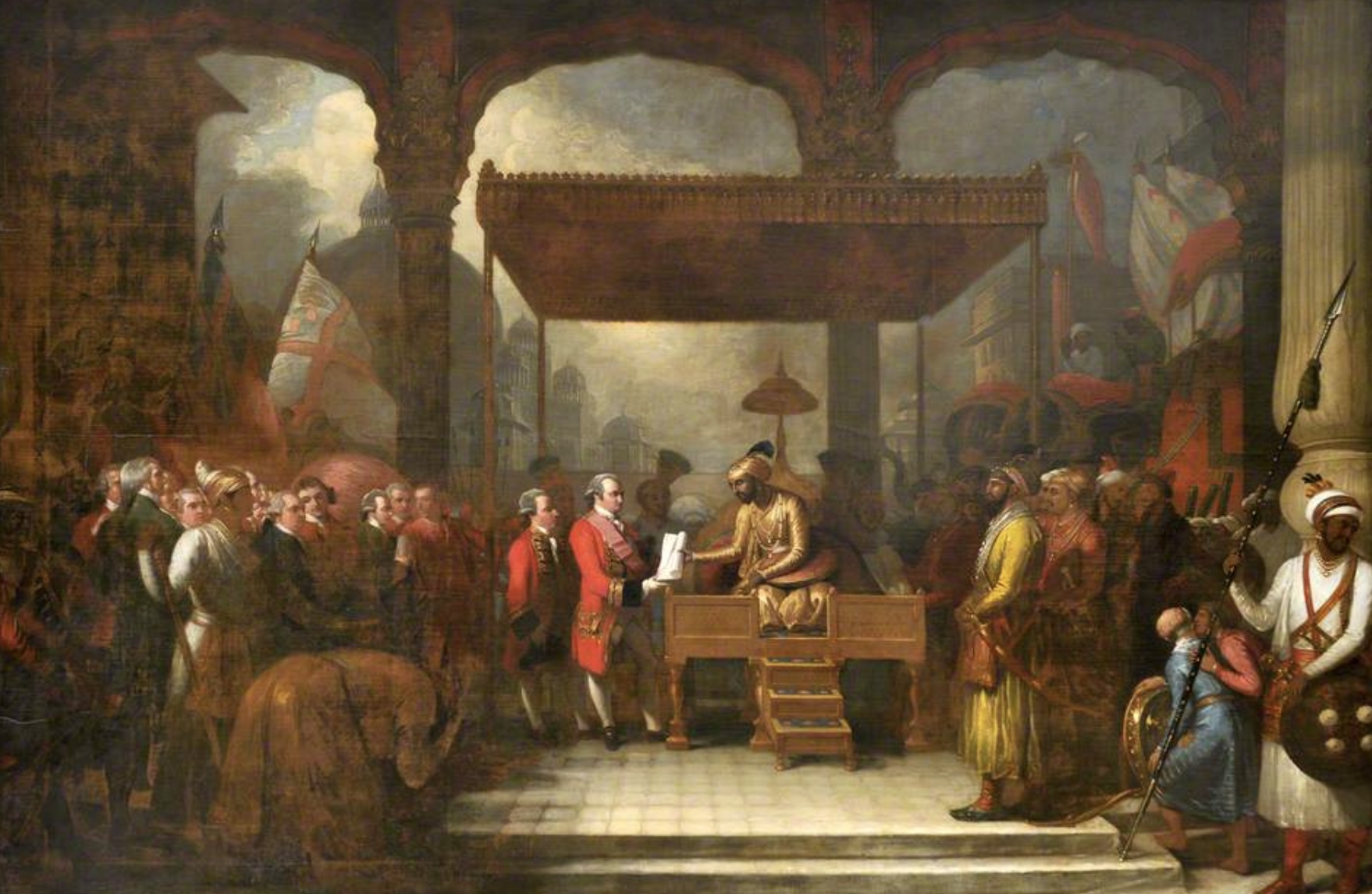 Benjamin West’s painting of Robert Clive receiving the diwani of Bengal, Bihar and Orissa from Shah Alam, on 12 August 1765. (British Library)
Writing to the Company’s directors, Clive reported an event ‘which … must be productive of advantages hitherto unknown.’ He forecast a gain to the Company of £1,650,900 during the coming year, which would finance the ‘investment’, the China trade, the demands of the other settlements, and leave a positive balance. In practice, he overestimated the Company’s revenues and he underestimated their expenses. Within a few years, they were brought close to ruin.
The introduction of the ‘Dual System’, by which the Company enjoyed the revenues and the power in Bengal, and the Nawab was left responsible for administration, has been much criticised. In a sense, it was unavoidable, because the Company lacked people with the experience necessary to administer a region so large. It also reflected the previous Moghul system, in which zemindars (tenants-in-chief) paid rents to the state and collected rents from the peasants. Nevertheless, the Company’s men aggravated the system’s weaknesses by demanding more – partly because of Clive’s sanguine estimates – and supervising less. They used their supremacy to monopolise the country’s manufactures and trade, supplanting merchants of long standing with agents of their own, who became notorious for their oppression. Clive complained that they swarmed ‘like so many bees,’ but he was powerless to do much before the fearful famine of 1769-1770 struck.
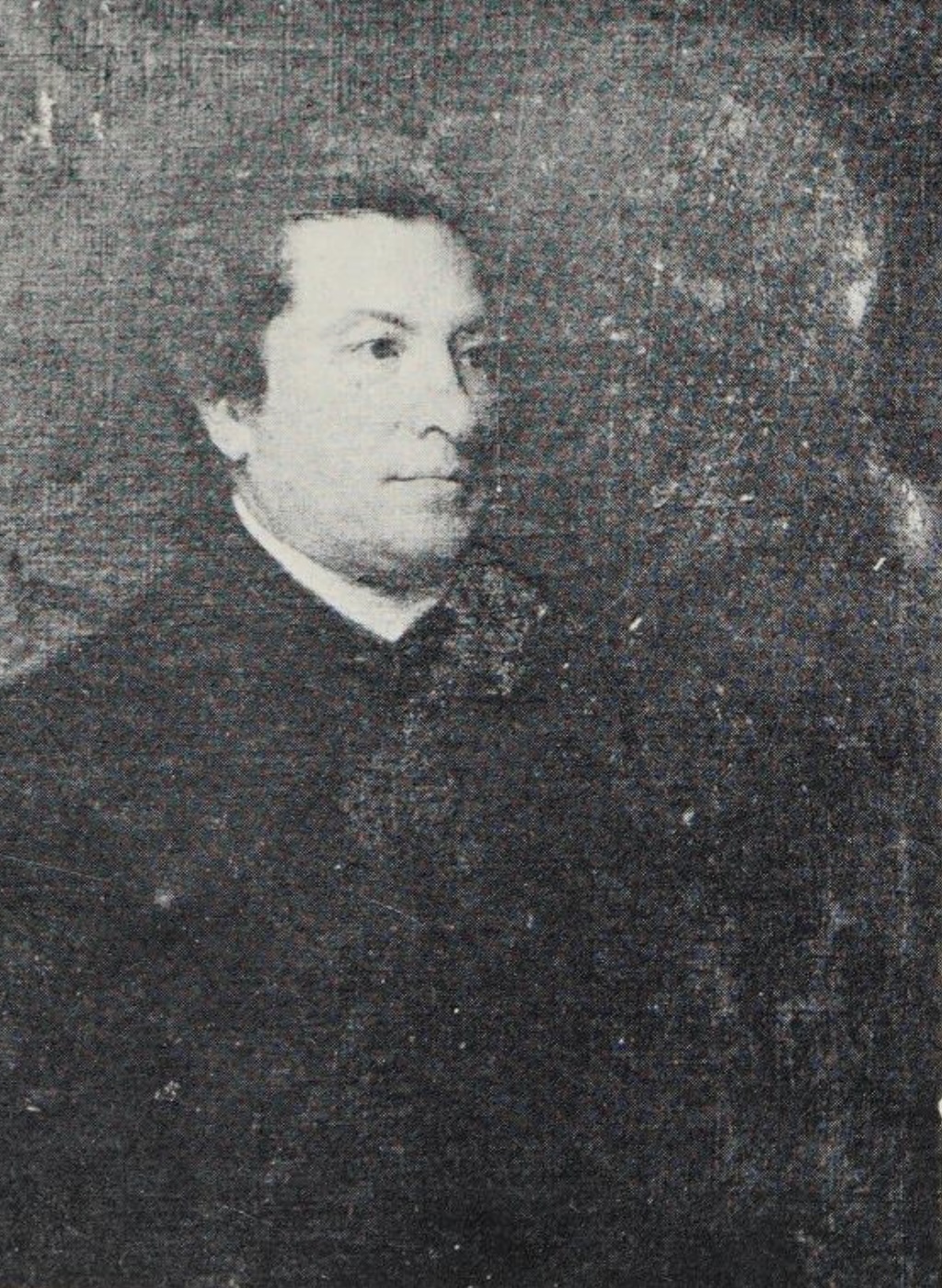 Harry Vereslt, governor of Bengal (1767-1769). From Mark Bence-Jones, Clive of India (Constable, 1974), on Archive.org.
Edmund Burke, no mean critic of the Company, described Verelst as ‘one of the honestest men’ ever to have served it, but his record was patchy, and Clive judged him ‘too lenient’ an administrator. Verelst was president of the Calcutta council at the time of George Kinloch’s expedition. James Logan’s proposal for a follow up mission was addressed to him, in August 1769.
Verelst joined the Company as a writer, in 1749, at the age of just fifteen, thereafter serving as chief in Lakshmipur, Nadia and Burdwan (1757-1759). After taking his seat in the council, in February 1760, he was appointed chief at Chittagong, which had been ceded to the Company by Mir Qasim that year. There, together with his associates, Thomas Rumbold and Randolph Marriott, he ran a commercial venture trading with Arakan in Burma, especially in salt produced on the island of Sandwip. They set up their own shipyard, near Bakarganj, and owned several country ships in an entity which traded on a capital of £30,000 by 1763.
In 1765, Verelst returned from Chittagong to take up his seat in the select committee during Clive’s second governorship. He succeeded to the governorship, in January 1767. Verelst identified the need to reform the government of Bengal, but ended by adhering to Clive’s ‘Dual System’, despite his better judgement. His attempts to suppress corruption among the Company’s servants failed because he lacked his predecessor’s power and authority.
After he returned to Britain, in 1770, Verelst was subjected to a sustained attack by William Bolts, a Company employee whom he had deported for misconduct, in 1768. In time, he was ordered to pay £9,700 in damages to two Armenians who had worked as Bolt’s agents and claimed to have been imprisoned unlawfully. Although he was later compensated by the Company, the fine fell at a time when Verelst’s finances were pressured by his purchase of the Aston estate, near Sheffield, and the Bengal famine. In 1775, Verelst’s secretary travelled to Bengal to collect his belongings, but he died on his journey home overland, and all of Verelst’s papers and possessions were lost in the desert. By this time, Verelst was heavily in debt. He left Britain for the continent, to escape his creditors, and died in Boulogne, in October 1785.
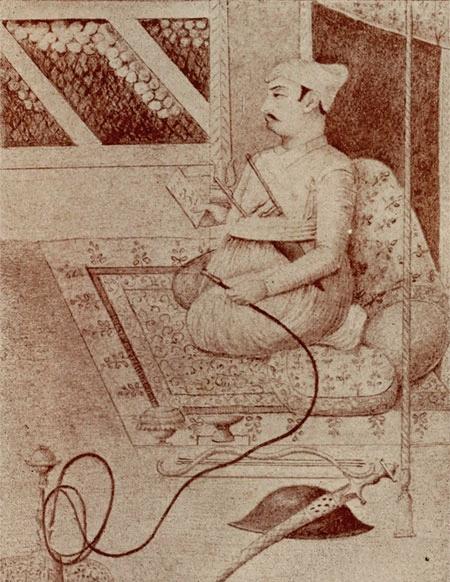 Mir Qasim was installed by the Company as the Nawab of Bengal, in 1760. In this role, he replaced his father-in-law, Mir Jafar, who had supported the Company at the Battle of Plassey (1757), but afterwards fell from favour. Qasim also fell out with the British, particularly with William Ellis, the Patna factory chief, who in Warren Hastings’ words, exposed the nawab to ‘daily affronts such as a spirit superior to a worm when trodden on could not have brooked.’ In 1763, Ellis and numerous others were killed, on Qasim’s orders, in the ‘massacre’ of Patna.
That same year, Qasim led an invasion of Nepal. He did so at the urging of the chief minister of Makwanpur, after the Gorkha Raja, Prithvi Narayan Shah, had invaded and captured its king. Qasim was attracted by Nepal’s reputed wealth in gold, which promised compensation for the revenues lost to the Company’s officers, as well as by a desire to test the mettle of his newly organised army. (He anticipated a struggle with the British.) Like George Kinloch, he underestimated the quality of his opponents and the difficulty of campaigning in the hills. After a fierce fight, his troops succeeded in driving the Gorkha forces from the Makwanpur Pass, but they were caught in a surprise attack as they rested at night, and their victory became a rout.
In 1764, Mir Qasim’s army suffered a second defeat at the Battle of Buxar, after which the Company became the pre-eminent power in Bengal. The nawab died in obscure poverty near Delhi, in 1777.
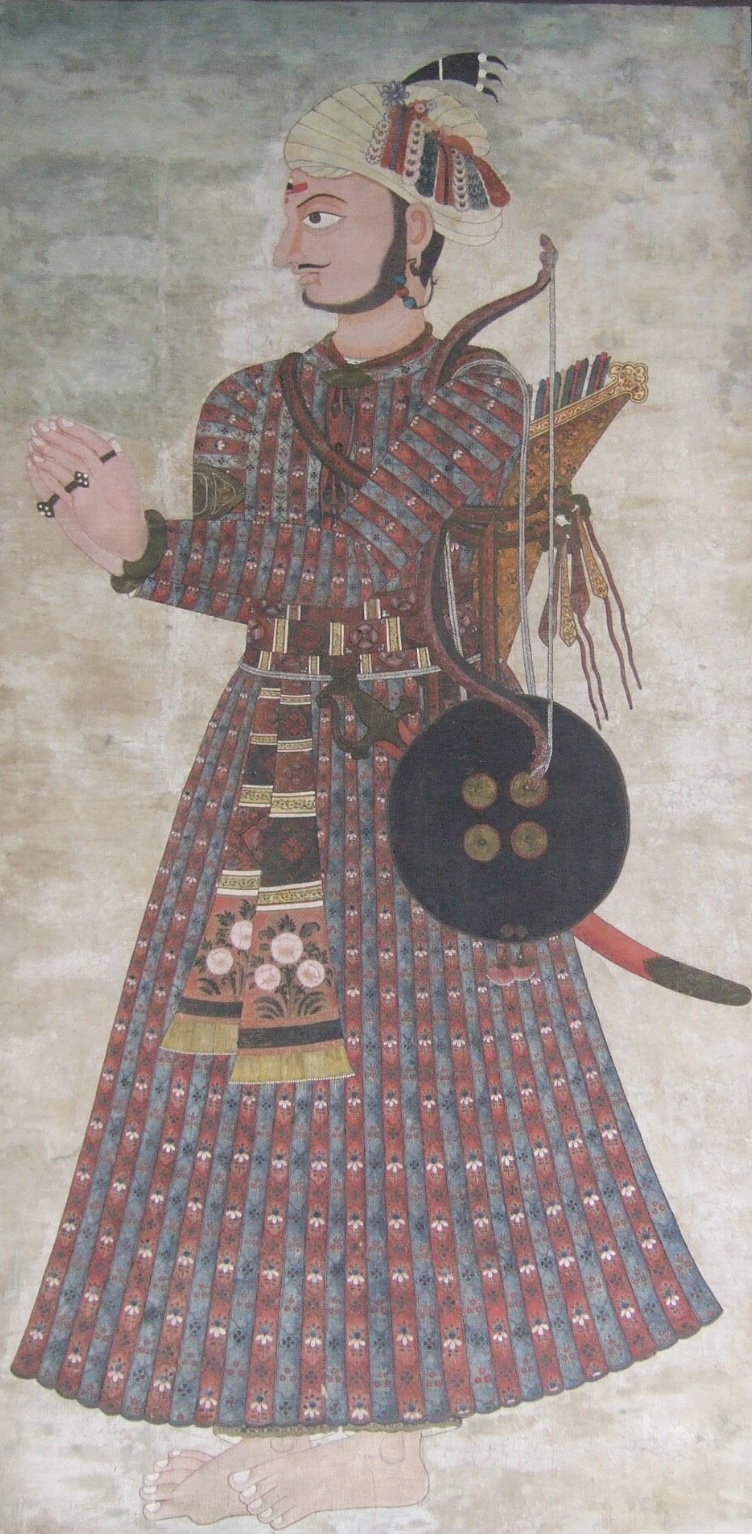 Portrait of Jaya Prakash Malla, the last Newar king of Kathmandu, in the National Museum of Nepal. Photo by Clemens Marabu at English Wikimedia.
In 1737, Jaya Prakash successfully repelled an attack on the fortress of Nuwakot by the Gorkha ruler, Nara Bhupal Shah. However, Nara Bhupal’s son was a determined opponent and Jaya Prakash’s defence of the Kathmandu Valley was made difficult by a quarrel involving Ranajit Malla, chief of Bhatgaon, who invoked Gorkha support. Ranajit later repented of his error, but too late to permit Jaya Prakash to repel the onslaught of the Gorkhas without external help.
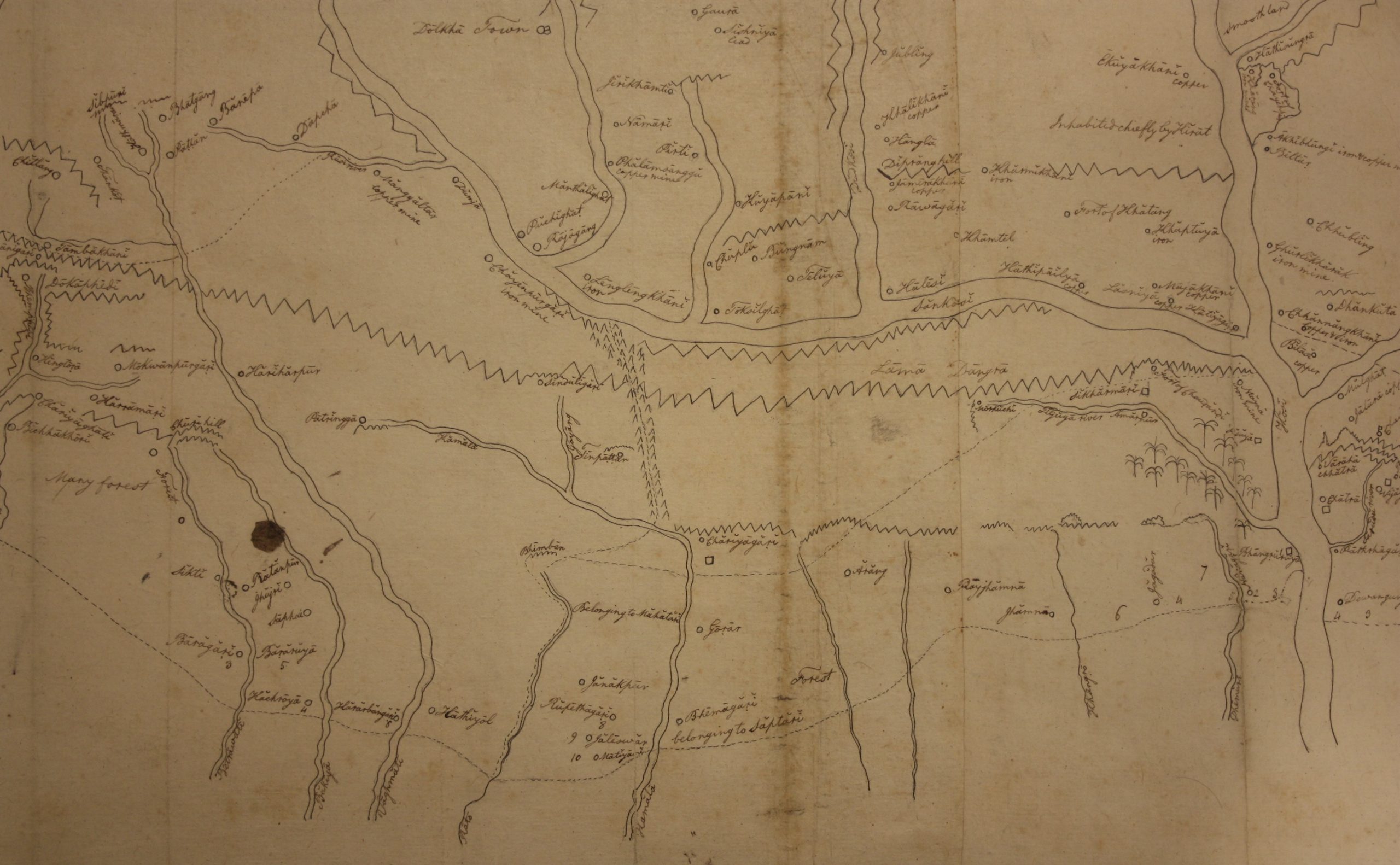 Detail of one of a series of maps prepared for Francis Buchanan-Hamilton, in 1802-1803. (Ref: British Library, Mss Eur D97, f.6).
Kathmandu, Patan and Bhatgaon appear at top left, in a fork of the upper Bagmati River. The Kosi River appears on the right, flowing from top to bottom, with the Sun Kosi flowing into it from the west. Hariharpur is marked beside the Bagmati a little above centre on the left, with Sindhuli Gadhi in the range of mountains running west to east, a little to Hariharpur’s right.
Charles Crawford accompanied the surgeon and naturalist Francis Buchanan-Hamilton on his expedition to Nepal, and prepared three maps; one of the Kathmandu Valley, now in the possession of the Linnaean Society of London, and two other, simpler ones showing the route into Nepal from Bettiah, and the limits of the ‘Dominions of the Gorkha.’ In the preface to his published account (1819), Hamilton acknowledged the debt he owed in the preparation of the maps to Crawford, later the Surveyor-General of Bengal, as well as to several local sources, including a Kirat chief, a brahmin, and a slave of the Gorkha Raja, who had been a source of information on plants ‘from the alpine regions.’
In August 1814, Hamilton wrote to John Adams, Secretary to the Government, to provide (upon request) ‘such information as I could give relative to Nepal, especially in a military point of view.’ His letter, published in Papers Respecting the Nepaul War (1824, pp.37-46), refers to two accompanying maps, ‘executed entirely by different natives, [which] although exceedingly rude, will upon careful examination … convey a good deal of light on the political state of the country.’ Evidently, these were the maps he referred to later in his book, and this is one of them. In September 1814, Adam acknowledged Hamilton’s help which, he wrote, had proven to be ‘of the greatest utility, in framing the system of operations to be undertaken against the Nepalese.’
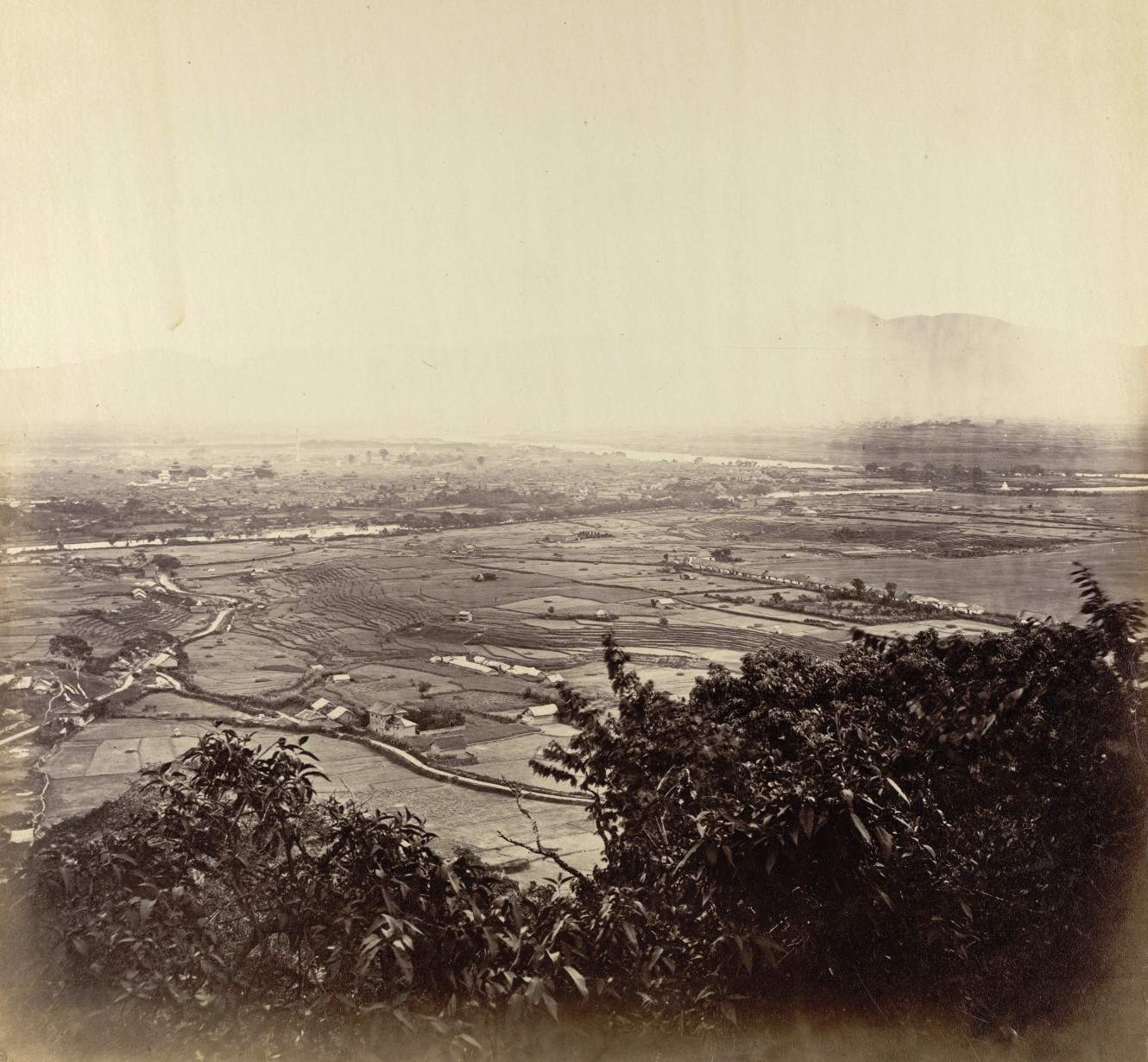 View of the Valley and City of Khatmandoo from the Hill of Sumbhoonath, by Clarence Comyn Taylor (1863). (Ref: British Library, Photo 855/14).
According to Swayambhu Purana, the Bodhisattva Manjushri was inspired by the appearance of a radiant light emitted by lotus flowers on the lake covering the valley, to cleave its southern rim with his sword. By draining the valley of its waters, he rendered it habitable and so suitable for the propagation of religion.
Later, the Bodhisattva Vajrasattva concealed under a stone slab the ‘self-manifest’ light which had guided Manjushri, to protect it from an ‘age of degeneracy’. In time, the monk Shantikara Acharya, a Bengali prince who had renounced his throne, raised the great stupa at Swayambhunath over the hidden flame.
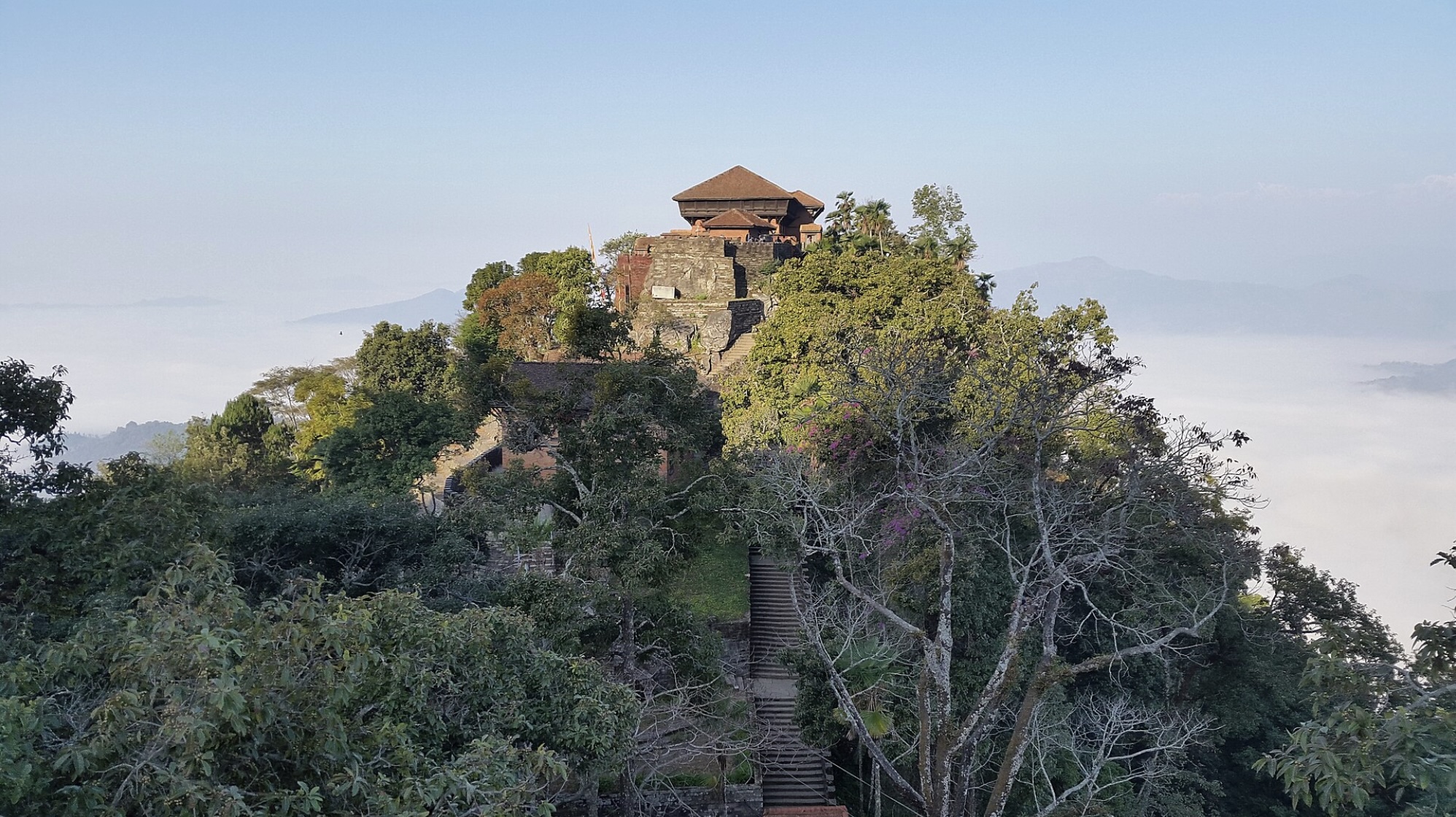 Photograph of the Gorkha Palace Durbar by Anuj Devkota. (Source: Wikimedia Creative Commons)
Gorkha is a district of the Gandaki province of Nepal, about seventy-five miles north-west of Kathmandu. It is the birthplace of Prithvi Narayan Shah, son of Nara Bhupal Shah and the founding monarch of the unified kingdom of Nepal.
If the account in Dibya Upadesh, understood to be Prithvi Narayan’s own, is to be believed, the Gorkha Raja conceived his ambition to conquer the Kathmandu Valley on first sighting it during journey to Makwanpur, to claim his bride. That was in around 1740. He began with the capture of Nuwakot, in 1744, but relative to Kathmandu, which enjoyed the advantages of richer agriculture and trade, his resources were modest. Prithvi Narayan therefore took a deliberate approach over many years. In 1762, after he had consolidated his hold on districts in the west, he started to blockade the Valley. After the capture of Kirtipur, in 1765, his grip progressively tightened. By the end of 1766, Kathmandu’s position had become desperate and, in early 1767, Jaya Prakash Malla turned to the Company for help.
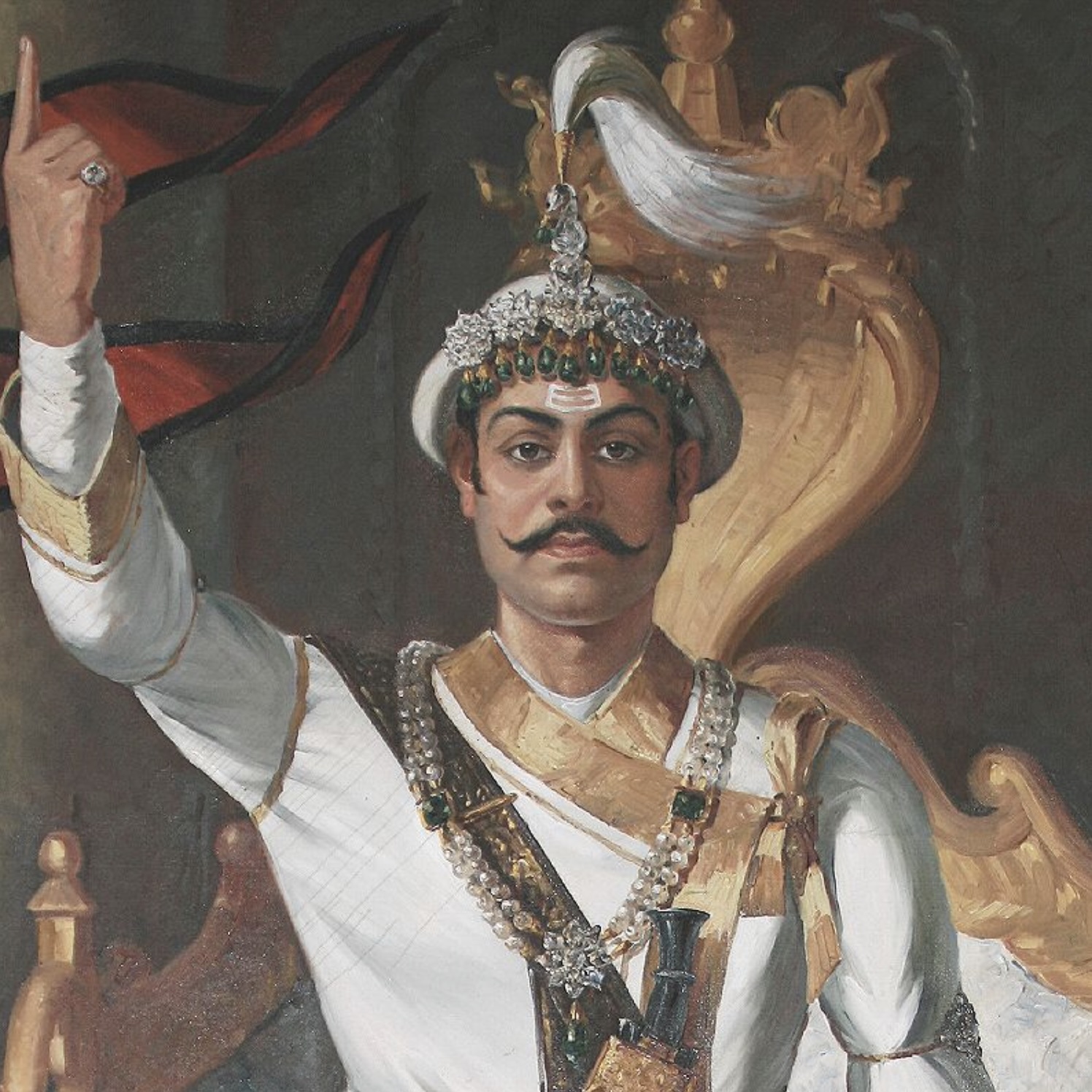 Detail of a portrait of Prithvi Narayan Shah commissioned by King Mahendra in the 1960s. One of the paintings of the Shah monarchs by Amar Chitrakar in the National Museum of Nepal. (Wikimedia Commons.)
The king’s raised index finger is intended to signal national unity under the refrain, ek raja, ek bhes, ek bhasa, ek desh (‘one king, one dress, one language, one country’).
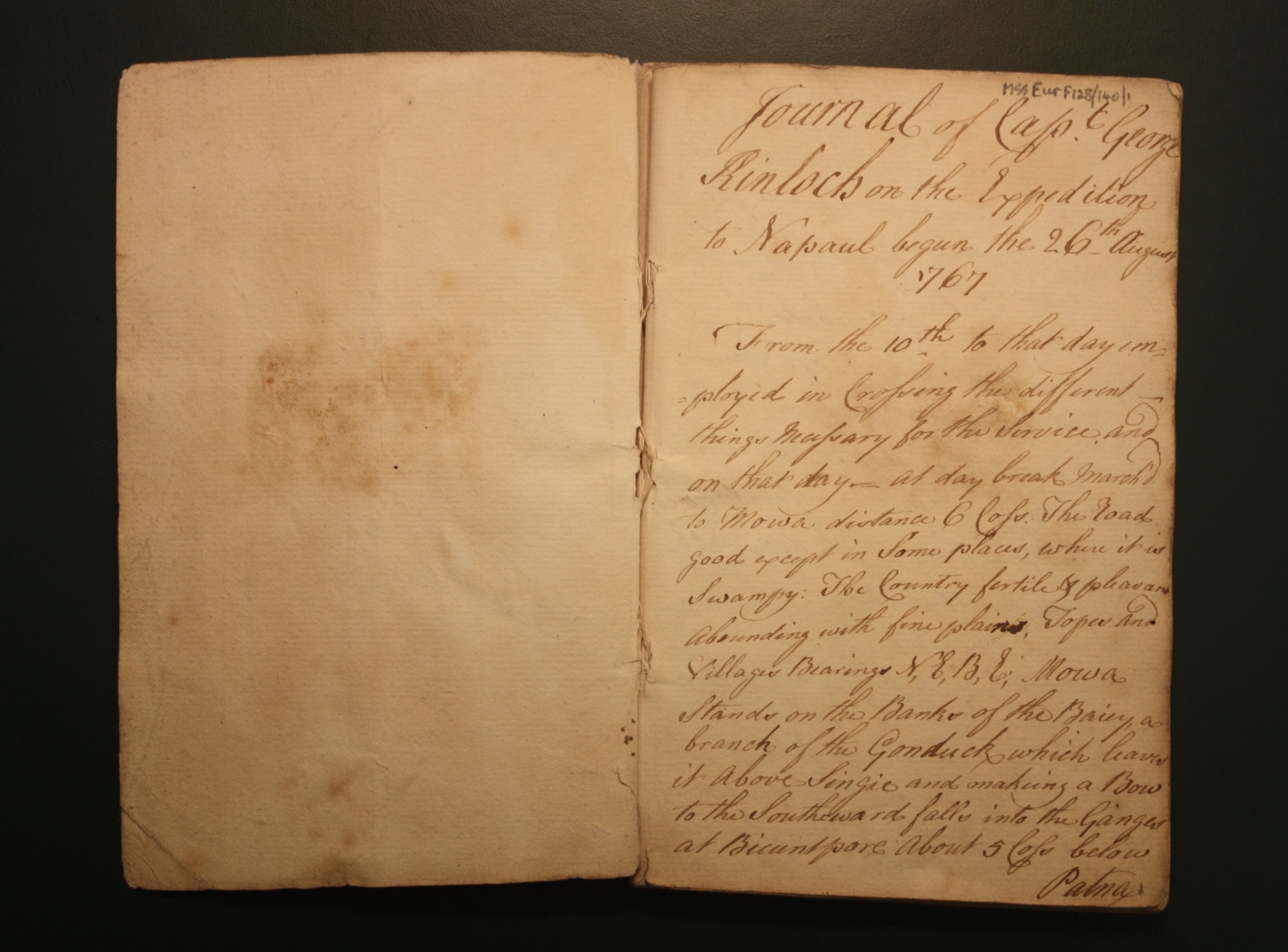 The opening entry in Captain George Kinloch’s Journal, 26 August 1767. (British Library, Mss Eur F128/140).
Prior to his departure, Kinloch had reported the advice of Jaya Prakash’s vakils that, despite the onset of the rainy season, there would be no impediment to reaching Nepal for ‘a month or three weeks since.’ Thereafter, they warned, the rains caused ‘an immense growth of jungle which almost chokes up the road.’ These remarks were presented to the Bengal Select Committee, on 21 July. Kinloch set off a full five weeks later, when the monsoon was already fully developed.
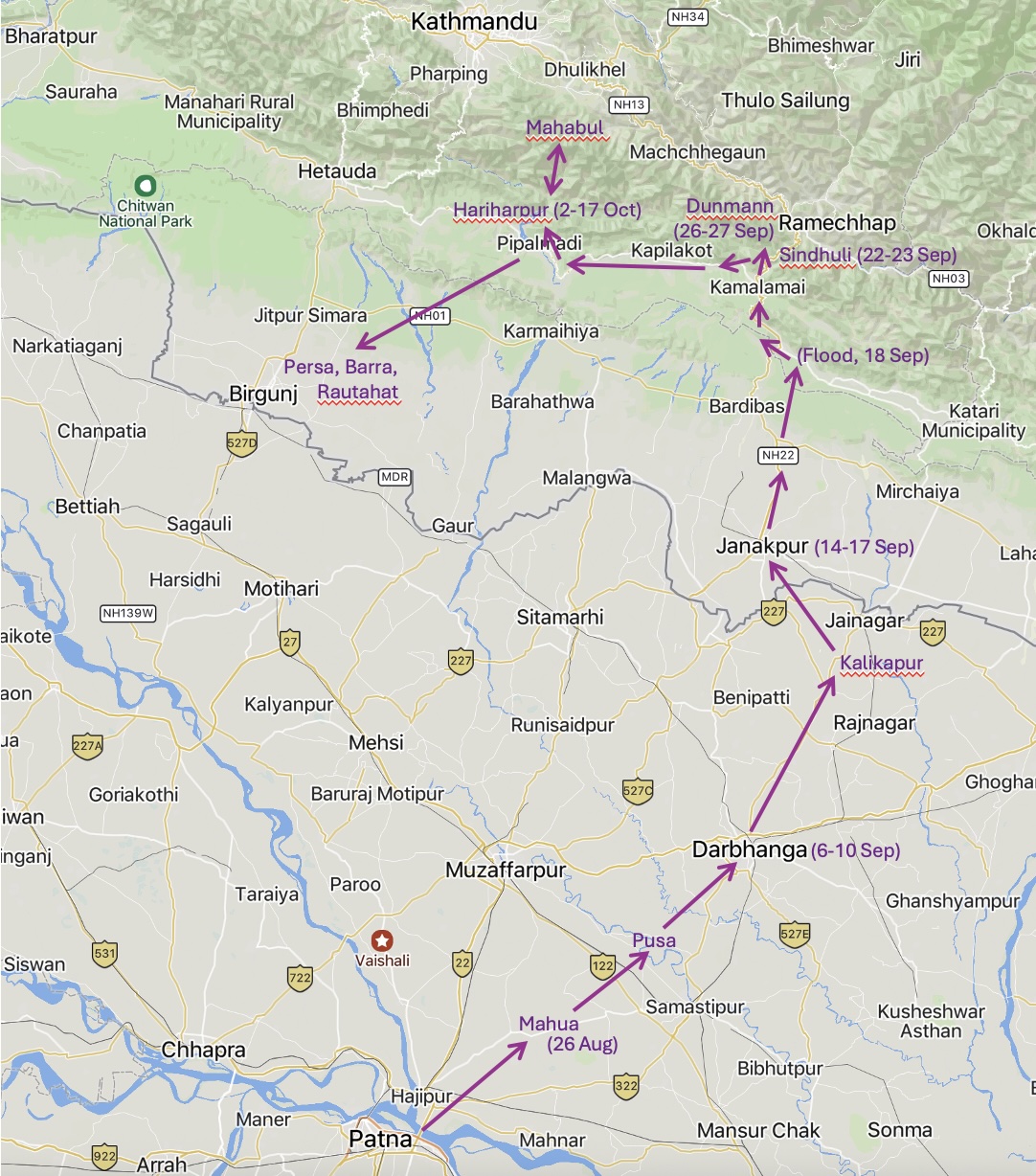 Track of George Kinloch’s expedition to Nepal, 26 August to 17 October 1767.
Alongside the problems of the monsoon, Kinloch found that the local population, which might have assisted him, withdrew in the face of his advance. Dealing with the cannon was another challenge. The journey to Janakpur (100 miles on today’s roads) took 18 days, and Kinloch did not arrive until 14 September.
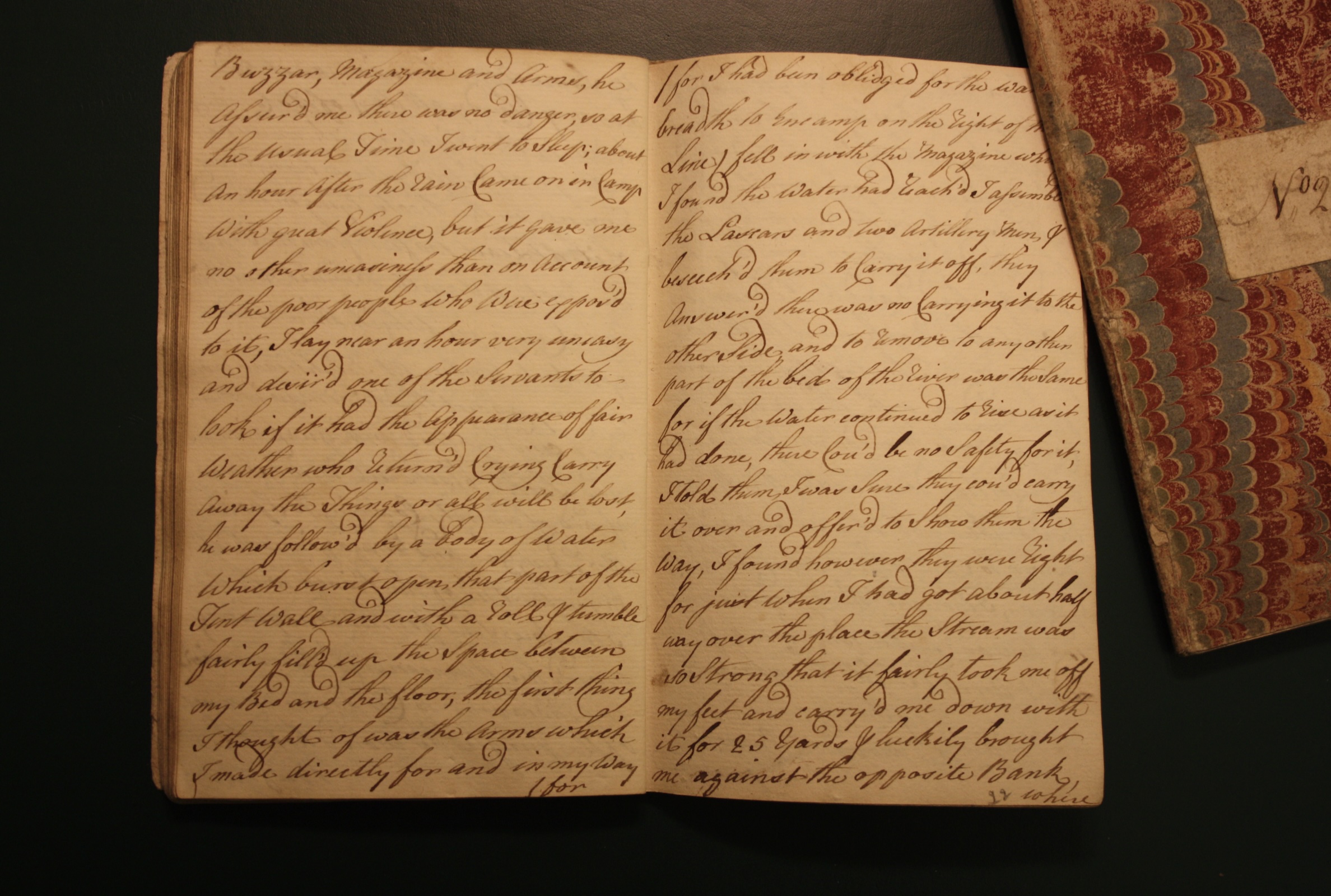 Two more pages from Kinloch’s Journal, describing the destruction of his camp by an inundation of the river, probably near Bhiman, on the night of 18 September 1767.
… at the usual time I went to sleep; about an hour after the rain came on in camp with great violence, but it gave me no other uneasiness than on account of the poor people who were expos’d to it; I lay near an hour very uneasy and desir’d one of the servants to look if it had the appearance of fair weather who retun’d crying carry away the things or all will be lost, he was follw’d by a body of water which burst open that part of the tent wall and with a roll & tumble fairly fill’d up the space between my bed and the floor; the first thing I thought of was the arms which I made directly for and in my way (for I had been obliged for the want of breadth to encamp on the right of the line) fell in with the magazine which I found the water had reach’d. I assembled the lascars and two artillery men & beseech’d them to carry it off, they answer’d there was no carrying it to the other side, and to remove to any other part of the bed of the river was the same for if the water continued to rise as it had done, there cou’d be no safety for it; I told them I was sure they cou’d carry it over and offer’d to show them the way. I found however they were right for just when I had got about half way over the place the stream was so strong that it fairly took me off my feet and carry’d me down with it for 25 yards & luckily brought me against the opposite bank …
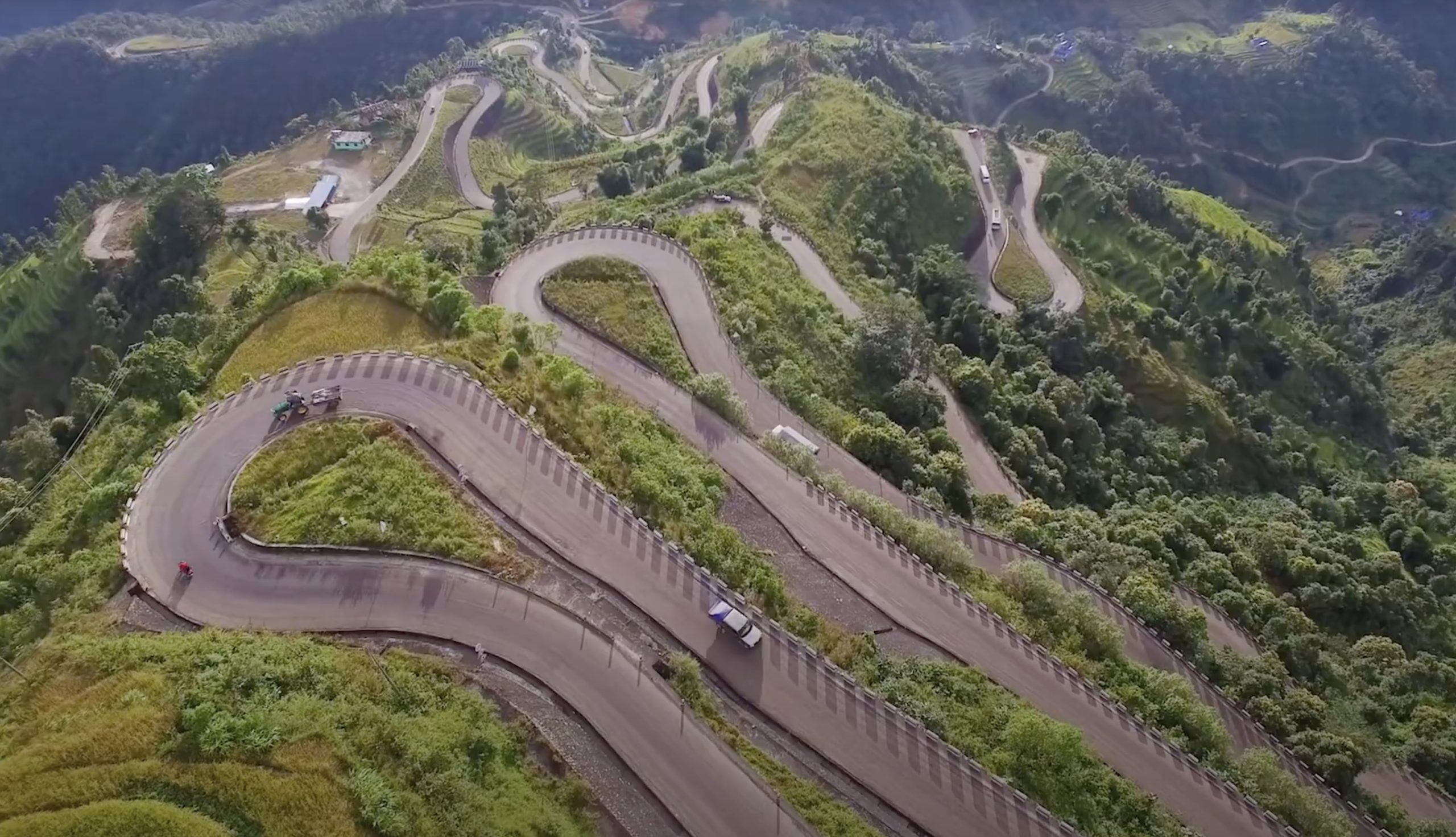 A photograph of the BP Highway at Sindhuli Gadhi, giving an idea of the terrain Kinloch’s force had to deal with.
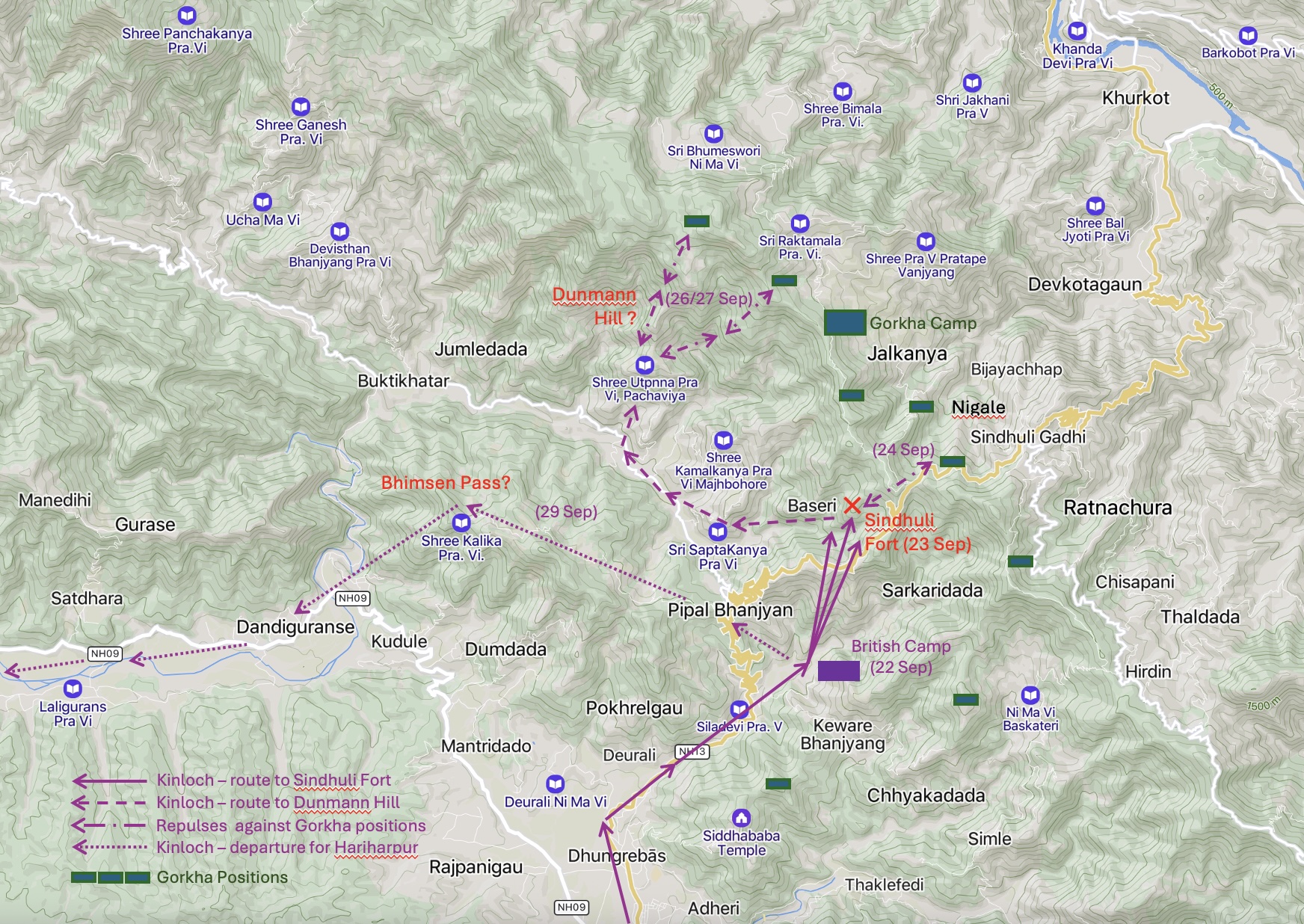 An attempt to suggest how the engagement at Sindhuli may have unfolded between 22 and 29 September 1767.
This interpretation, which is by no means certain, relies principally on a reading of Kinloch’s diary. However, we know from Nepali sources that the Gorkhas established a rearguard somewhere between Sindhuli Fort and Khurkot. Gorkha positions were also established in the hills behind the British camp, in the direction of Dhungrebas.
Kinloch says that he approached Sindhuli along the bed of a river, and that, on 22 September, he encamped on a large plain in sight of the fort and mountain. That suggests he halted on the south-eastern side of the mountain. The climb to the fort will have been about 800 metres (2,600ft.), from 650m to 1,450m.
From Sindhuli Fort, the most direct way to Khurkot was north-east, and this may have been the way the British attempted (and failed) to force the Gorkha positions on the night of 24 September. However, the land falls away on both sides of the road quite precipitately, which will have made the Gorkha position easier to defend. The British may have struck in a more northerly direction, along the line of a ridge running north-west to south-east, which another, smaller road follows before descending to Benighat upstream of Khurkot on the Sun Kosi.
Identifying Dunmann Hill, the scene of the repulses on 26 and 27 September, is problematic. Kinloch says he approached it along a river full of large stones. This suggests he travelled towards Jumledada to join Hardy and Osborn, and that they had previously tried to force Gorkha positions on the ridge above them, to the north-east.
Kinloch indicates that, on 27 September, he travelled ‘6 coss. Bearing N&b.E.’ It is clear he returned to camp that night. 6 coss is about 11 miles, and Jumledada is about 6 miles from the British camp – about the right distance, provided Kinloch had the return trip in mind. Still, identifying a line of attack from Jumledada which fits Kinloch’s description of the view towards the Gorkha positions is difficult.
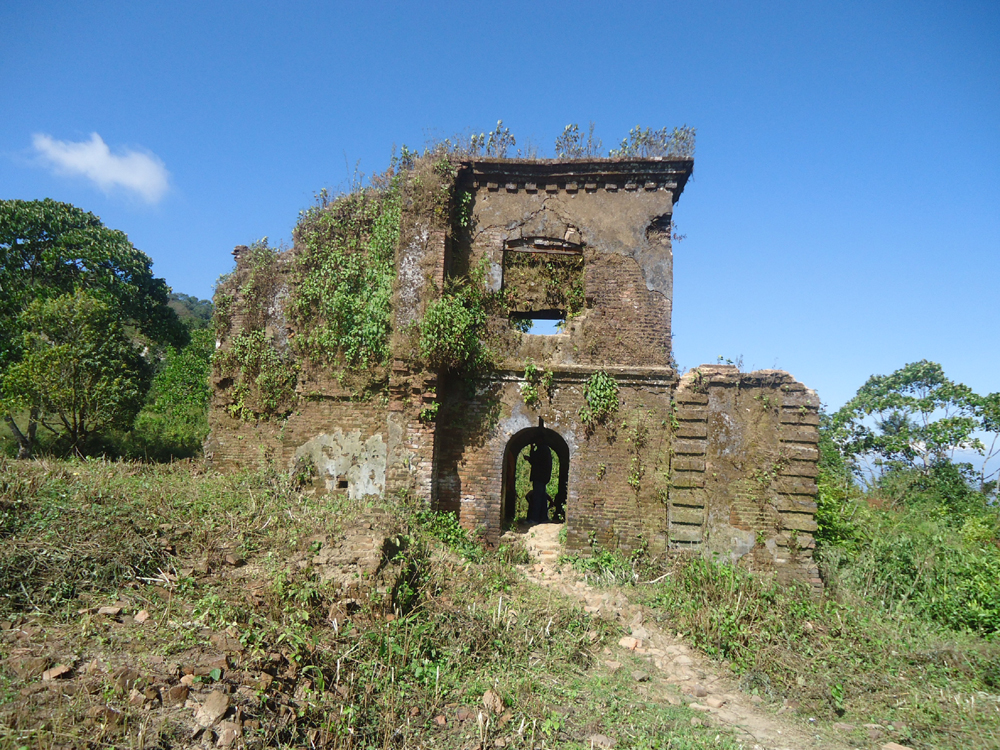 The ruins of the fort at Sindhuli Gadhi. (Photo by Krish Dulal, via Wikimedia Commons).
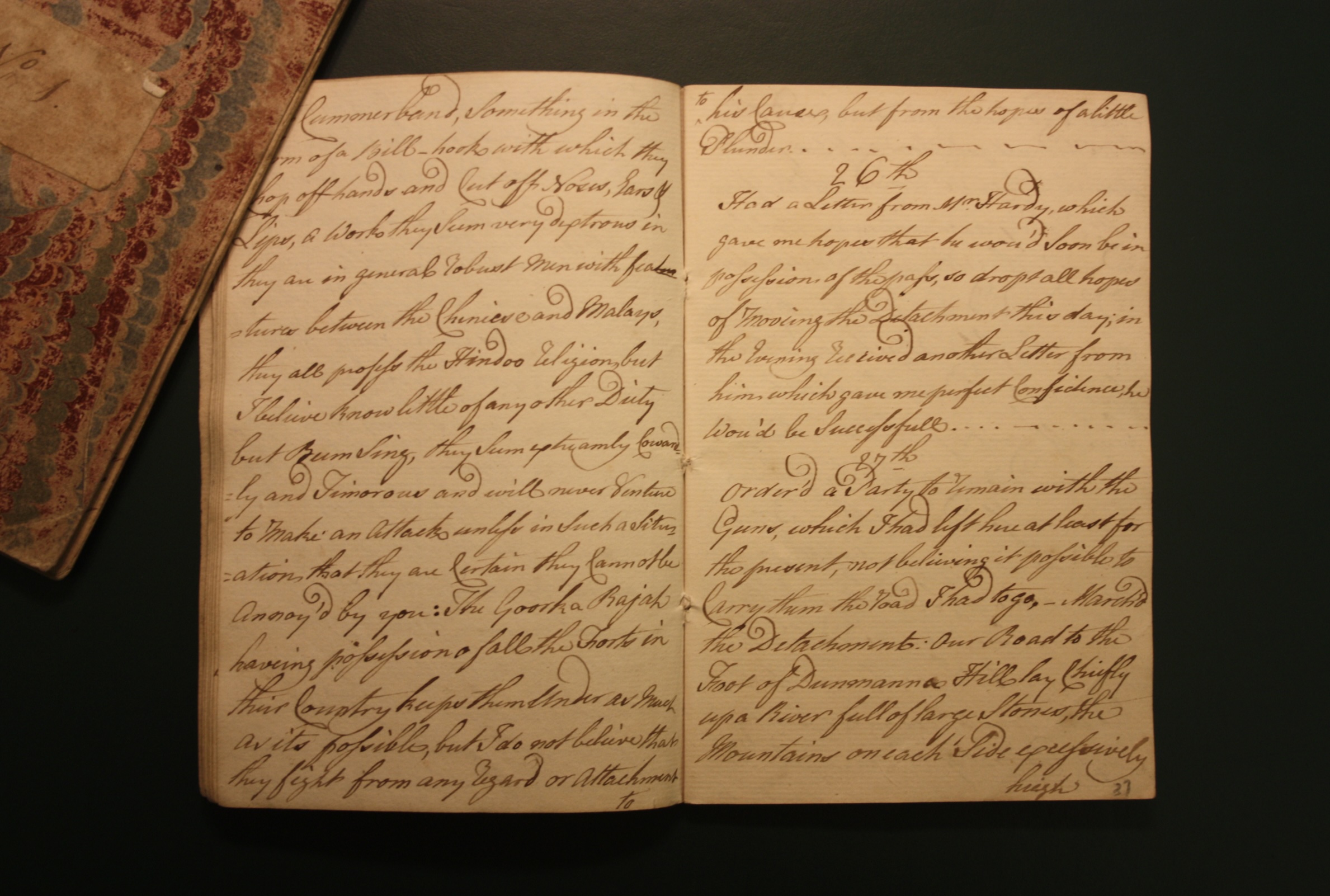 Kinloch’s diary entry for 26 September, where, after the first supplies had reached Sindhuli from Janakpur, he ruminates on the character of his Nepali opponents.
[They have … a knife which they wear in their] cummerbund, something in the form of a bill-hook with which they chop off hands and cut off noses, ears & lips, a work they seem very dextrous in; they are in general robust men with features between the Chinese and Malays, they all profess the Hindoo religion, but I believe know little of any other Deity but Beem Sing; they seem extremely cowardly and timorous and will never venture to make an attack unless in such a situation that they are certain they cannot be annoy’d by you: The Goorka Rajah having possession of all the forts in their country keeps them under as much as its possible, but I do not believe that they fight from any regard or attachment to his cause, but from hopes of a little plunder …
Kinloch does not seem to have considered the possibility that he was being drawn into the hills by deliberate policy, or that the supply problems he was experiencing were to any degree the result of Gorkha tactics, or their intimidation of the population.
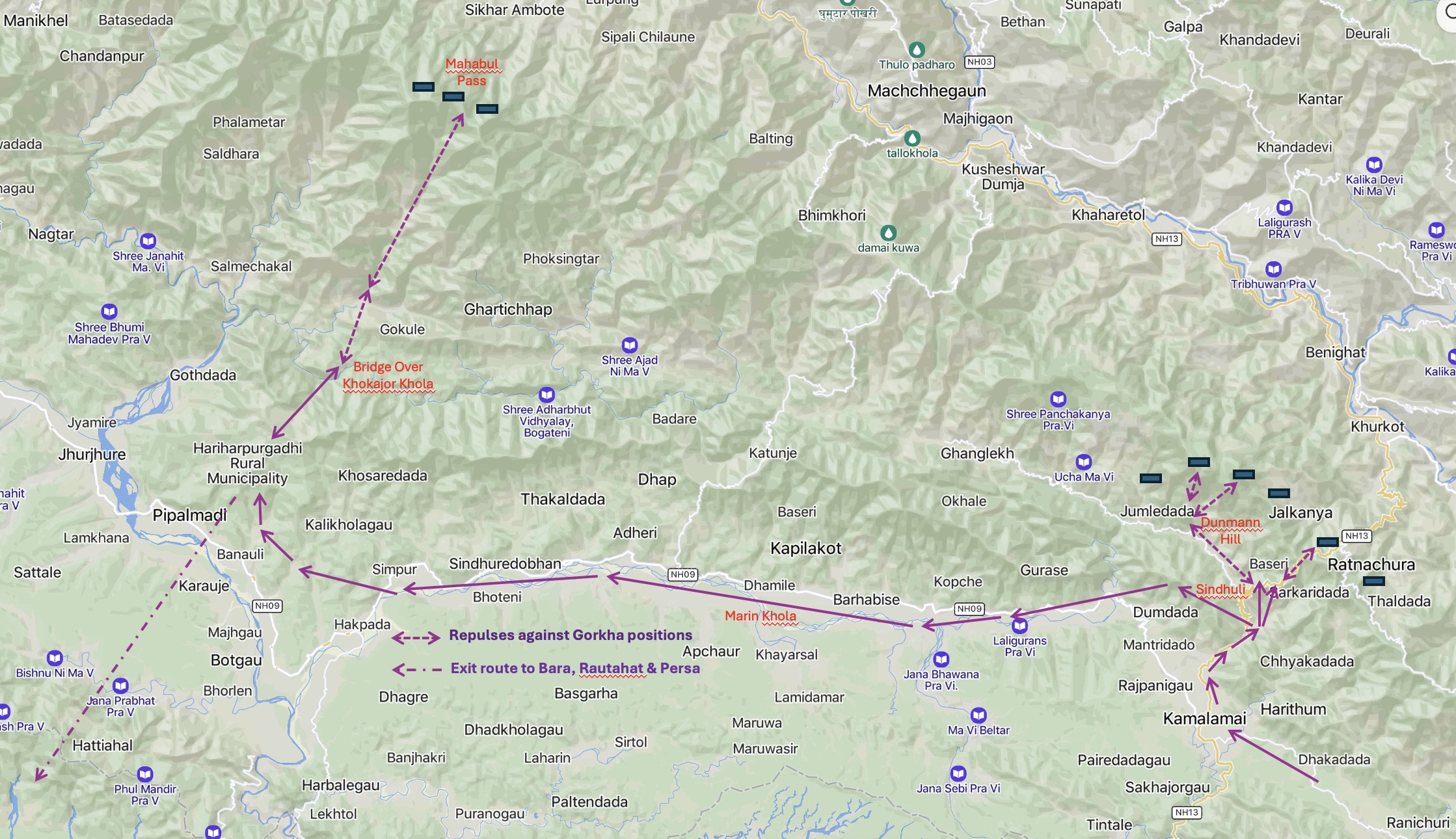 Another chart depicting a suggestion for the route taken by Kinloch to Hariharpur Gadhi, and the repulse of his attempt to reach Kathmandu via the Mahabul Pass.
After the failure to breach the Gorkha defences at Dunmann Hill, Kinloch immediately sent Lieutenant Hoggan with five companies of sepoys to seize the Mahabul Pass. He himself followed on 29 September, leaving a residual force at Sindhuli. He followed the bed of a river, taken here to be the Marin Khola. On the night of 30 September, he encamped on an island in the stream, on which he was marooned until the evening of 1 October. When he finally reached Hariharpur, on 2 October, he discovered that the fort had been easily taken, but that Hoggan was still there.
Hoggan’s party had reached a rapid river which they bridged by felling a tree. However, while the vakil Ramdas continued ahead, Hoggan feared that the swelling waters would cause him to lose contact with Kinloch in his rear. With his return, it seems the expedition’s last chance of reaching Kathmandu was missed. Still, Kinloch seems not to have criticised Hoggan heavily. He noted that ‘the sepoys’ allowance being near out [he] had determined on returning,’ which suggests he believed Hoggan had little choice in the matter.
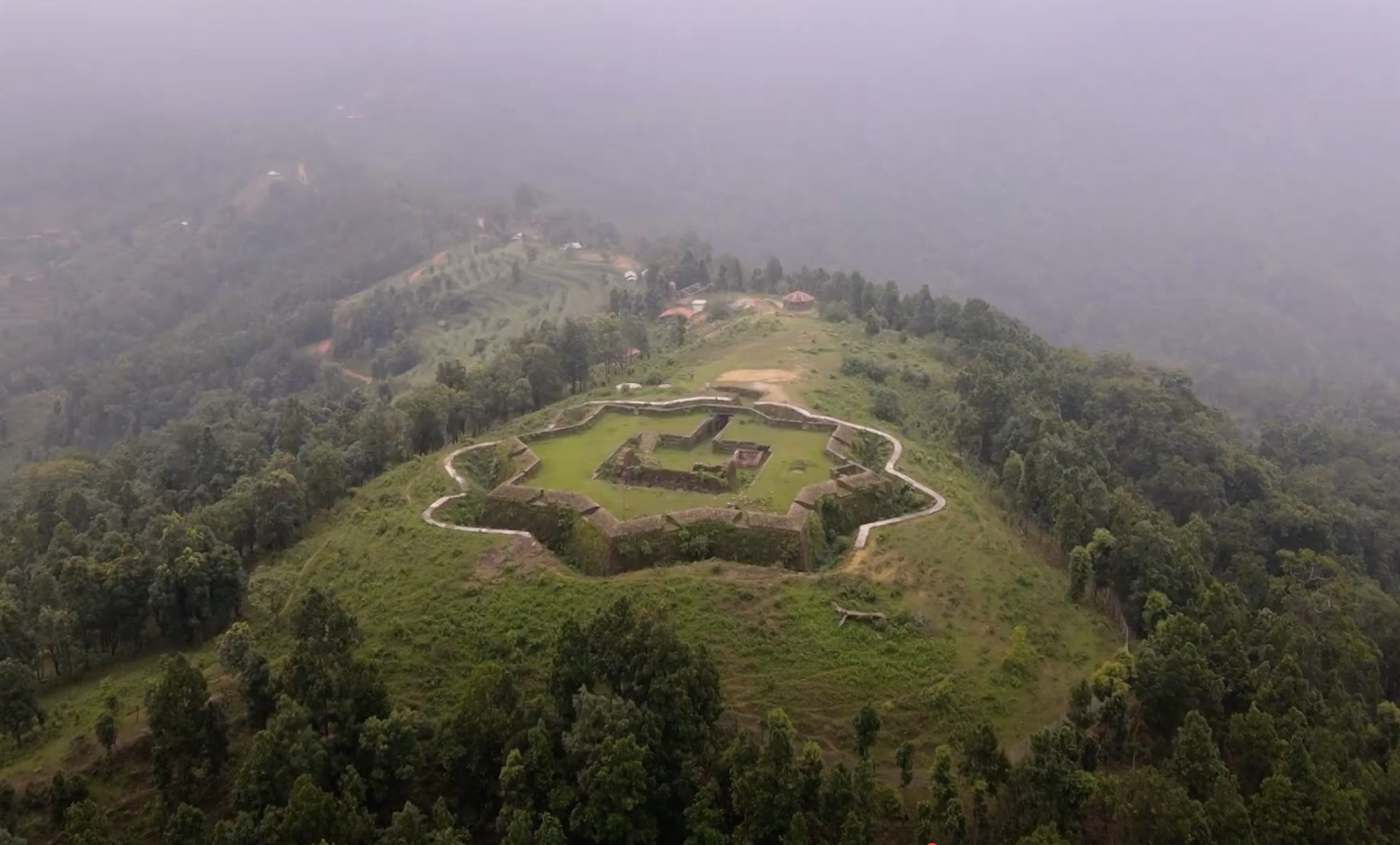 The fort at Hariharpur Gadhi, captured by Lt. Hoggan, on 30 September 1767.
The fort sits at about 900 metres (3,000 feet) above sea level (700 metres above the Bagmati River). Kinloch wrote that it had been abandoned by the enemy, ‘most probably the strength of the garrison having been sent to the pass at Danmanna.’
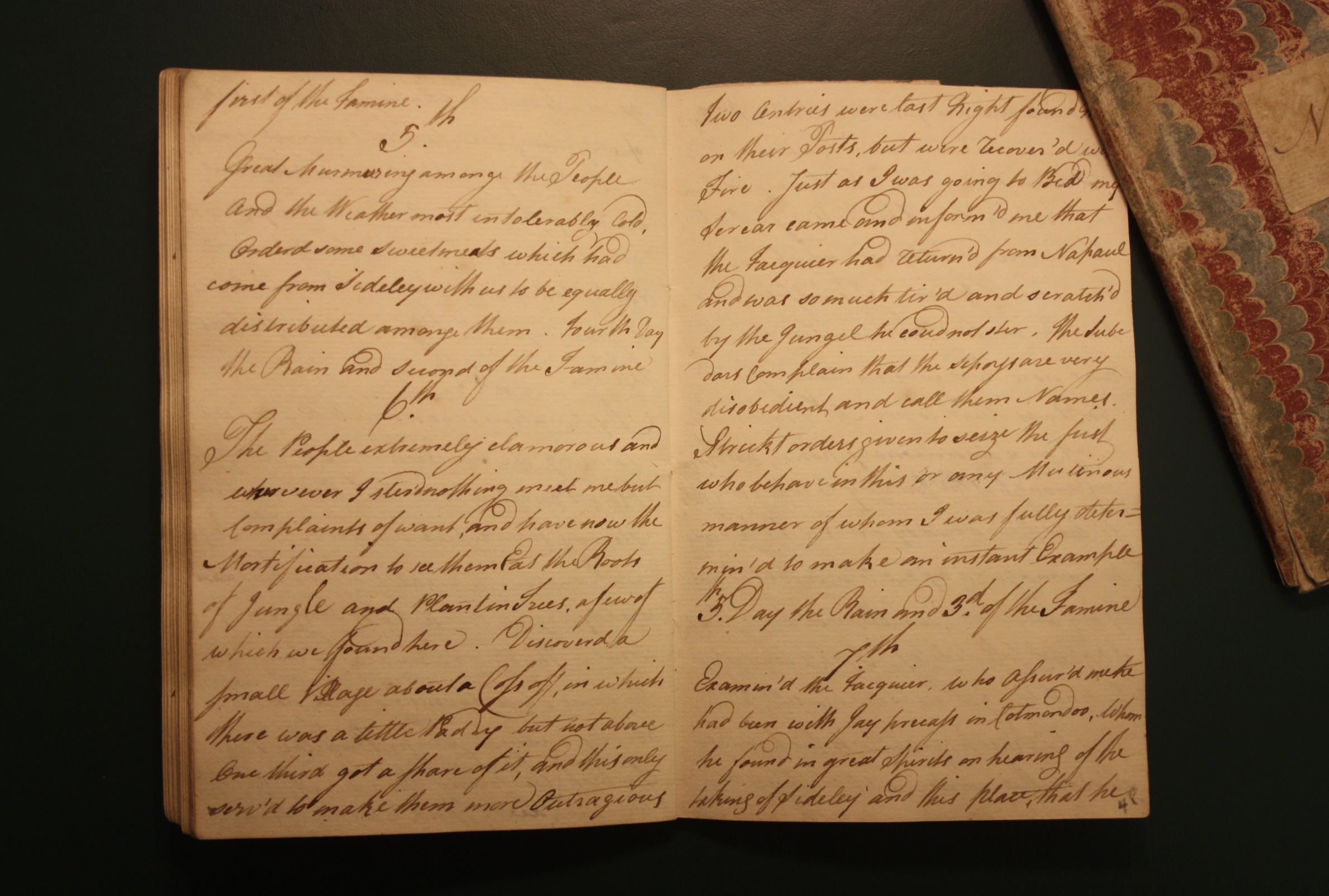 Another extract from Kinloch’s diary, from 5 and 6 October. By then, the failure to take the Mahabul Pass and the want of provisions was taking a toll on Kinloch’s mood:
5th
Great murmuring among the people and the weather most intolerably cold. Ordered some sweetmeats which had come from Sindhuli (‘Sideley’) with us to be equally distributed among them. Fourth day [of] the rain and second of the famine.6th
The people extremely clamorous and, wherever I stir’d, nothing met me but complaints of want, and have now the mortification to see them eat the roots of jungle and plantin trees, a few of which we found here. Discovered a small village about a coss off, in which there was a little paddy, but not above one third got a share of it, and this only serv’d to make them more outrageous.Two sentries were last night found numb on their posts, but were recovered with fire. Just as I was going to bed my serang (‘serear’) came and inform’d me that the Faquier had return’d from Nepal and was so much tir’d and scratch’d by the jungle he cou’d not stir. The subedars complain that the sepoys are very disobedient and call them names. Strickt orders given to seize the first who behave in this or any mutinous manner, of whom I was fully determin’d to make an instant example. Fifth day [of] the rain and third of the famine …
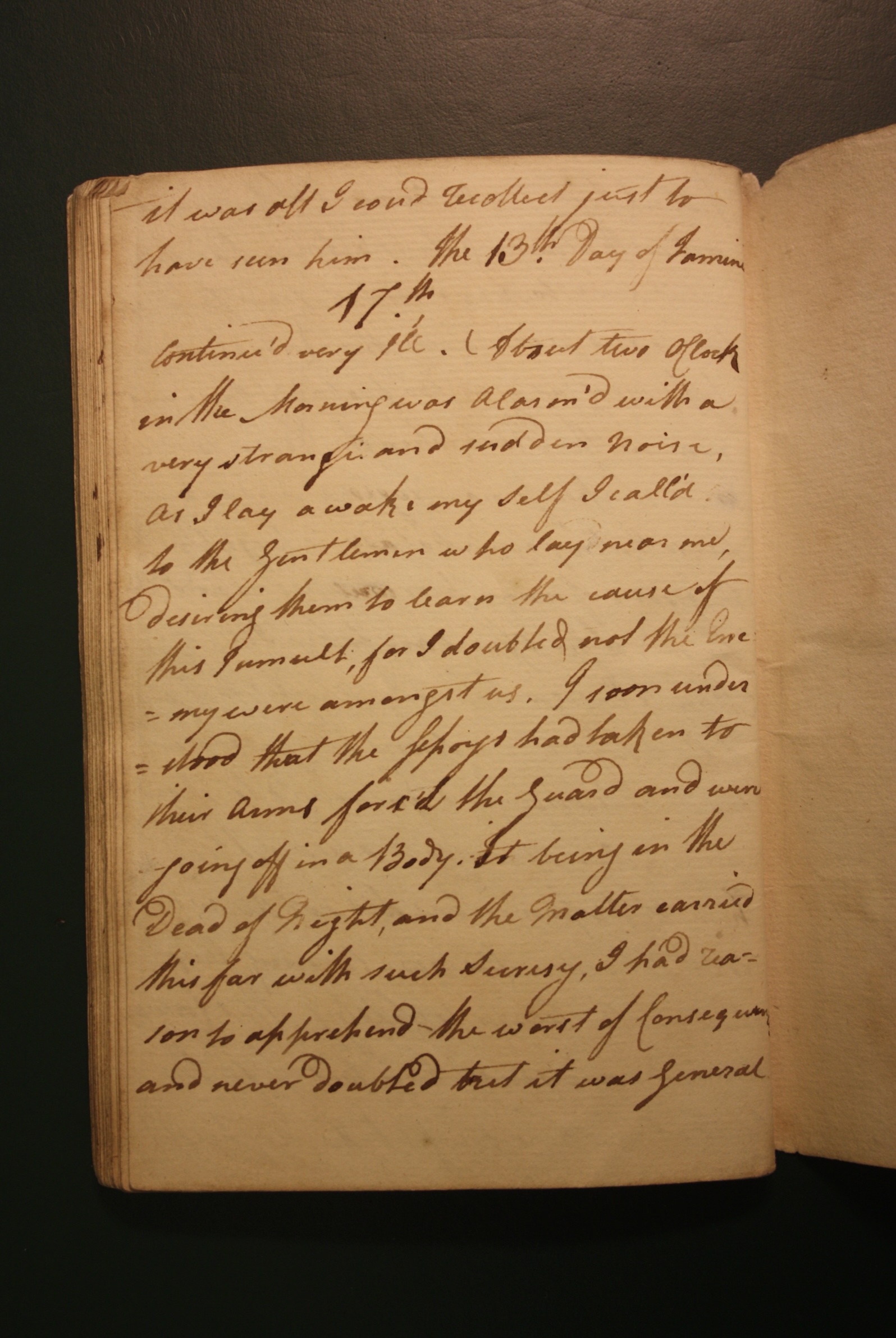 The last page of Kinloch’s journal (17 October). His writing has visibly deteriorated, but it is still quite legible:
Continu’d very ill. About two o’clock in the morning was alarm’d with a very strange and sudden noise. As I lay awake my self I call’d to the gentlemen who lay near me, desiring them to learn the cause of this tumult, for I doubted not the enemy were amongst us. I soon understood that the sepoys had taken to their arms forc’d the guard and were going off in a body. It being in the dead of night, and the matter carried this far with such secrecy, I had reason to apprehend the worst of consequences and never doubted but that it was general …
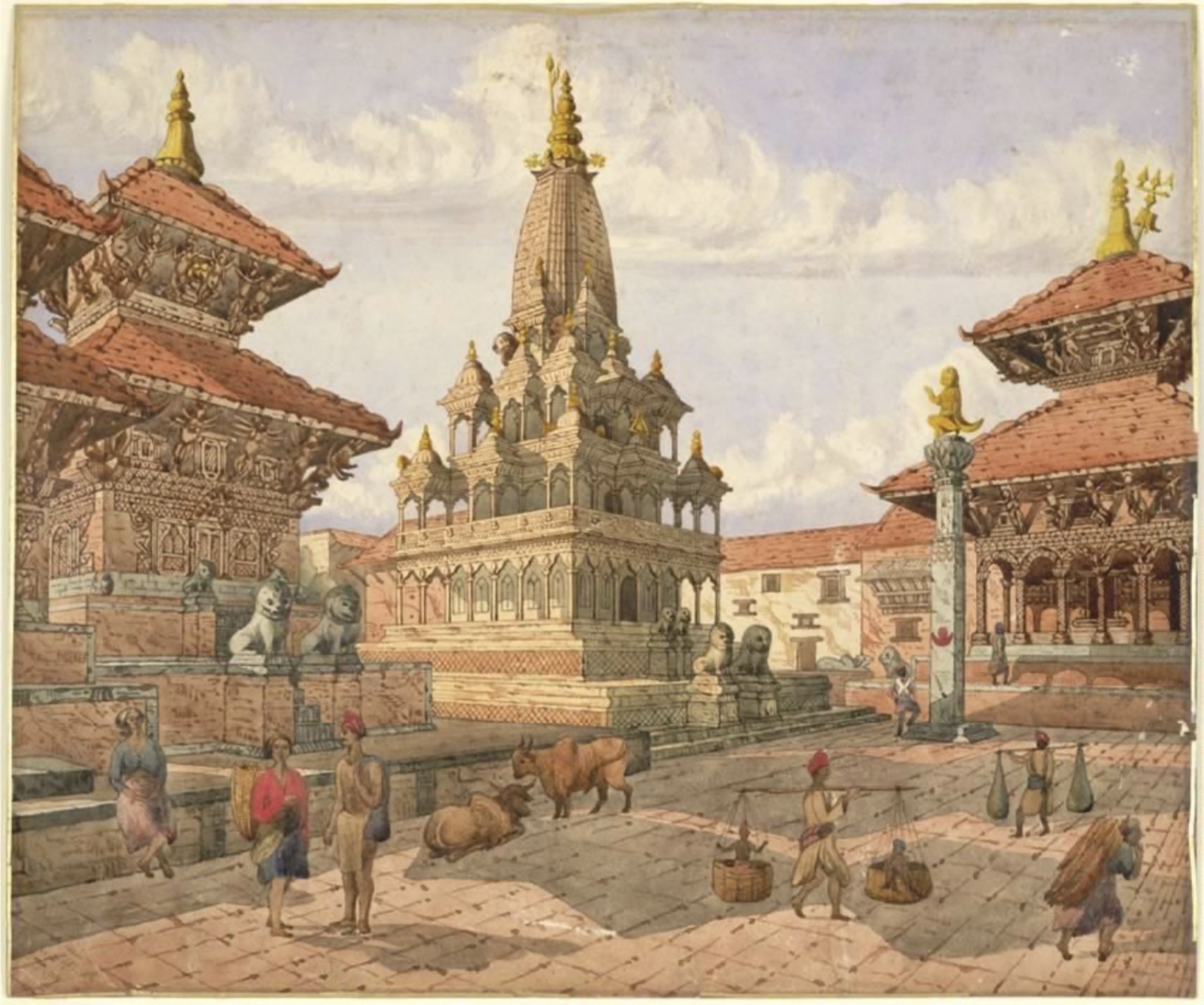 The Centre of Patan with the Temple of Krishna, by Henry Ambrose Oldfield (1855). (Source: WatercolourWorld.org).
Oldfield was the doctor in the British Residency, Kathmandu from 1850 to 1863. A keen sportsman, he enjoyed friendly relations with Jung Bahadur Rana, the prime minister of Nepal (1857-1877). As a result of his failing eyesight, he painted few pictures after 1857. An account of his experiences, Sketches from Nipal, Historical and Descriptive, was published posthumously, in 1880.
The temple of Krishna, the most important in Patan, was built over six years by Siddhi Narasingh Malla, and completed in 1637. The pillar with a gilt Garuda, Vishnu’s mount, was established ten years later. The Char Narayan temple, on the left, was built in 1566, in memory of his father, by Purandar Singh, a local nobleman, who controlled the city for much of the late 16th century. The Vishvanath Temple, on the right, was completed in 1627, and is dedicated to Shiva.
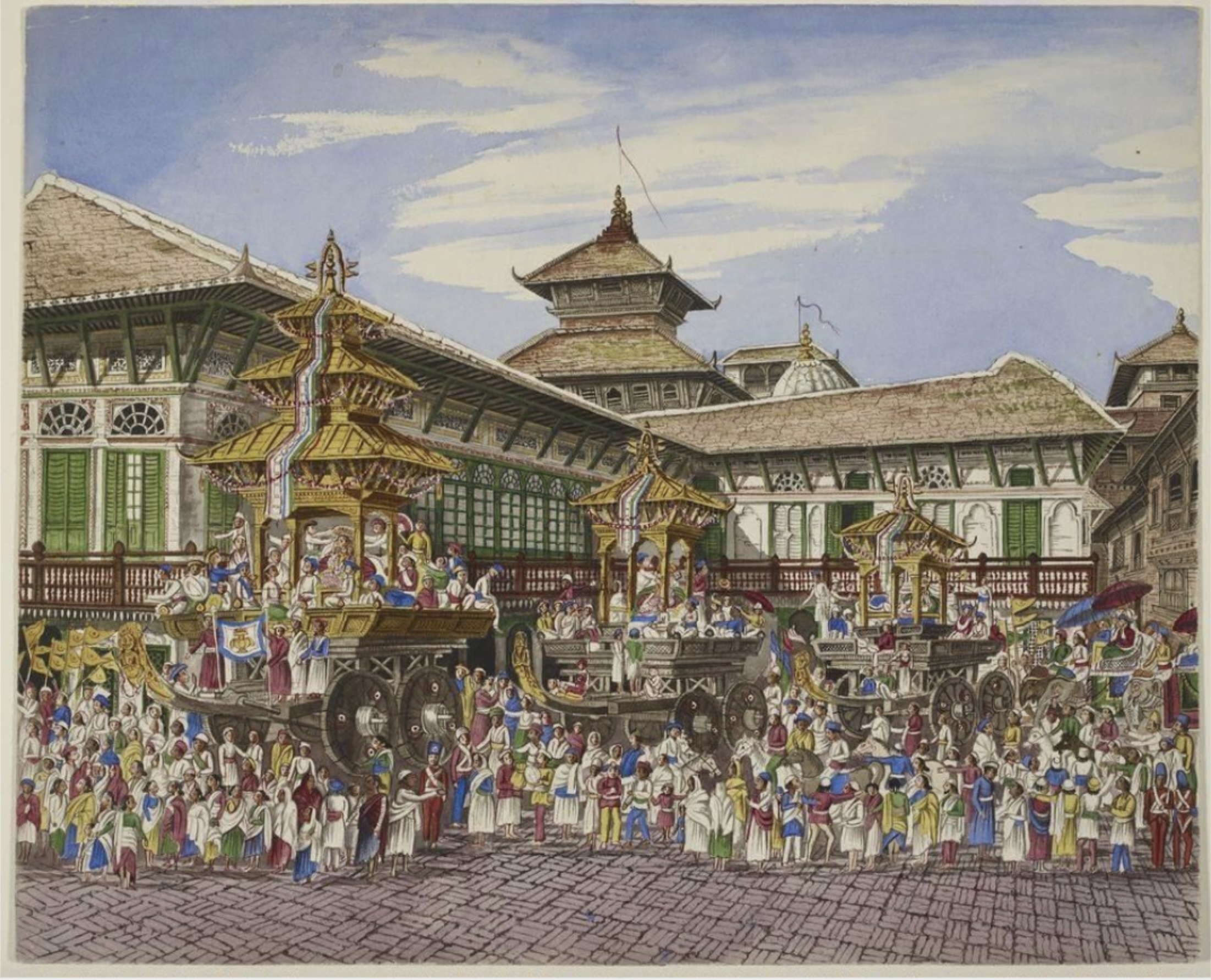 The Kumari Jatra: Three Temple Cars outside the Hanuman Dhoka, or Old Palace, Kathmandu, by Henry Ambrose Oldfield. (Source: WatercolourWorld.org).
The Kumari Jatra, established in 1756 by Jaya Prakash Malla, was that part of the Indra Jatra festival in which Kumari, a prepubescent girl called the ‘living goddess,’ bestowed her blessings on the king and was drawn around Kathmandu on a chariot accompanied by young boys representing Ganesh and Bhairav. Although the ceremony was closely connected to the Malla cult of Taleju, the tradition was maintained by the Shah kings. (Prithvi Narayan captured Kathmandu during the 1768 festival and immediately received Kumari’s blessing, thus affirming his right to rule.) Today, Kumari’s dwelling place, the Kumari Baha, offers a fine demonstration of elaborate window design in the south-western corner of Kathmandu’s Durbar Square. It is Jaya Prakash’s most important architectural legacy.
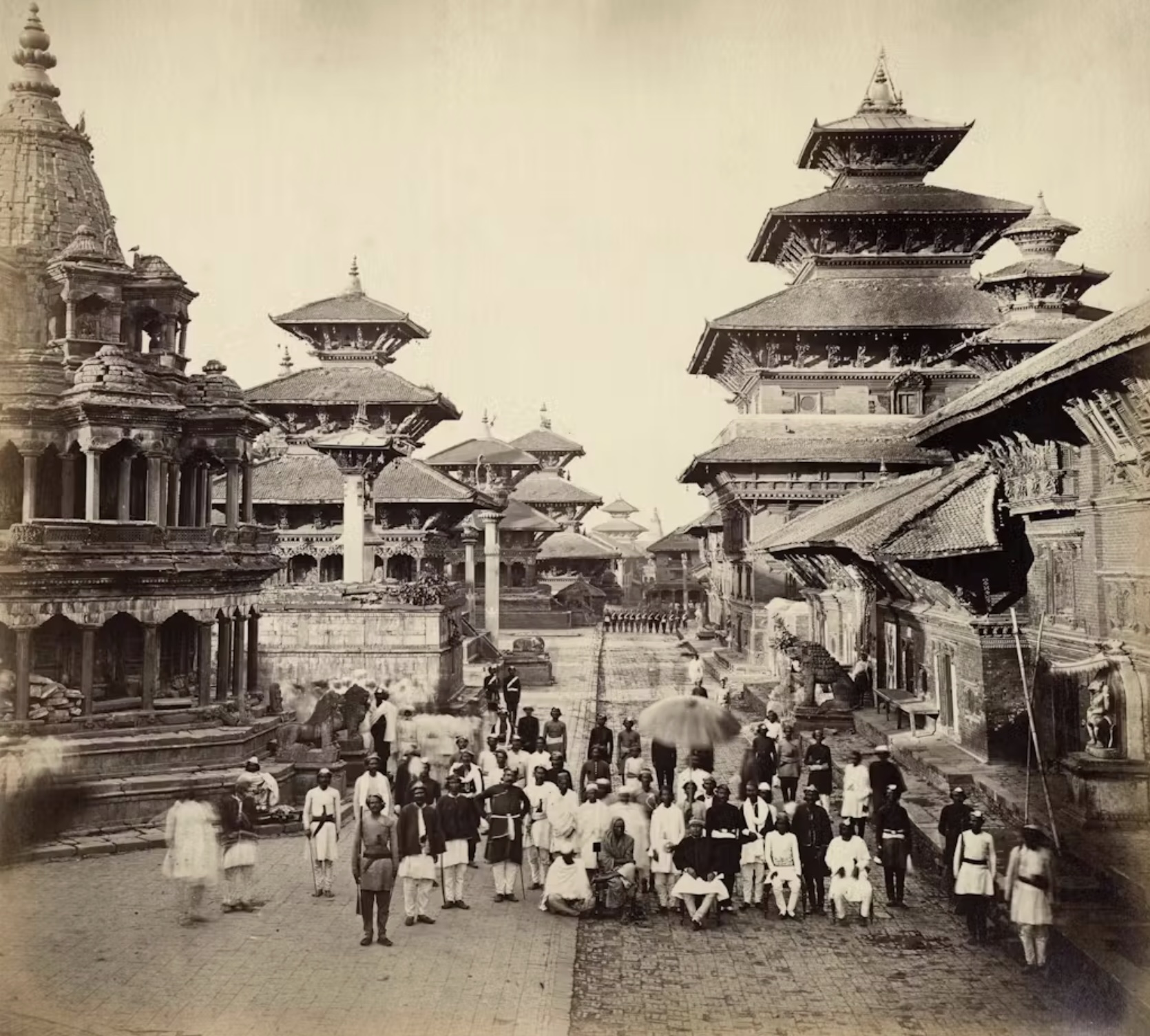 West front of the Durbar at Patun with the Deo-Patun, also a temple dedicated to Krishna, by Clarence Comyn Taylor (1863). (Ref: British Library, Photo 855/7).
The kings of Patan, like those in Kathmandu and Bhatgaon, demonstrated their piety by establishing temples to the gods of the Hindu pantheon in front of the palace. Temples to Taleju, the king’s tutelary goddess, are built within the palace itself. On the left is the octagonal Chyasing Deval (1723), dedicated to Krishna and the memory of King Lok Prakash, who died of smallpox, aged eight, after a reign of just one year. Beyond it, on a stone platform, the Taleju Bell was built by King Vishnu Malla, 1737, ‘to terrify his enemies’. Next are the three-roofed temple of Harishankar (1706), and a tall stone pillar surmounted by the figure of King Yog Narendra seated under the expanding hood of a cobra, on which there is perched a golden bird.
Towards the rear is the two-storied, Vishvanath temple painted by Oldfield (the Char Narayan and Krishna Mandir temples are hidden.) Legend says that when the stone elephants before Vishvanath have a drink at the Mani Dhara fountain opposite, and Yog Narendra’s bird flies away, the Kathmandu Valley will again fill with water.
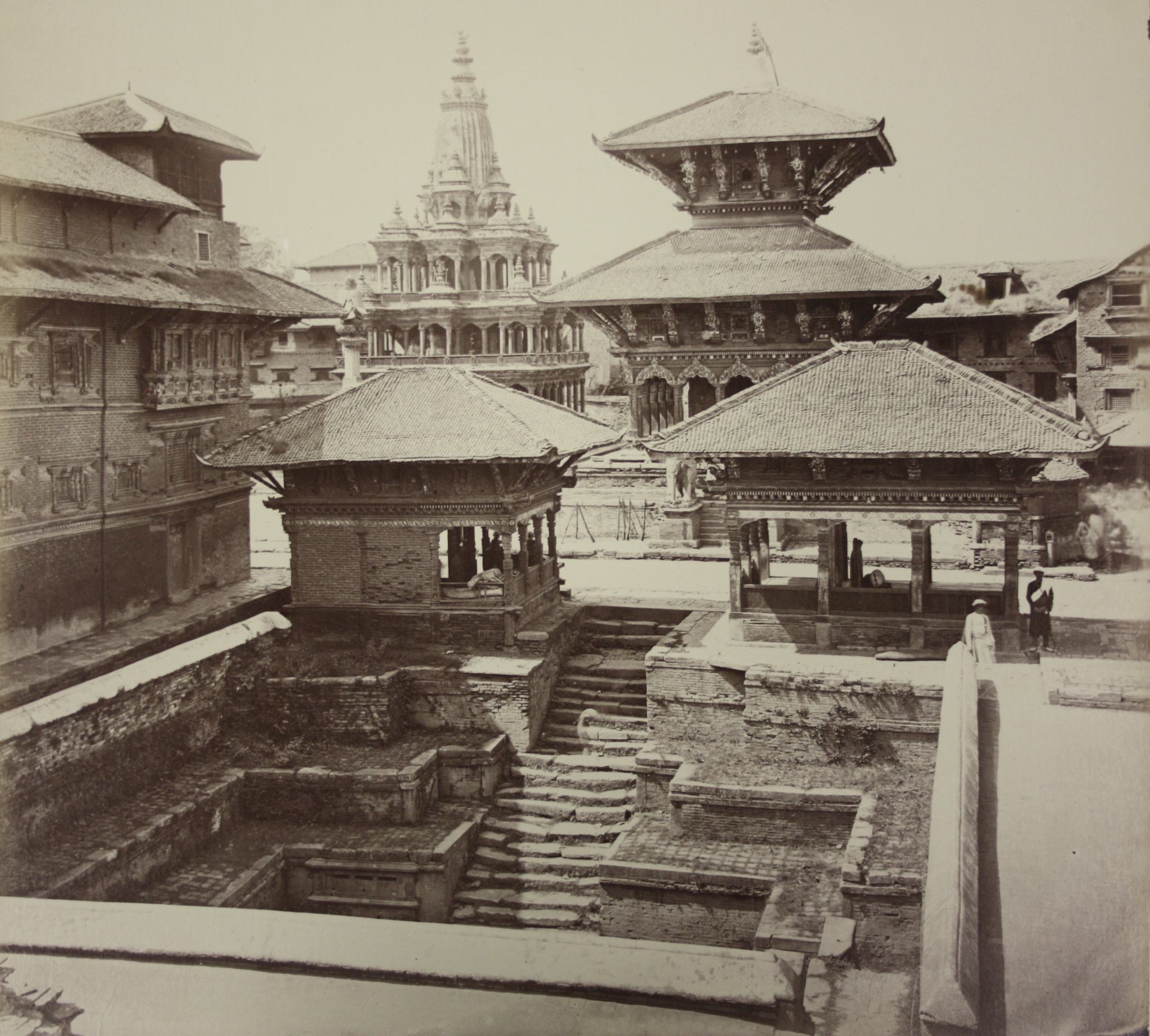 View from the principal room in the palace at Patun. On the left, the temple of Krishna; on the right, the temple of Mahadeo (Vishvanath). Photograph by Clarence Comyn Taylor (1863). (Ref: British Library, Photo 855/8).
This picture shows the same subject a Oldfield’s first painting, from a different perspective. In the foreground is the site of the Mani Dhara fountain. One of the elephants in front of the Vishvanath temple can just be seen near the centre.
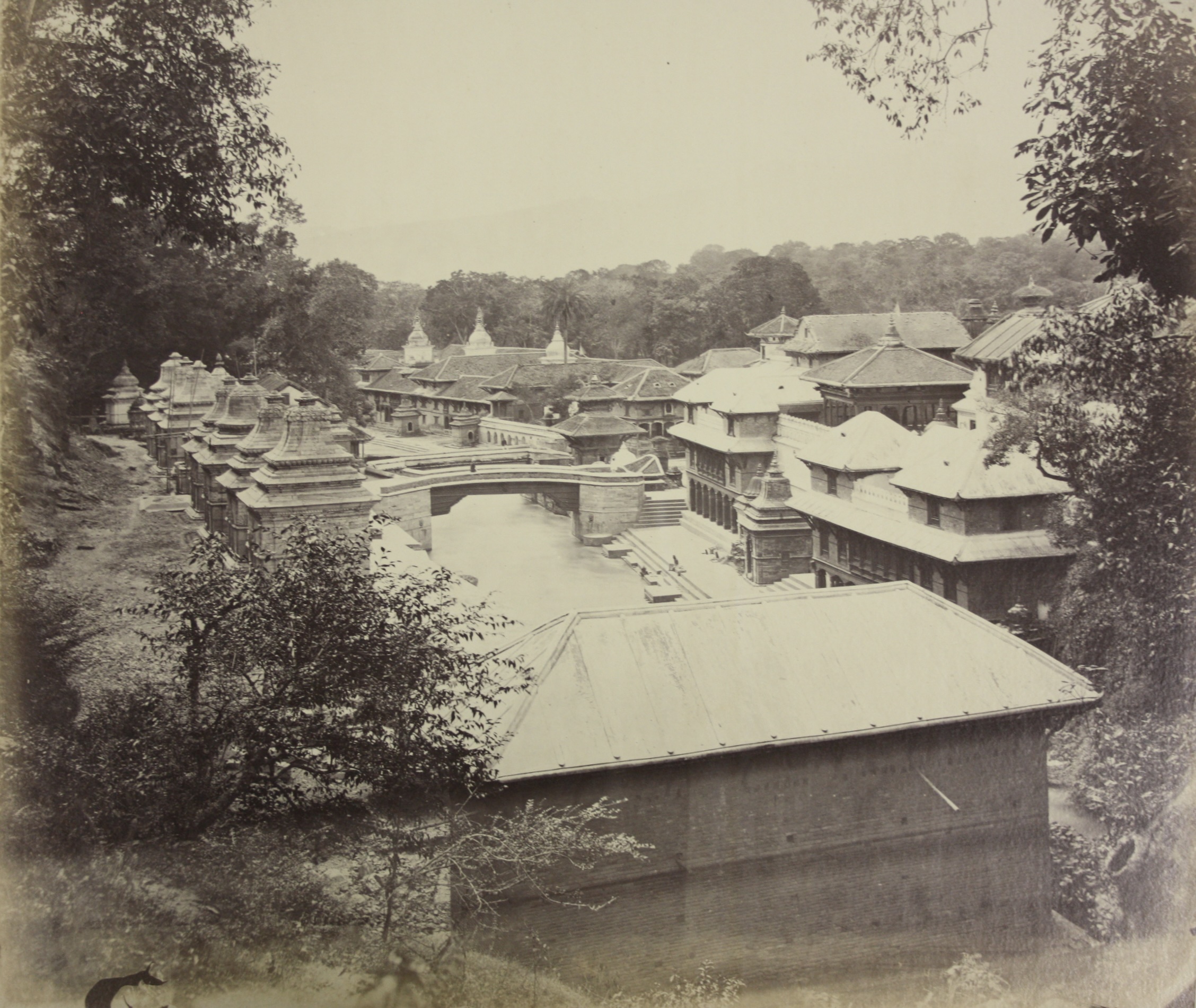 Ghat and Bridge of Pushputtinath, the Place of Royal Suttees, by Clarence Comyn Taylor. (Ref: British Library, Photo 855/5).
The temple of Pashupatinath, located a little to the north-west of Kathmandu, quickly established pre-eminence, spawning imitations at Bhatgaon (1480), Patan (1566) and Varanasi (early nineteenth century). According to local chronologies, the original temple dates from the third century BC, though the first documentary reference to it is to renovations undertaken by Ananta Malla (r.1274-1307). It acquired its current form under King Bhupalendra Malla, in 1697.
In this photograph, the temple is to the right of the Bagmati River, just before the twin bridges. At Pashupati, there is said to be a triveni, a confluence of three holy rivers, like that of the Ganga, Yamuna and subterranean Saraswati, at Allahabad. This explains the numerous bathing places built for pilgrims. However, Arya Ghat, before the temple, is the only place where purificatory water for Pashupati may be obtained, and where members of the royal family may be cremated.
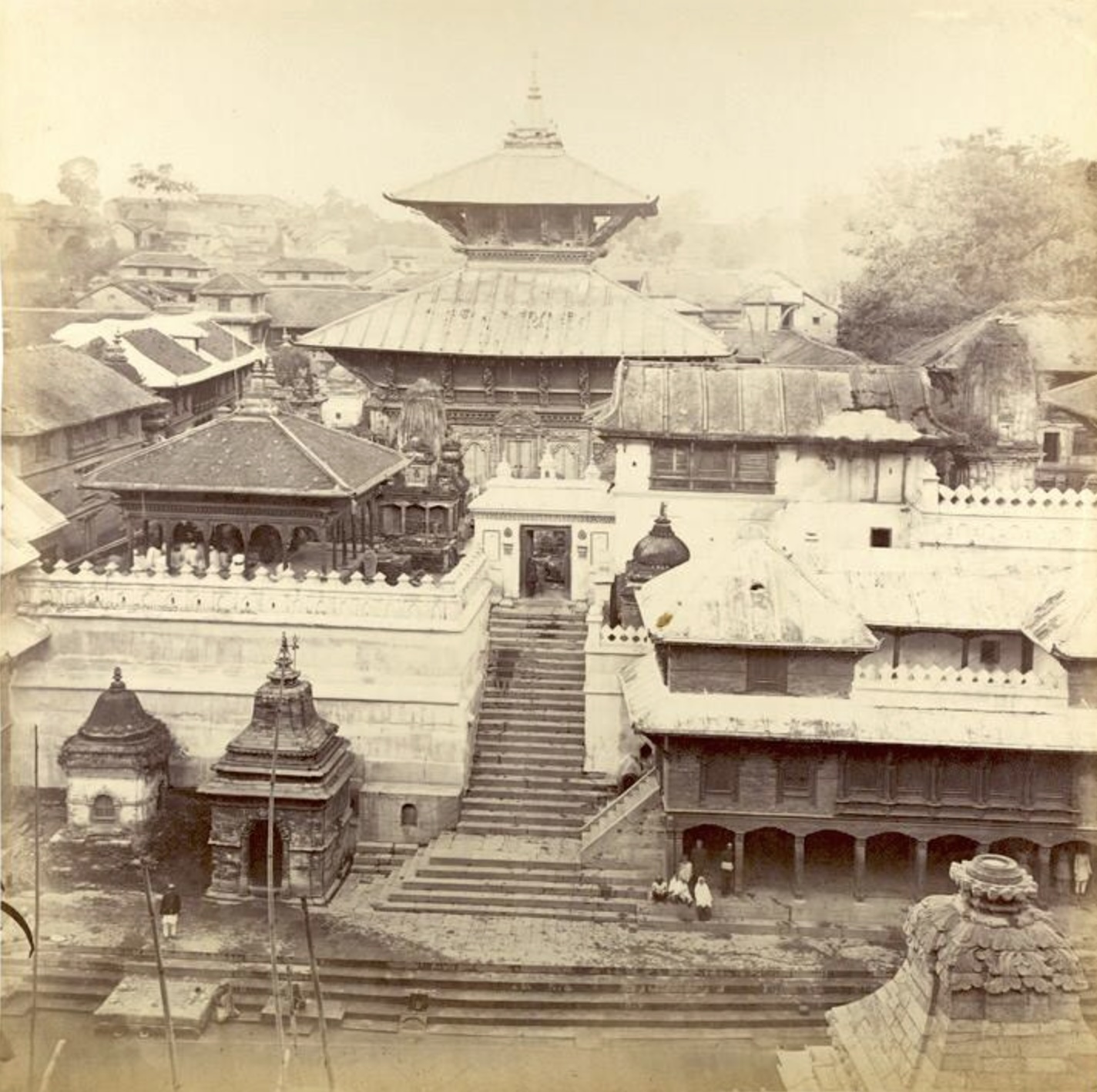 Temple of Mahadeo on the Bagrutty at Pushputtinath, Most Sacred Temple in Nepal, by Clarence Comyn Taylor (1863). (Ref: British Library, Photo 855/4).
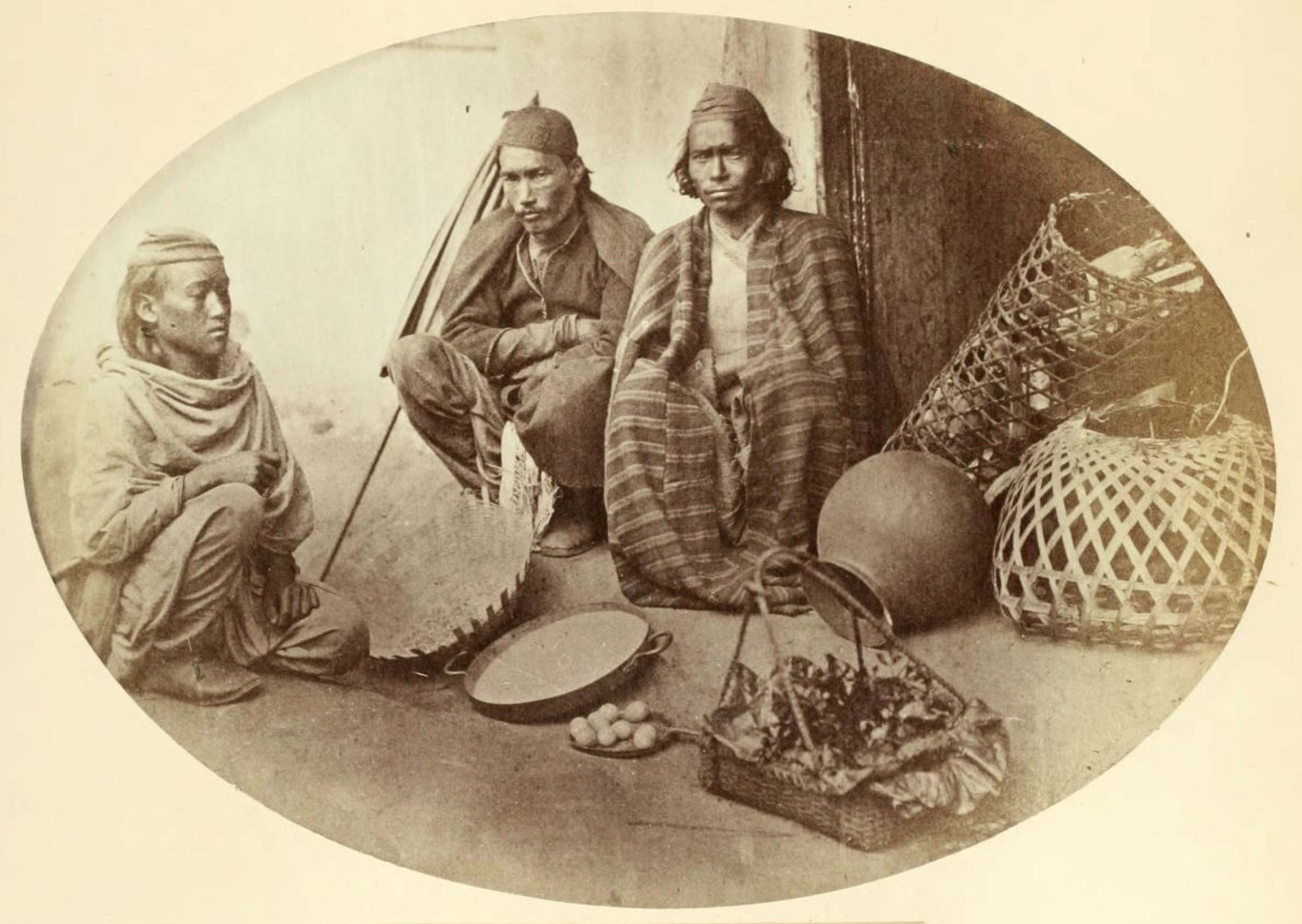 The first in a series of photographs of some of the tribes of Nepal, taken from Watson and Kaye (eds.), The People of India, Vol.2 (London, India Museum, 1868).
Their language reflects the ideas of the time:
‘Newar is the name of the bulk of the inhabitants of Nipal, who were the rulers of the valley before the Goorkha conquest, and are, indeed, believed to have been its first inhabitants. Their original country has not been ascertained, though the Tartar cast of their physical form, and the monosyllabic structure of their language, point to Tibet; their traditions, however, indicate India as their previous home. They now constitute the great mass of the agricultural and artisan population; and the ruins of their well-built towns and temples attest the civilization to which they had attained before their conquest by the rude mountaineers, who now consume in military idleness, the fruits of theh fields. About two-thirds of the Newars are Buddhists, the remainder Brahminical Hindoos. They are a cheerful and industrious race, possessing a skill in agriculture far exceeding that which exists in Hindostan, and presenting a marked contrast to the sour looks and arrogant demeanour of the Goorkha on the one hand, and to the melancholy and apathetic countenance of the inhabitant of Hindostan on the other.’
‘The Khas, or Khus, now the dominant population of Nipal, were, until 1816, the ruling tribe of the entire tract from the Sutlej to the Teesta …
They are excellent soldiers, and form a considerable proportion of the Nipalese (Goorkha) army. Though more liable to Brahminical prejudices than other military tribes of the country, they have no religious feelings which prevent them from becoming excellent servants in arms, and they possess pre-eminently that masculine energy of character and that love of enterprise which distinguish so advantageously the Nipal soldiery. Despatching their meals in half-an-hour, and satisfying the ceremonial law by merely washing their hands and face, and taking off their turbans before cooking, they laugh at the pharisaical rigour of our (Bengal) Sepoys, who must bathe from head to foot and make puja ere they begin to dress their dinner, must eat nearly naked in the coldest weather, and cannot be in marching trim again in less than three hours. The former will carry several days’ provisions on their backs, the latter would deem such an act intolerably degrading.’
‘The Goorungs of Nipal are a division of the ‘Purbuttiahs,’ and therefore nominally Hindoos. They live on the hills, uniformly selecting an altitude of 5000 or 6000 feet, especially between Jumla and Kirant, where they rear immense flocks of the Barwal goat. They exhibit, in common with most of the aboriginal tribes of Nipal, a modified form of the Mongolian type, retaining, like the Magars, their own vernacular tongue, though, from long intermixture with the Khas, they have also acquired the language of the latter. Their original seat is supposed to be in the valleys around the peak of Gosainthan; and they retain to a certain extent the manners and religion of their ancestors, though the latter has in some degree been mixed with Hinduism; mainly, it would seem, because this is the religion of the reigning family, whom they serve largely in the capacity of soldiers. From their energy of character, love of enterprise, freedom from the shackles of caste, unadulterated military habits, and perfect subjectibility to discipline, they are eminently fitted for a military life.’
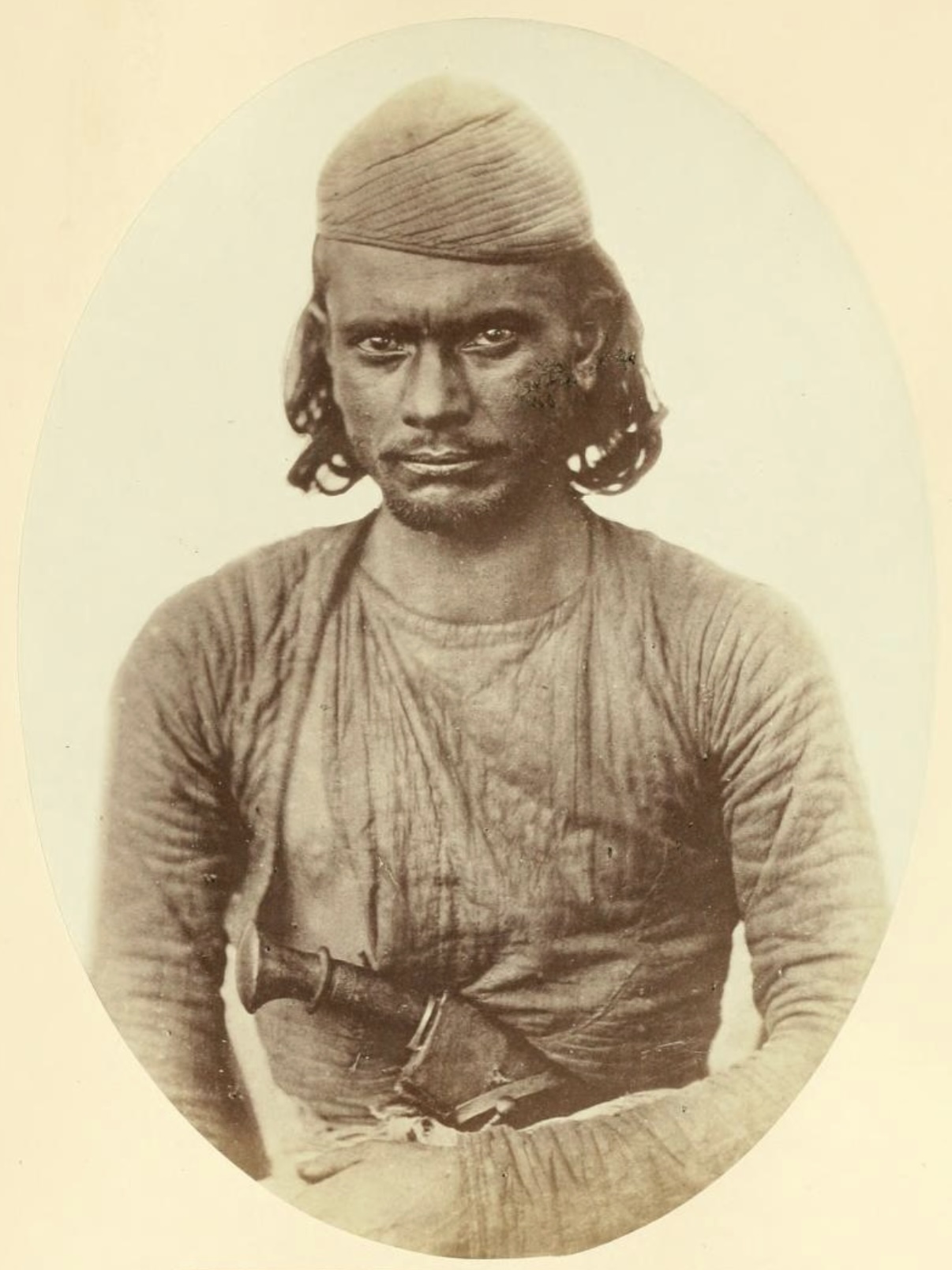
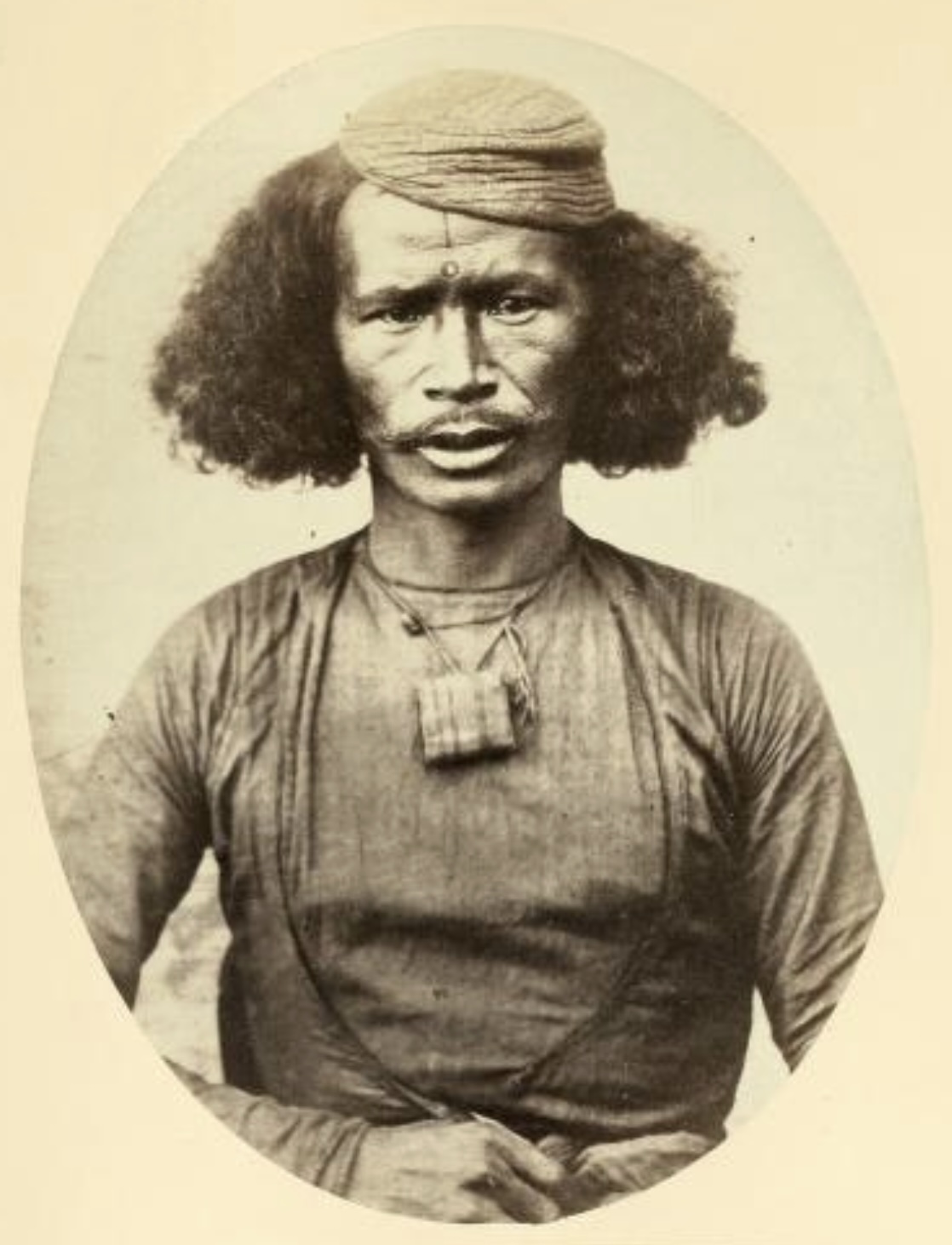
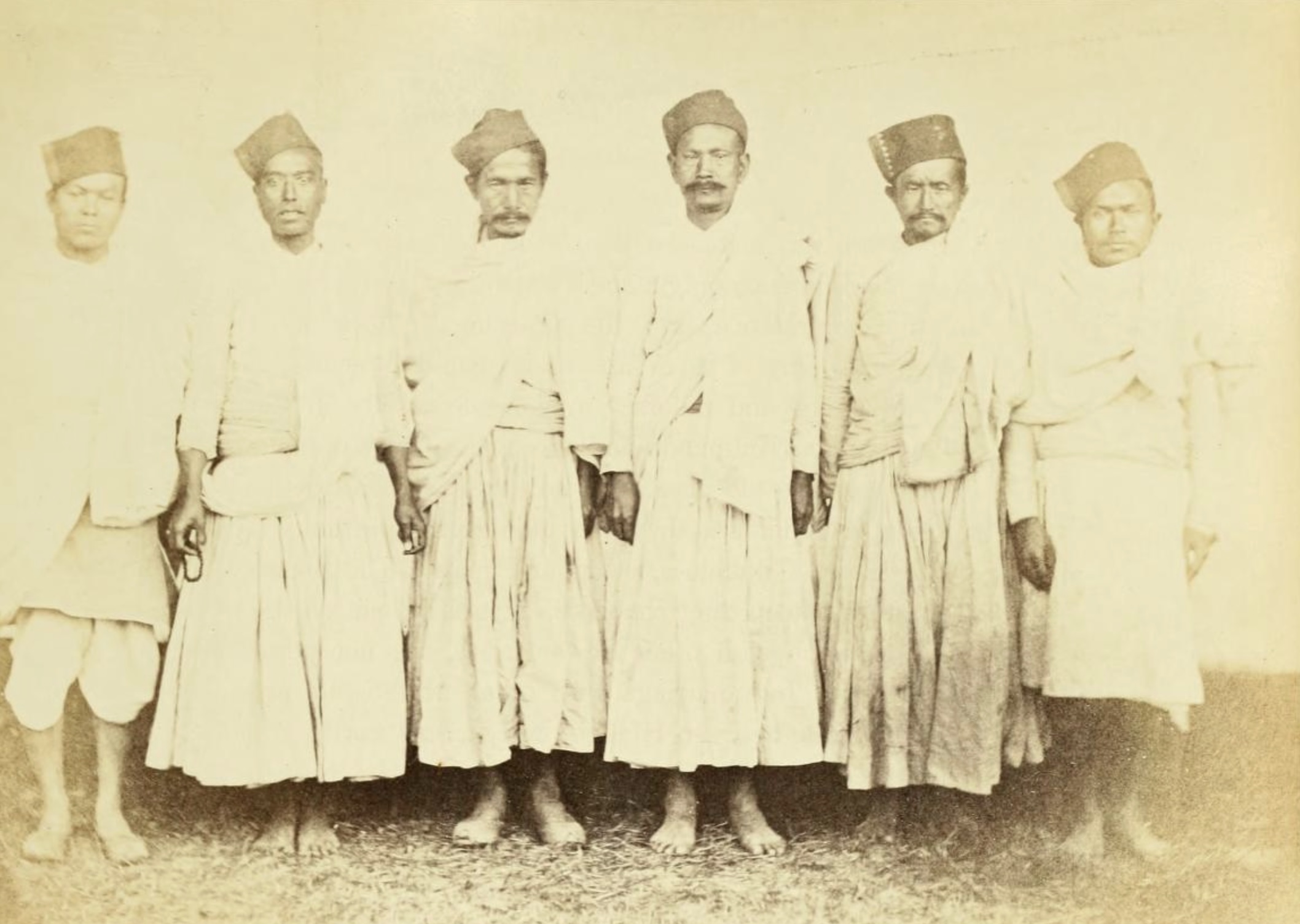
‘The Banras are the only tribe in Nipal that do not keep the ‘choorkee,’ or tuft of hair, on the crown of the head; and they, in common with other Newar tribes, are not permitted to enlist into the Nipalese Army.
… Once or twice a year, or oftener, if the wealthier classes of Newars feel charitably inclined, a festival called the Banra jatra is held either in Kathmandu or the neighbouring city of Patun, on which occasion all the Banras are collected, and presents of grain, rice, &c., are made to them only by those Newars from whose hands water can be given without ceremonial defilement. Sometimes a rich Newar may be disposed to give a special jatra on his own account. He then gives notice to the Banras that, on a certain day, all of the tribe who wish to partake of his bounty are to assemble at his house, and when the doors are opened, the Banra who succeeds in entering first gets a larger share of the charity than the rest.’
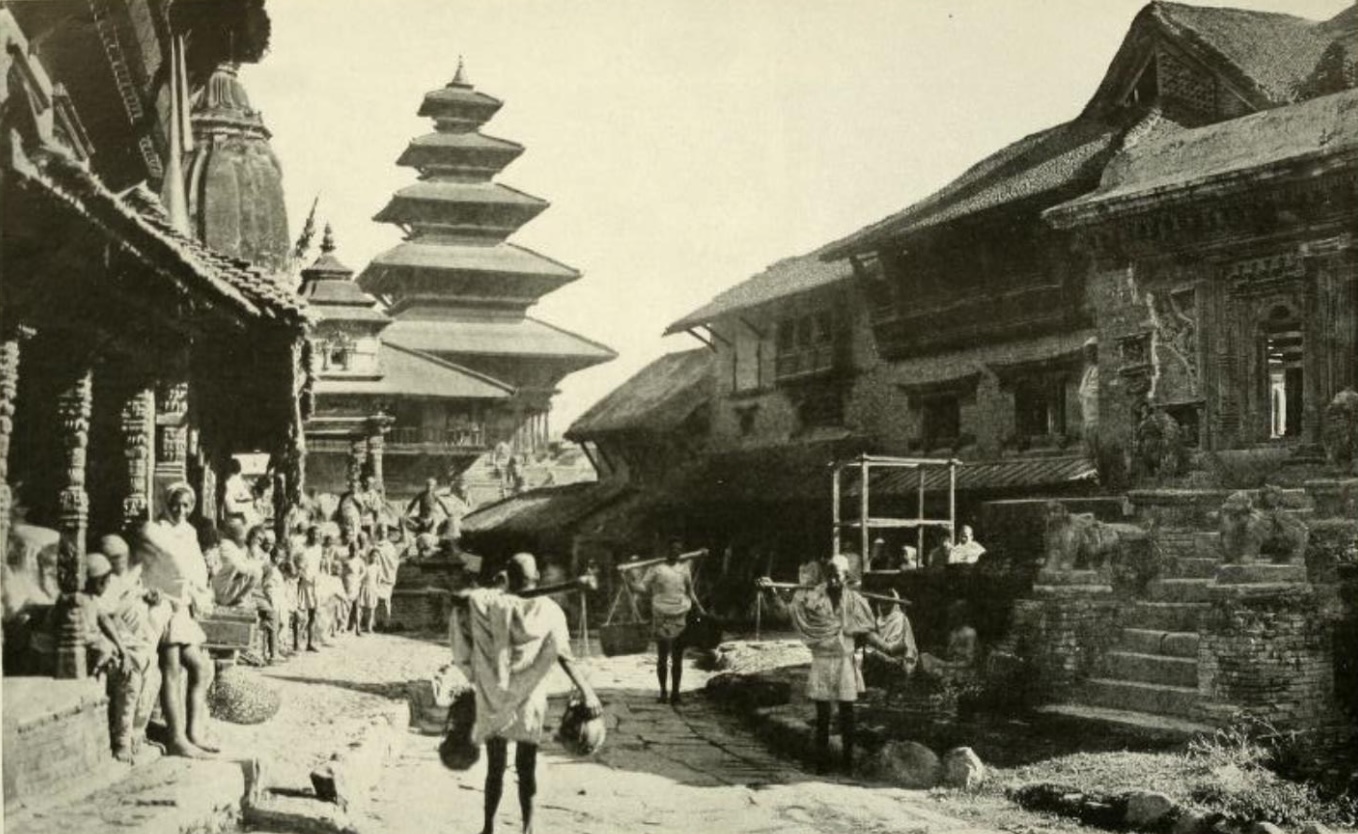 A Busy Nepal Street Scene by John Claude White, from his article on Nepal in the National Geographic Magazine (October 1920), on Archive.org.
‘Vehicles are almost unknown except in Khatmandu, and animal carriers are rare, for the country long ago launched a bad-roads movement as its major military protection. A considerable export trade is borne almost wholly on the backs of the natives, who are accustomed to surprising loads, up to 300 or 400 pounds. For lighter town carriage, coolies use bamboo poles, as in this street scene in Bhatgaon.’
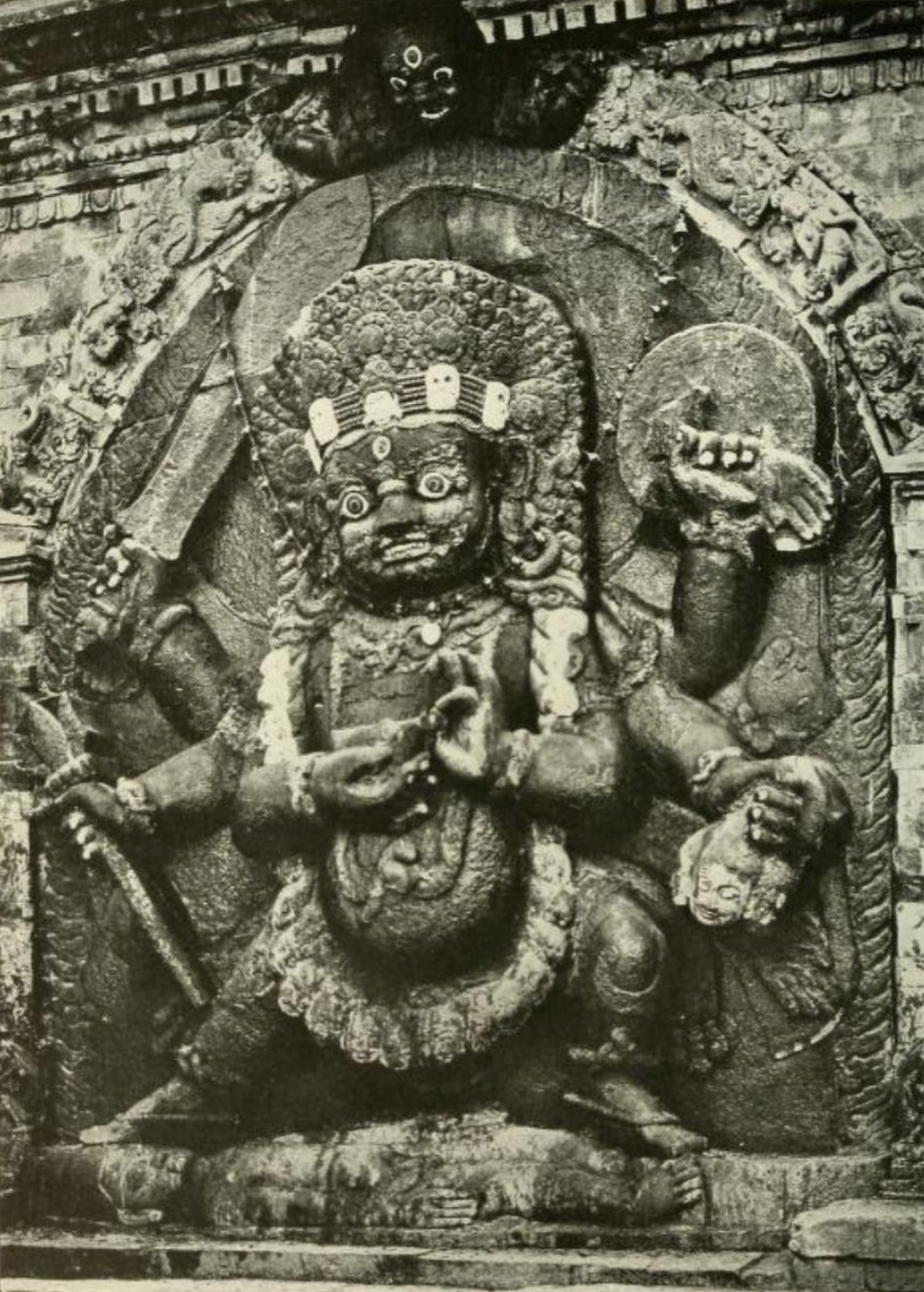 Image of the Goddess Kali in the Khatmandu Market-place, by John Claude White.
‘A procession of women to honour this image is a feature of the ten-day festival known as the Durga Puja. While the men are engaged in military manoeuvres, the women march in what may be mistaken for a visiting fireman’s parade to the square, headed by a representative from the royal household, walking under a huge red umbrella. The costumes are bizarre, vivid in colouring, tinsel-bedecked, and the women’s faces are liberally daubed with vermilion.’
Elsewhere, John Claude White wrote,
‘The Nepalese are a fighting people, have an excellent army and organisation, and are fond of show, both in military display and in their religious festivals … Some of the semi-military pageants end in the massacre of hundreds of buffaloes and indescribable scenes of blood and dead animals. In one ceremony, known as the blessing of the colours, the commander-in-chief dips his hands in a bowl of blood and clasps each banner in turn, thus imprinting on each the mark of bloody hands. The scene is somewhat revolting, but probably has its use in keeping up a martial spirit in the army.’
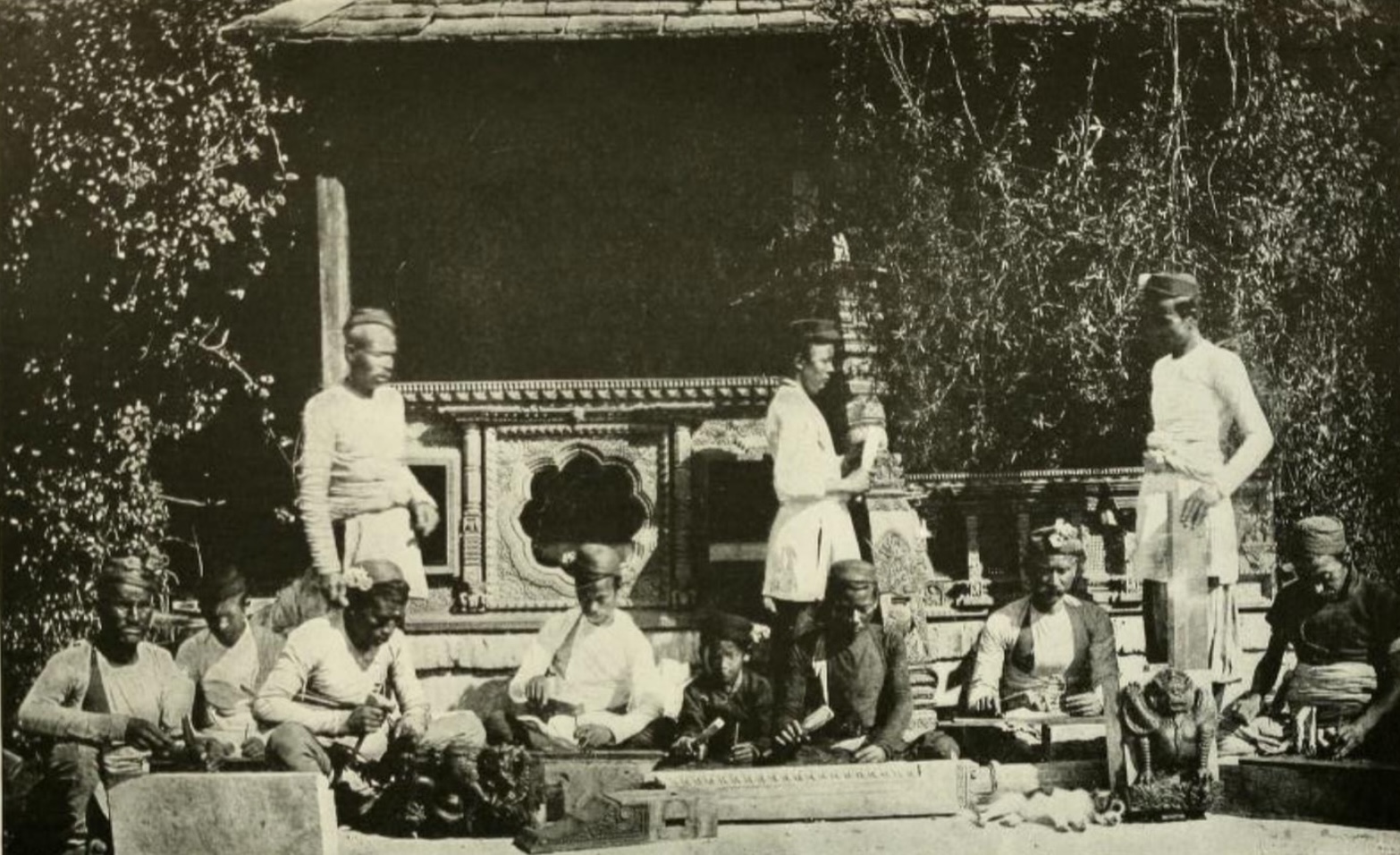 Group of Nepalese Carvers, by John Claude White.
‘The inhabitants of Nepal are collectively known as ‘Paharias,’ or ‘Dwellers in the Hills,’ and are divided into innumerable castes, of which the principal among the Gurkhas, now the dominant race, are as follows … 1.Brahmans, who eat rice cooked only by members of their own caste. They drink water from the hands of members of castes Nos.2 to 19. 2.Surmgasi, who eat rice cooked by Brahmans, Thakuris, and Khas only. They drink water from the hands of all castes up to No.19. 3.Thakuri, who eat rice cooked by Brahmans only. They drink water from hands of all members of all castes up to 19. 4.Khas or Chitsi, who eat rice cooked by Brahmans and Thakuris only and drink water from hands of all members of castes Nos.2 to 19.
The intermediate castes run from 5 to 19, inclusive, and the lower castes from 20 to 24, inclusive. The five castes from 20 to 24 do not have Brahmans as priests … They must leave the road on the approach of a member of castes Nos. 1 to 19 and call out to give warning of their approach. They may not enter the courtyards of temples. The Bantor, Danuar, and Drai tribes belong to the plains, and no one knows how to classify them in respect to social precedence.’
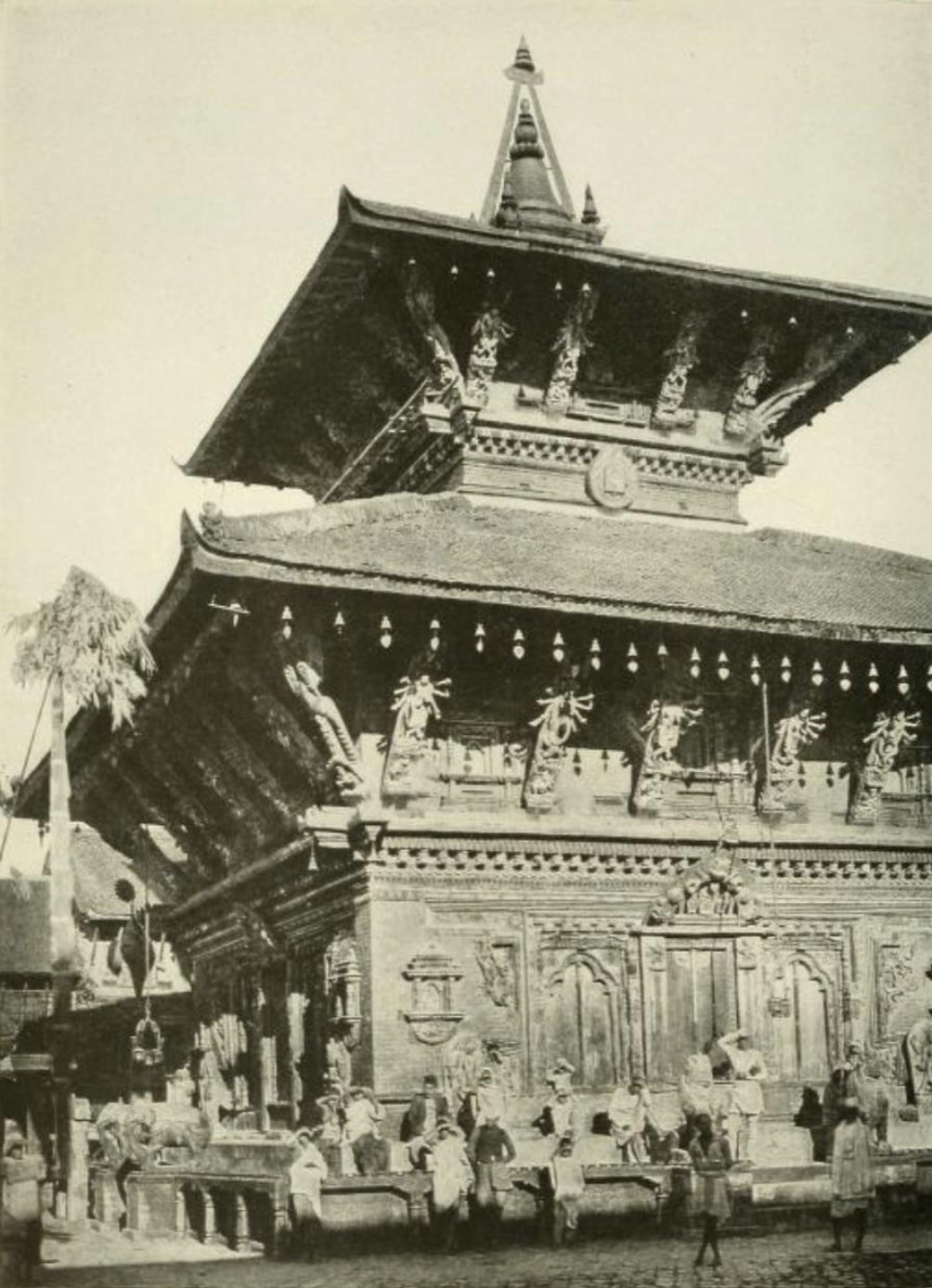 A View of the Vishnu Temple of Changu-Narain, by John Claude White.
‘The old buildings are built of fine red brick with hair joints, leaving no mortar visible, and the ornamentation is generally of moulded bricks of the same red colour, although sometimes terra-cotta tone is used. ‘Sal’, which turns almost black from weathering, is used for woodwork. The roofs are of red corrugated tiles set in mud, with elaborate, grotesque finials. The combination of red brickwork, toned down and weathered by age to a delightful colour, with the dark wood used for the overhanging windows and doorways, produces a most picturesque effect, relieved from monotony or sombreness here and there with some brilliant colouring and the sparkle and glitter of the brass and copper repoussé work with which most of the doorways are ornamented.’
According to Nepalese myth, the god Vishnu, in one of his acts of benevolence, beheaded a demon who, unknown to him, was also a Brahman. When Vishnu discovered his sin, he wandered the earth before finally settling on Changu Hill. There, Sudarshana, a hermit-sage, discovered him surreptitiously milking his cow, and struck of his head. When his crime had thus been assuaged, Vishnu emerged from the body and decreed that he should be worshipped on this spot.
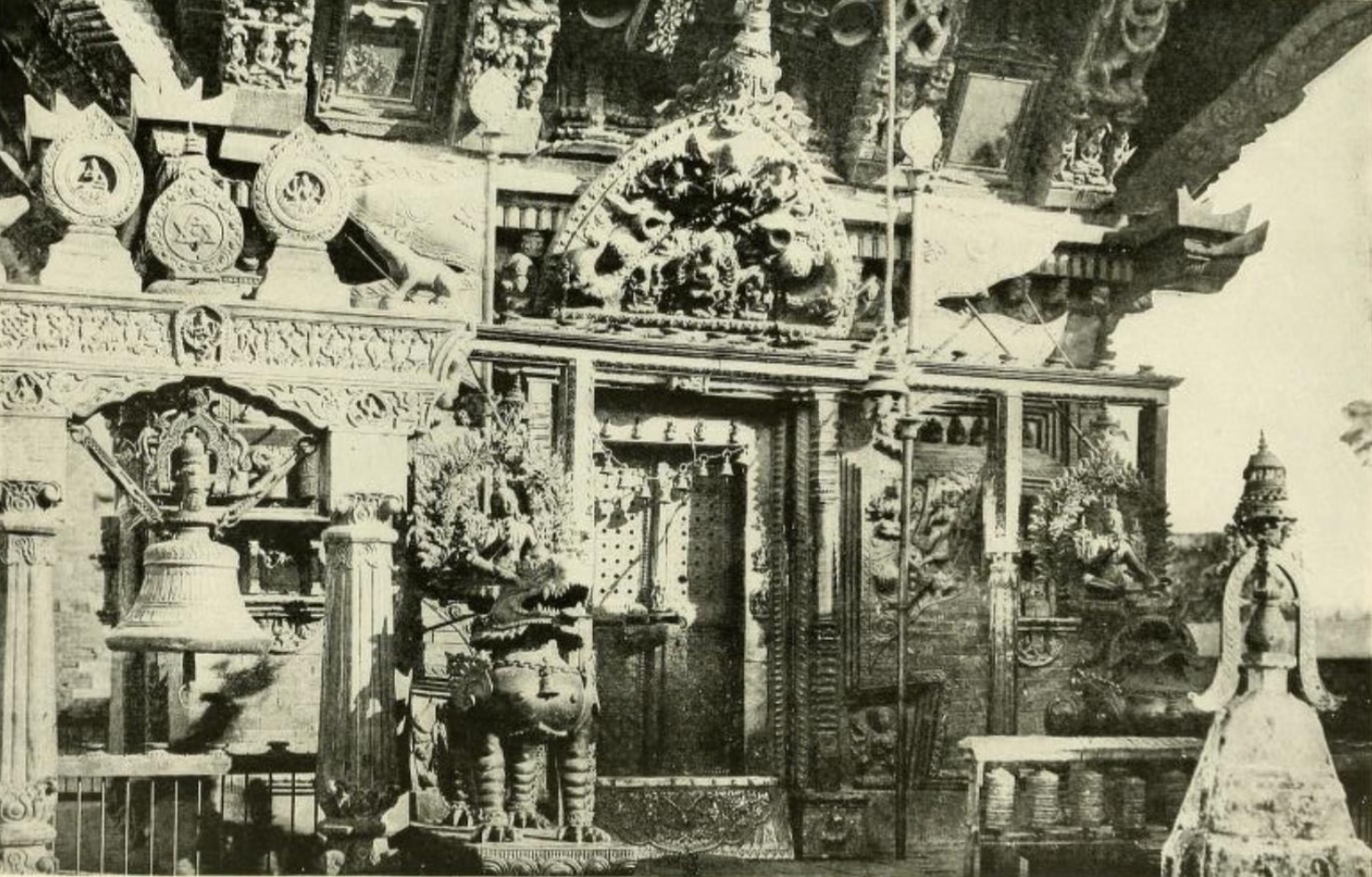 Photograph by John Claude White showing bronze ‘Singis’, or dogs, guarding a temple gate in Patan.
‘To the casual observer, Newar architecture often may seem over-elaborate, tedious, needlessly ornate. To the student it is as expressive of this oldest Nepal civilisation as a Roman arch or a Greek temple. Every idea of the complicated design has a meaning – generally a religious significance. Its very intricacy is expressive of a people of many races, whose tongues today are as those of ancient Babel.’
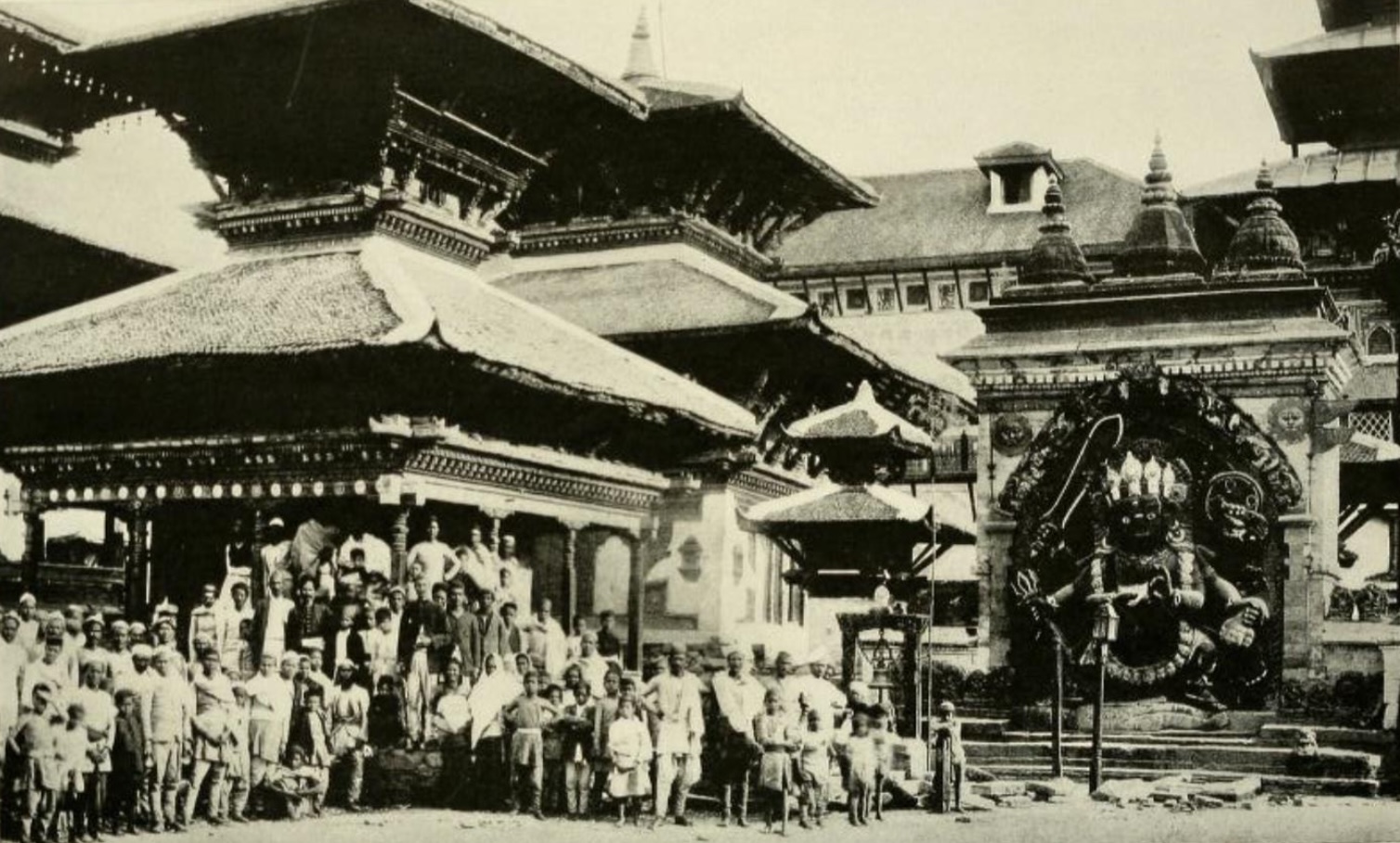 Art and Children in evidence, even in the Market-place of Khatmandu, by John Claude White.
‘The prolific art of Nepal knows no conservation; it pervades the marts of trade as generally as it does temples and homes. This buoyant energy, further exemplified in the rapid increase of population – for a glance at this picture will show that race suicide is not a Nepalese problem – explains why Nepal natives seek an outlet along the foothills of Bhutan and into Assam.’
The fearsome image at the right of this photograph is of the god Bhairav, a manifestation of Shiva. According to the Basha Vamshavali, the sculpture was discovered during the excavation of a water course for Pratap Malla in the palace treasury garden (‘Bhandarkhal’), in around 1650. As he tramples the body of the demon Betala, Bhairav sports a crown decorated with skulls, a garland of skulls reaching down to his knees, and he has serpents around his ears, wrists and ankles.
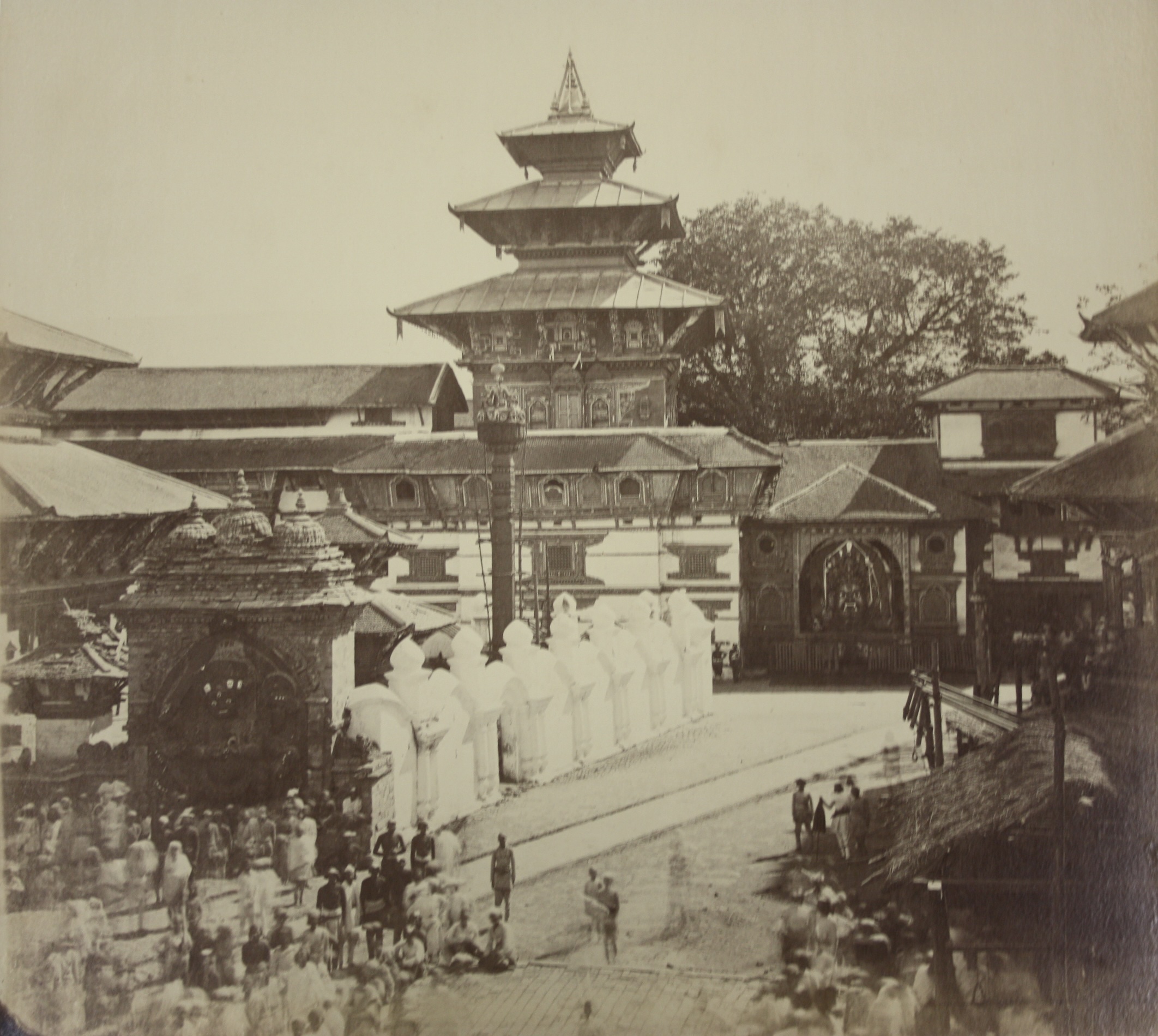 The image of Bhairub, uncovered only during the Indra Jatra festival, Kathmandu by Clarence Comyn Taylor (1863). (Ref: British Library, Photo 855/3).
‘The Shweta Bhairav mask, located behind a latticed window at the base of the Degutale temple … was installed by Ran Bahadur Shah in 1795, and cost the king 4.000 rupees. During Indra Jatra, images of Bhairav are established at various points throughout the old city, and these images dispense beer as prasad (consecrated food) to the faithful. The Shweta Bhairav is the biggest and fiercest of them all … Painted in a sharply rendered colour-scheme, the golden mask stands 3.5 metres tall against a background of whirling flames. During Indra Jatra a pipe protrudes from its mouth and young men climb up on one another’s shoulders to partake of the holy liquor.’ (Hutt, Nepal, p.92).
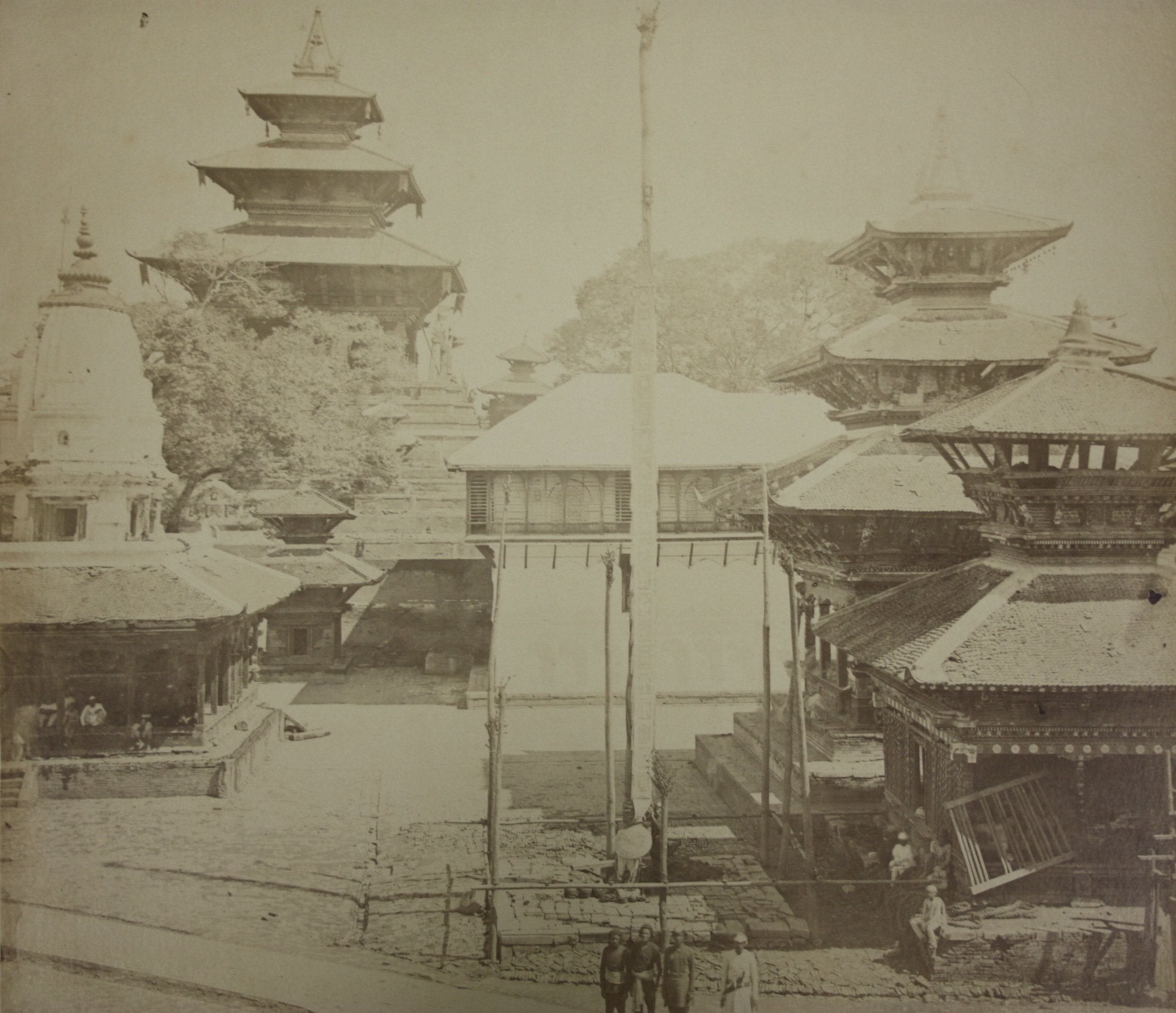 Part of the King’s Palace and Zenana Apartments, Kathmandu, by Clarence Comyn Taylor (1863). (Ref: British Library, Photo 855/2).
‘View of part of the King’s Palace, the building with the white roof in the centre of the picture being a part of the zenana and ladies’ apartment. In the foreground is seen the tall wooden mast called a ‘Linga’ surrounded by 8 small beams which is annually erected on the first night of the Indra Jatra festival in September to commemorate the conquest of the valley by the Goorkhas, in 1767. The long silken flag attached to its top is decorated with numerous symbols of Hindoo mythology.’
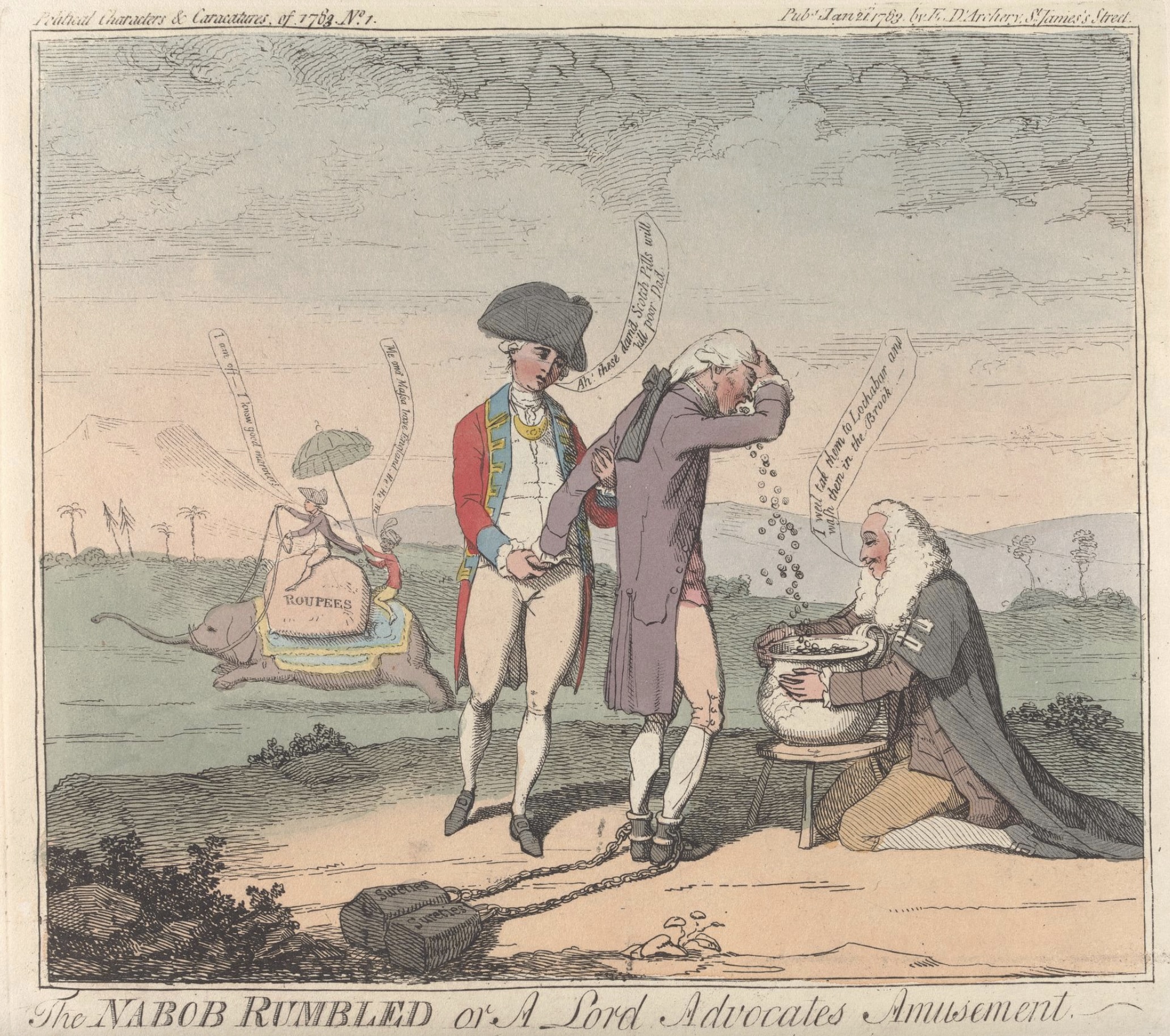 The Nabob Rumbled, or a Lord Advocate’s Amusement, by James Gillray (1783).
Sir Thomas Rumbold was the Company’s chief agent in Patna at the time of George Kinloch’s expedition, and one of its principal proponents. Having served as Robert Clive’s aide-de-camp at the Battle of Plassey (1757), he joined the Bengal civil service, rising to third in council at Chittagong by 1760. There he was heavily involved in private trade with Randolph Marriott and Harry Verelst. Rumbold was appointed chief at Patna, in 1763, and took up a seat on Bengal’s council in 1766, after Clive had returned to India.
At the time of his return to England, in 1769, Rumbold was believed to be worth between £200,000 and £300,000, but much of his fortune was tied up in India, leaving him exposed to the effects of the Bengal famine. For some years, he endeavoured to gain re-election to the Bengal Council. He was finally chosen to succeed Lord Pigot as governor of Fort St. George (Madras), in 1778. When he returned to England, in 1781, his activities became the subject of a parliamentary enquiry. This was allowed to lapse, but James Gillray’s caricature of Sir Thomas vomiting guineas into a chamber pot held by Henry Dundas neatly captures the reputation the Indian Nabobs enjoyed for ill-gotten gains.
In the picture, Rumbold’s son, in a military officer’s uniform, laments, ‘Ah! these dam’d Scotch Pills will kill poor Dad,’ whilst, in the background, a Company officer gallops away on an elephant, crying, ‘I am off – I know good manners!’ An Indian retainer seated behind him calls out, ‘Me and Massa leave England. He. He. He.’
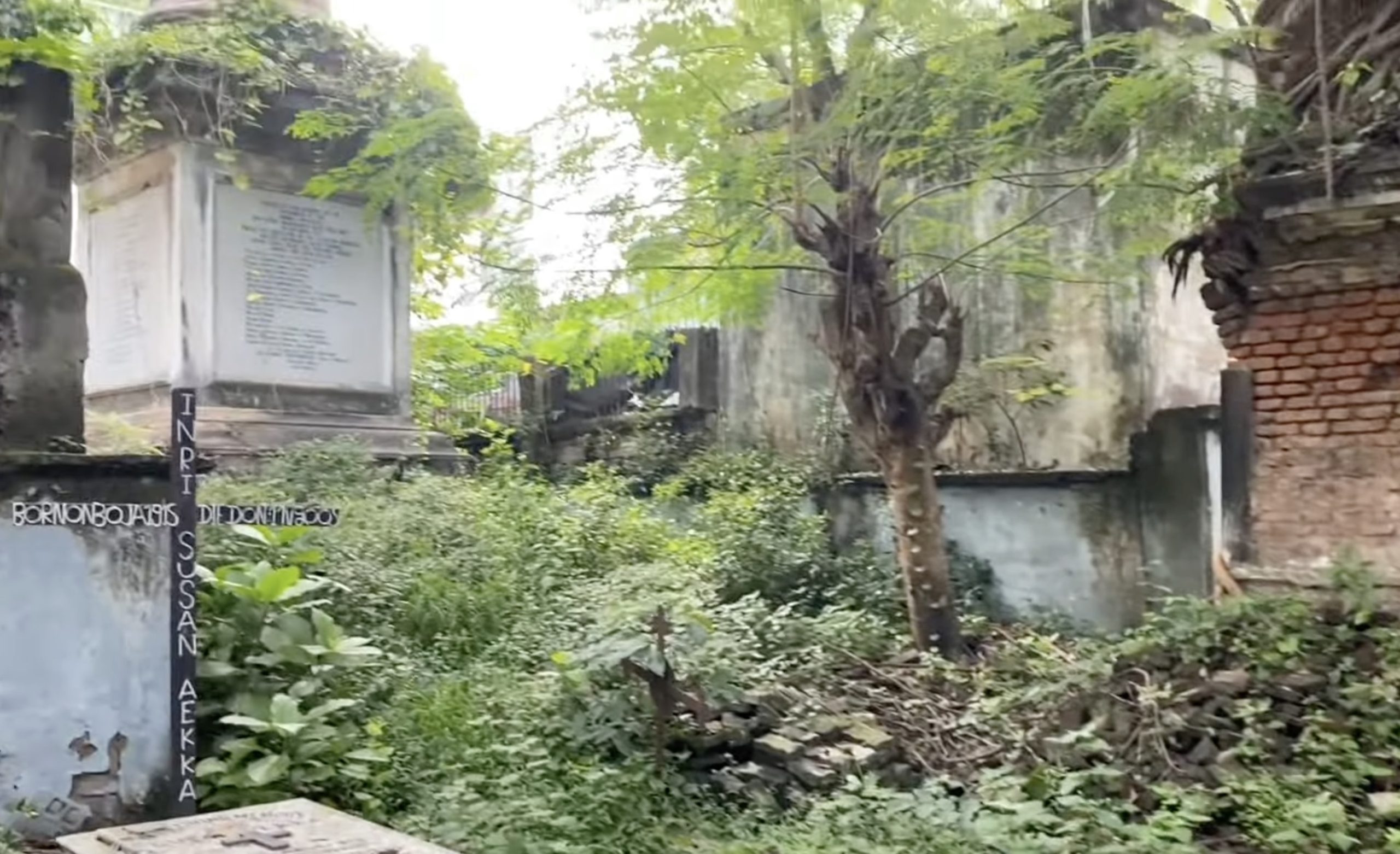 A photograph of the dilapidated Christian cemetery in the Gurhatta district of Patna, in which George Kinloch’s brother, Charles, erected a memorial to his brother.
At the rear may be seen the lower part of a memorial to the victims of the ‘Patna Massacre’, in which forty-five Company employees and two hundred of their loyal servants were killed on Mir Qasim’s orders (11 October 1763). Under the leadership of William Ellis, the chief of the Company’s Patna factory, the victims of the massacre had stormed and sacked the city’s citadel before being forced to flee on the approach of Mir Qasim’s army. They retreated to the factory, but they were driven from there and captured by Qasim’s German commander, Walter Reinhardt (‘Sumru’). He imprisoned them within Monghyr Fort.
Ellis had gone out of his way to make rule as difficult as possible for the Nawab. In this, he earned the sympathy neither of Henry Vansittart, Bengal’s governor, nor of Warren Hastings, his deputy, but the antagonism led to conflict and, ultimately, the Nawab’s defeat. It was in the wake of this that Mir Qasim’s prisoners were slaughtered, as they finished dinner in their prison courtyard. It was said that, as they were being bayoneted, they fought off their executioners with wine bottles and stones, as their knives and forks had been cleared away. Their corpses were thrown into a well.
An article in Bengal Past and Present (Vol.55, 1924) refers to an obelisk erected, in 1880, over the site of the well, to replace a monument set up earlier. It commemorated those ‘brutally massacred near this spot by the troops of Mir Kasim, Nawab Subadar of Bengal, under command of Walter Reinhart, alias Samru, a base renegade.’ It ended with the epitaph e dedecore hostium nata est gloria eorum. The inscription on the memorial shown above is different, so it is possible that this is a third monument, set up when part of the cemetery made way for a hospital.
The memorial to George Kinloch was probably sited near the first monument. If today’s state of the cemetery is any guide, it may now be unidentifiable, if it has not been completely removed or dismembered for its stone.
The Rise of the Gorkha
Running along the northern frontier of Uttar Pradesh and Bihar, Nepal occupies the centre of the zone where, in its northward drift, the Indian subcontinent meets the landmass of Eurasia. Where they collide, India’s plate is being forced down, and Nepal’s lifted. The country has buckled, and a series of step-like folds have formed lengthwise, separating habitable corridors at increasing elevations.
On the northern fringe of the Gangetic Plain, before the escarpment of the Siwalik Hills, is a low-level region of agricultural, marsh and jungle ground known as the Terai. After the Siwaliks and the forested valleys between, the Mahabharat Lekh serve as a second barrier before Nepal’s heartland: valleys at between six hundred and two thousand metres, including those of Kathmandu and Pokhara. Thereafter, the land sweeps up again to the peaks of the Himalaya, before declining, in the west, into some elevated valleys between the principal chain and the Tibetan plateau.
Thus the basic picture. Reality is less orderly. Myriad ridges cut across the corridors of habitation and the systems of the Karnali, Gandaki and Kosi Rivers cut through the strike of the mountains. Travel has long been difficult. It is easier in winter, when the climate is temperate, but for most of Nepal’s history, few trails were fit for horses and carts. During the monsoon (June to September), communication was almost impossible. Even in the 1960s, it was said that the easiest way of travelling between east and west was to cross into India and take the train, before crossing back.[1]
In December 1721, the Jesuit missionary, Ippolito Desideri, journeyed from Nyalam (‘Kuti’), on Nepal’s northern frontier, to Kathmandu:
The road skirted frightful precipices, and we climbed mountains by holes just large enough to put one’s toe into, cut out of the rock like a staircase. At one place a chasm was crossed by a long plank only the width of a man’s foot, while the wooden bridges over large rivers flowing in the deep valleys swayed and oscillated most alarmingly.
During the last days we ascended and descended one mountain after another, but they are not so bare as in Tibet; there is grass and the pleasant shade of trees. Here it is of course impossible to ride, but easy to find men who will carry you. They have leather straps across the shoulders and forehead attached to a board about two hands in length and one in width. On this one sits with legs hanging down, and arms round the man’s neck.[2]
In 1871, pundit no.9, Hari Ram, travelled the same way. Over twenty-five miles, he crossed the Kosi River fifteen times:
At one place, the river ran in a gigantic chasm the sides of which were so close to one another, that a bridge of twenty-four paces was sufficient to span it … Near this bridge, the precipices were so impracticable that the path had of necessity to be supported on iron pegs let into the face of the rock, the path being formed by bars of iron and slabs of stone stretching from peg to peg and covered with earth. This extraordinary path is in no place more than eighteen inches and often not more than nine inches in width, and is carried for more than one-third of a mile (775 paces) along the face of the cliff, at some 1,500 feet above the river …
According to Major Thomas Montgomerie, the pundit ‘never in his life met with anything to equal this bit of path.’ Below Listi, about sixty miles from Kathmandu, it became more like others south of the Himalaya. Still, for a considerable distance, it was ‘rugged in the extreme’, becoming easy only in the valleys. The merchant trail from the low country to Kathmandu used by Francis Hamilton, in 1802, shared its qualities. During one eighteen-mile section, he crossed the Rapti River twenty-two times.[3]
It should not surprise, therefore, that for most of its history, Nepal was fragmented politically. Before the 1740s, the record speaks of twenty-two allied principalities (‘Baise Rajya’) in the Karnali Basin, and twenty-four more (‘Chaubise Rajya’) in the Gandaki’s, west of Kathmandu. At best, however, these alliances were intermittent. On only three occasions did Nepal’s statelets coalesce into more permanent groupings: a Malla (‘wrestler’) kingdom, which flourished in the west in the twelfth and thirteenth centuries; a Sen kingdom centred on Makwanpur, which peaked in the sixteenth; and another kingdom, which reached its zenith in the Kathmandu valley under Jayasthiti Malla, after 1382. It is with the last, and with the Gorkhas, Rajputs from Chittor who settled among the Chaubise in the fourteenth century, that we are concerned.[4]
The Malla realm began to fracture, in 1482, when Yaksha Malla appointed joint successors. By 1548, it had separated into three kingdoms centred on Kathmandu, Patan (Lalitpur) and Bhatgaon (Bhaktapur). Mostly, they quarrelled over trade with Tibet and the profitable exchange of its bullion for Nepali rupees. (As Desideri and, later, George Bogle attest, Tibet produced no coins of their own: their silver was monetised at the Malla mints, a service which, in 1811, Colonel Kirkpatrick estimated earned up to a third of Gorkha revenue.) There were two principal trading routes, one to Gyirong in the north-west, which Kathmandu controlled from Nuwakot, the other Desideri’s route to Nyalam, which passed by Bhatgaon and the fort at Naldum (Nagarkot).[5]
The Kathmandu Valley was rich in agriculture and manpower, as well as trade. Its architecture proclaims its greater prosperity. It was protected by mountains on all sides. Dissension between the Mallas gave the Gorkhas their opportunity, yet their conquest took twenty-five years (1744-1769).[6]
Some supporters of Nepal’s founding raja have suggested he united the country for protection against a new southern threat. This may be doubted. Nepal’s statelets lacked scale, and Prithvi Narayan Shah may have anticipated that a greater power would fill the void left by the disintegrating Mughal empire. Yet it is likely that, initially, he was drawn to the Valley by its wealth. Such is the implication of his words in the Divya Upadesh, that he was stimulated by his first sight of it, whilst journeying to Makwanpur to claim his bride. A later visit to Benares, in 1742, will have given him an appreciation of the challenges facing the Mughals. The East India Company will not have been especially prominent among them. Fort St. George (Madras) fell to the French in 1746, Fort William (Calcutta) to Siraj-ud-Daula, ten years later. It was the eclipsing of the French in India (1763), Buxar (1764), and the assumption of the tax administration of Bengal, Bihar and Orissa (1765) that transformed the Company into a powerful force.[7]
Prithvi Narayan struck first at Nuwakot, in September 1744. The forts protecting the route to Nyalam took longer to secure, but by 1755 they too were in Gorkha hands. Jaya Prakash Malla, ruler in Kathmandu, was severely weakened: for a period before 1750, he was deposed in favour of his eight-year-old son. Afterwards, his reliance on expensive mercenaries intensified the adverse effects of reduced trade. Nonetheless, for a few years, Prithvi Narayan concentrated on protecting his rear against the Chaubisi, and on augmenting trade with Tibet. In 1762, he began to blockade the Valley. Makwanpur, the principal fort in the south, fell in August, the subsidiary forts at Sindhuli and Hariharpur, in October.[8]
The capture of Makwanpur drew Bengal into the conflict for the first time. Mir Qasim, whom the Company had installed as replacement nawab, in 1760, responded to an appeal from Makwanpur’s rulers and sent an army. Henry Vansittart, governor in Bengal (1760-1764), suggested that, truly, he aimed at the reduction of Nepal to recover the revenues he had relinquished to the Company’s officers. Unfortunately, his army was ill-prepared and the Nawab’s ‘excessive and known timidity’ ill-suited him for war. The attack became a rout. Many men, much equipment, and significant prestige was sacrificed.[9]
Armed with Mir Qasim’s modern rifles, Prithvi Narayan tightened his grip on the Valley. In 1764, Jaya Prakash’s attempt to retake Naldum was defeated when Gorkha troops, mistaken for a relief force, infiltrated his lines and wrought havoc on his camp. In October 1765, Prithvi Narayan besieged the southern town of Kirtipur. It had repulsed two previous assaults and was only induced to surrender after six or seven months. For this there were consequences. The Capuchin missionary, Giuseppe of Rovato, wrote that the enemy were admitted into the town after promising an amnesty:
… but two days afterwards Prithvi Narayan, who was at Nuwakot, … issued an order to Surtiparatna his brother, to put to death some of the principal inhabitants of the town, and to cut off the noses and lips of everyone, even the infants, who were not found in the arms of their mothers; ordering at the same time all the noses and lips, which had been cut off, to be preserved, that he might ascertain how many souls there were, and to change the name of the town into Naskatapur, which signifies ‘the town of cut noses’. The order was carried into execution with every mark of horror and cruelty, none escaping but those who could play on wind instruments … it was most shocking to see so many living people with their teeth and noses resembling the skulls of the deceased. [10]
By now, Ranajit Malla, the disaffected ruler of Bhatgaon, had repented of his decision to solicit Gorkha support. He was late to do so. After the fall of Kirtipur, the Valley was fully invested. Already, Jaya Prakash Malla was using the wealth buried in the palace’s treasure garden (Bhandarkhal) to pay his troops. Perforce, he turned to the Company.[11]
The Company Becomes Involved
On 6 April 1767, Edward Golding, the Company’s agent at Bettiah, advised Thomas Rumbold, chief at Patna, that some Nepalese envoys (vakils) had appeared, soliciting help. Prithvi Narayan had written to frustrate them, but Golding favoured intervention. Justice would be on Calcutta’s side, he argued, and so would self-interest:
It would be rescuing a large city from plunder and the sword, and there is not the least doubt from the former very insolent letter of the Goorkally Rajah, and some letters which have lately passed between him and the phouzdar (commander) here, but that if he succeeds at Nepal, he will most certainly come down to Bettiah, for he has already encroached upon us not a little …
Rumbold agreed. Because of the siege, he declared, the inhabitants of the Valley had been driven to extremities, and trade, ‘which formerly was very considerable,’ had ground to a halt. Since he expected a vakil to come to Patna, he asked whether he should give him encouragement.[12]
Whether the trans-Himalayan trade with India had really been of great consequence is a matter of some debate. Francesco della Penna, who visited Nepal and Tibet between 1719 and 1747, wrote of Tibet’s minerals and gold, of its imports from China and Nepal, and of its trade in white and patterned cloth, European scarlets, corals and amber from ‘Mogul’. Quantities are left opaque. Bogle, who visited Tibet in 1775, believed its largest share of trade was with China. (By then, Prithvi Narayan had interrupted commerce through Nepal.) Nonetheless, he encountered several Kashmiri merchants in Tibet, and Francis Hamilton described Kathmandu as an emporium where Kashmiris dealt with merchants from Lhasa. No doubt, for the inhabitants of the border districts and the pilgrims (gosseins) who ferried precious goods into the mountains, the trade was material. Yet, Bogle wrote that the trade of the Kashmiris was ‘not considerable’ and that Tibetans feared the heat and the unhealthiness of Bengal. The failure of the mart established at Rangpur after his return to India, despite the waiving of duties, suggests that trade through the eastern Himalaya may have been limited.[13]
In 1774, Warren Hastings expressed especial interest in the goats (tús) which produced the fine wool later termed ‘cashmere’. In this, his instinct was sure, for the trade was valuable. But, as the name implies, it followed a westerly route into Ladakh and Kashmir. An effort by the Raja of Jammu, Gulab Singh, to engross the trade in the 1830s and 1840s caused much unease. It was only settled after the Anglo-Sikh War (1845-1846).[14]
Golding’s primary concern was the extraction of timber from the Terai. Following Colonel Robert Barker’s declaration that its firs could supply masts for all of India, private entrepreneurs quickly became involved. They were strictly enjoined not to impede the public benefit. Yet, in October 1766, Richard Barwell, composer of the letter which opens this account, was castigated by Fort William for his disobedience. Calcutta had ordered seven thousand timbers. When they could not ship them, because he had ‘engrossed’ the boats, they complained,
So bold a defiance of our authority cannot fail to incite our astonishment, and you may be assured it will incur our highest displeasure if you do not immediately give up such a proportion of the boats you have secured, as may enable the ministers to send down the Company’s timbers without loss of time.
When Calcutta decided that no European, servant or otherwise, should remain to molest their business, Mr. Pearce and Mr. Barton were given a month to extract themselves.[15]
Now, Golding declared that if Prithvi Narayan subdued Kathmandu, the fir scheme would have to be abandoned, leaving the Terai to become infested with his people. The forests in which the Company were engaged were subject to one of the ‘revolted rajas.’ Without his support, they could achieve little:
If the Company propose to themselves any advantage from cutting of firs or the revenue of the country, they must shortly be obliged to oppose Goorkally, and at a time when he may be better prepared too than at present to receive us. I therefore imagine it the most prudent step to attack him before he gains strength, and while it may be done without any expense to the Company.[16]
Rumbold agreed that a small force would be sufficient to raise the siege and reduce the Gorkha Raja ‘to obedience.’ He believed that both sides in Nepal’s lengthy struggle had been weakened by it. Yet his intelligence was incomplete, even misleading. When Prithvi Narayan indicated a willingness to visit Patna to negotiate a settlement, given a guarantee of safety, Rumbold put the best possible gloss on his message. The raja, he wrote, was,
… so very apprehensive of our assisting the Nepal Rajah (Jaya Prakash) that I had a letter from him the other day, desiring he might be allowed to visit Patna and that protection might be afforded him.[17]
During their consultations, the Bengal Committee acknowledged the need to defend Bettiah against incursions from the Terai and beyond. More pertinent for them, however, was Rumbold’s idea that ‘a lucrative branch of trade may be carried on by a free communication with Nepal.’ Given Bengal’s trade deficit and the scarcity of specie, they explained,
… we the more readily embrace a measure which promises to open new sources of trade and stores of money to replace those annual drains of treasury we are directed to make for supplying China investment.
(Nepal was perceived to be rich in gold, although, as James Logan reported in 1769, it was ‘chiefly brought there from Tibet.’) The committee were clear that they preferred to accomplish their objective through mediation than by force of arms. Nevertheless, Rumbold was instructed to inform Prithvi Narayan that,
… unless he will … desist from molesting the raja with whom we are upon terms of amity … the honour and interest of the Company require we should treat him as a declared enemy.
Captain George Kinloch was sent ‘with all expedition’ from Tripura to Patna, to receive such directions as Rumbold considered necessary for ‘establishing the peace and tranquillity of the country of Nepal and promoting a free intercourse.’[18]
Upon his arrival, he was introduced to Jaya Prakash’s vakils, Muktan Umdah and Faquir Ramdas. They explained how his people were confined to a handful of towns, where
… the number of families and vast consumption of grain, which is now brought him with great difficulty and danger, and in very small quantities, must in a very short time reduce him to the necessity of opening his gates …
Reassuringly, Kinloch wrote that, although the Gorkha Raja had about 50,000 men under arms, the majority were defending their own territory, leaving no more than 20,000 in the Valley. Most were armed with bows and arrows, swords and matchlocks and, since it was the sowing season, a majority were preoccupied with that.
With regard to the march to Nepal in the rainy season, [the vakils] both declare and offer to forfeit their lives that there will be no impediment from that now, a month or three weeks since, and offer the same pledge to carry the party safe to Nepal [on] a road where neither the hills nor rivers will obstruct them and where good water will be had …
All the same, the vakils were warning that Prithvi Narayan knew the English might intervene. He would ‘make every push’ to complete the siege and had recently captured the principal grain supply. Sixty thousand families were in peril of famine, so time was pressing:
[A] march there will be attended with much greater difficulty towards the end of the monsoon, as the rains cause an immense growth of jungle which almost chokes up the road. [But] if the expedition is delayed till the rains are over, the whole country will undoubtedly be in possession of the Ghorkwallah, which certainly would have been the case long ere now, had not the report of English assistance kept the Nepal rajah’s people in spirits …[19]
Finally, Kinloch sent a plan of the Gorkha lines prepared by Muktar Umdah. Although it was ‘altogether out of proportion,’ it showed the Gorkhas’ advantage of being protected in their redoubts. Of this shelter they needed to be deprived, if they were not to gain from the monsoon. Kinloch reported Muktar’s confidence that this could easily be managed, provided the expedition departed before the rains developed.
Rumbold appended an itinerary of the route. The distance to Kathmandu was ninety-six coss (about 170 miles), to be completed in eleven stages. Water and provisions would be provided at the first four stops (up to forty-four coss). Thereafter, water would be plentiful, but the troops would have to carry their own provisions to Daupchah (forty-six coss), where they would be supplied by the raja. Rumbold wrote,
From Patna to Jelaudbass (50 coss) the road is very good, from thence to Sidulhi (18 coss) is chiefly jungles, through which cannon may pass without difficulty; from Sidulhi to Nepal, the road is reckoned extremely good. In the march to Nepal by the route, there [are] no rivers to be crossed, nor any hills to be passed. It will be necessary to carry bullocks from Derbunga to Dumjah (54 coss); at the latter place the troops will be supplied with coolies from Nepal.[20]
This was a remarkably sanguine appraisal of the trail. London later criticised Fort William for sanctioning the expedition without consulting Colonel Richard Smith, their commander-in-chief. They had a point. Kinloch, they complained,
… seems never to have corresponded with him, or sent him his returns, which is contrary to all the rules of military subordination.[21]
When Bengal Committee met on 21 July, Prithvi Narayan’s response to Rumbold’s message was still awaited. They delayed no longer. Believing they enjoyed military advantage, they probably responded to the appeal for humanity. Yet, neither Rumbold nor Kinloch had experience of the route, and no attempt had been made at reconnaissance. The committee were aware of the risks. They ‘positively insisted’ that Rumbold should give up the plan if he were less than fully convinced it would meet with success. Defeat, they warned, would reflect ill upon the committee and ‘would bring dishonour upon our arms.’ They expressed confidence in his prudence but warned of the risk that the vakils may have given him ‘false reports and exaggerated accounts.’ On one thing they were adamant:
Should Captain Kinloch find in the progress of his march that the raja has been forced to submission and that the enemy are in possession of his country, you will in such case direct him not to proceed, but take post in some convenient and secure station in the Bettiah province … The same step he will pursue should he encounter unexpected difficulties from the season, the situation of the country, or the power of the enemy, so as to [render] dubious the success of the expedition.[22]
On 6 August, Rumbold announced that Kinloch would soon be departing. An evasive and insolent response had been received from Prithvi Narayan. Worse, he was demanding the surrender of Bettiah on the ‘pretence’ that it once belonged to his family. Rumbold repeated that, if he ever became master of Nepal, a force would have to be sent to reduce him.
In practice, Kinloch left Patna a full three weeks later, in the height of the monsoon. Still, on 25 September, Calcutta wrote to London expressing their confidence. They acknowledged that their actions appeared alien to the way the English usually regulated their conduct. Nonetheless, the decline of trade and scarcity of specie required that ‘every spring of industry should flow freely and without interruption.’ In particular, they noted that the terms of trade with Nepal were favourable. Promising that the expulsion of the Gorkhas would render the traffic ‘more easy and secure than in former times,’ they expressed optimism that they would have positive news by the last despatches of the season. They were to be gravely disappointed.[23]
The Journal of George Kinloch
Kinloch begins his journal at Mahua (‘Mowa’), beside a stream of the Gandaki River, six coss north-east of Patna. He put no number on the size of his force, but Richard Barwell states that there were 2,400 sepoys, and we know that, at Janakpur, they left behind some servants and women, for want of provisions. The train was sizeable. Faquir Ramdas was on hand to show the way and arrange supplies. Carts and cannon were drawn by bullock.
Kinloch began cheerfully. The country was flat and fertile, dotted with numerous ‘topes’ (mango groves or stupas) and villages. The road was good, except in a few places, where it was ‘swampy’. Yet the stream proved an obstruction. Its crossing had to be managed using canoes,
… which made it very troublesome and tedious, especially the embarkation of the cannon, for which purpose we were obliged to tie five canoes together and make upon them a platform of bamboos …
This balancing act was intricate. The canoes became separated, and three men were drowned. Kinloch sent ahead for boats, but few were available. The appearance of his force had caused the population to decamp. Transport became a persistent problem. On 30 August, he crossed another branch of the Gandaki, at Pusa, and discovered that
… the country before me was overflowed for 7 coss by the quantity of water in the Bagmati, which the faquir, my guide, had all along assured me he could carry me round, however he now found it impossible …
Before leaving Patna, Kinloch had organised boats to deal with the Bagmati, but they became isolated on the far side of a stream whose floodwaters had subsided, leaving an area of impenetrable mud. A crossing was found, but the obstructions kept coming – trackless morasses, nullahs too deep to be fordable, streams too shallow for boats. Kinloch sent half his detachment to Darbhanga and followed with the guns, using rafts made of canoes as before. The weather was showing convincing signs of change; for a period, the violence of the wind made even the boats unusable. Then it transpired that, beyond Darbhanga, there was an unfordable nullah cut for the transport of timber. With no boats to hand, Kinloch resigned himself to building a bridge.
On 6 September, he received intelligence that,
… most of the villages between us and the mountains were deserted, particularly Janakpur, at which place I had been informed I should find plenty of grain. The reason given for this was that the people were much at a loss whether to join us or the enemy …
Here was cause for alarm. Kinloch had been warned that,
… from Janakpur to Sindhuli (4 days’ march) it was quite a jungle in which there was no provision or even a house to be seen, and that from Sindhuli to Nepal there were some villages but my finding grain in them depended entirely on the people remaining when I arrived, which was hardly to be expected.
He summoned Dondao Choudery, who was responsible for supplies. In Patna, he had refused the offer of an advance to ensure that nothing would be wanting. Everything, he had explained, could be arranged at a week’s notice. Three weeks later, there were fewer than six hundred maunds of grain in the buzzar. In no uncertain terms, Choudery was warned that an example would be made of him if he failed in his obligation. He was adamant. In three days, three thousand maunds would be ready. Kinloch offered him another advance, but Choudery was almost offended. Generals Carnac and Barker, he protested, had betrayed no doubts about his efficiency on their campaigns. Kinloch reminded him that, in their case, provisions had been readily available. Now they were headed for country where there were no houses to be seen. For encouragement, he gave Choudery some of his own share of the buzzar’s ‘emoluments’, and Choudery disappeared.[24]
In the meantime, Kinloch learned that the extraction of catechu, borax, copper and iron had rendered Darbhanga’s water ‘extremely unwholesome.’ Worse, he understood that,
… nearer the hills it is said to be of a poisonous quality, occasioned by the minerals and poisonous herbs, roots &c. with which it is impregnated …
On Ramdas’s advice, he bought some ‘cheerata wood’ for use in boiling. Then the heavens opened. Kinloch had travelled some fifty miles, but Nepal’s foothills were as far distant. His troubles were mounting: [25]
8 [September]
Rain continues without intermission. Sent the bildars (engineers) on my arrival here to repair the road to Janakpur; the hircarrahs (messengers) bring account that where the bildars had mended the road, is by the rains rendered worse than ever.
9 [September]
Violent rain, now three days without ceasing – many of the people sick, and last night fourteen deserted. No appearance of fair weather, nor no marching without the certainty of spoiling the ammunition and all the grain in the buzzar …
On 10 September, Kinloch was informed that the people of Janakpur would be waiting for him with supplies. Choudrey would be with them. He set off at dawn the next day. Yet his troubles increased. He was entering the Terai during the peak season for diseases like malaria. In 1721, Desideri had warned that, during the monsoon, the road ahead was ‘impassable, being deadly’:
Anyone daring to take this journey at that time is liable to catch a disease called aul (‘ol’) by the natives. This aul is a sort of influenza which prevails in the plains and the valleys through which one is obliged to pass; it is less virulent in the daytime, but pestilential at night or when asleep; being caused by the great heat and humidity …
The malady is generally fatal; if the man survives he never really recovers his health. It is true that the men who carry the mail from Nepal to Patna, and from Patna to Nepal, are obliged to pass at all seasons, but they know the short cuts, avoid the valleys, and spend the nights on the mountains. They also know certain secret remedies and a drink called bang, water in which dried leaves either of hemp or some similar plant have been soaked. It is greenish in colour and very refreshing, but makes people stupid and drunk. Many die on the way …[26]
For a few days, the rain eased, but the road was difficult, and the villages were deserted. Though flat and still fertile, the land was strangely uncultivated, turning to ‘grass jungle.’ Kinloch could not account for it, unless the mountain people to whose excursions it was exposed were the cause. He was confident that a few troops and ‘proper encouragement’ would quickly make the Terai prosperous. Yet, in the moment, many of his men were ‘knocked up’, complaining of soreness, cuts and pains from the badness of the road. The bullocks were also fatigued, so the expedition halted at Kalikapur (‘Calkipore’), on 12 September.
Kinloch hoped that the thirty-four miles to Janakpur would be easier. In fact, they involved the crossing of three nullahs, two of them ‘gullet high’, and a passage through three miles of thick jungle. When, after two days, he entered the town, it had the appearance of having been abandoned.
In the morning, some headmen appeared. In exchange for protection, they offered such limited provisions as they could afford. There was no sign of Choudery.
[Kinloch wrote] In such a situation, what was I now to do? I saw a prodigious chain of mountains before me, the highest of which I was told I had to go over. To wait here for grain was giving the enemy an opportunity (if not done already) to throw up works on mountains which seemed by their height and nature to be the strongest of barriers. In this emergency I asked the faquir how it was possible to proceed without a sufficient quantity of grain, to which he answered I had five days’ provisions in the buzzar and, were there not so much, my only chance now was to push on with the greatest expedition …
Although Janakpur stood at the periphery of Gorkha influence, Prithvi Narayan’s influence may have been affecting supplies. (Kinloch’s references to ‘protection’ and a Gorkha fort nearby are suggestive.) If the thought occurred to him, however, there is no betrayal of it in his diary. On the assurance that Sindhuli’s larger population promised ‘the greatest probability’ of a sufficiency, he maintained his advance. Sepoys were sent ahead to create a passage for the guns, with the injunction that they were to leave their women and servants behind. Other members of the force remained in Janakpur, to repair its fort, assist with communications and protect the flow of grain. Kinloch introduced a strict daily allowance for rations and confided to his diary,
Had intelligence that the enemy at Sindhuli did not exceed 300 in number but that there were many in the jungle and neighbouring hills, which could be soon collected to a large amount; that Chumpan Sing Tapa, the kellidar (commander) at Sindhuli, had sent letter to Nepal informing his master of my being here, who would certainly send a body of his best sepoys to dispute that place with me, being the key of communication and of the utmost consequence to him.
He resolved to leave at daybreak on 17 September, but the buzzar’s preparation delayed him till three. Then the cannon became mired in a swamp. Progress was limited to just one coss.
On 18 September, a letter arrived from Kathmandu, urging the British forward. Jaya Prakash promised to join Kinloch at Sindhuli, after its garrison had been reduced, a remark which earned him the sobriquet ‘the Considerate Rajah of Napaul.’ The force advanced into the jungle. Of its inhabitants there was no trace, excepting elephants, tigers and bears, of which there was evidence of ‘vast numbers.’ In time, impressive stands of timber gave way to grassland of immense height. It continued for six coss. At day’s end, the force halted in a riverbed, ‘there being no encamping in the jungle.’
There was just a rivulet of water, but Kinloch was apprehensive. He had reached the foothills, the skies had threatened all day, and trees measuring a hundred foot from tip to root were strewn about, suggesting a storm’s effects might be violent. As thunder and lightning played about the valley, he called Ramdas to one side and questioned whether they should not clear a space in the jungle for the stores. The faquir told him not to worry, and Kinloch retired to his tent.
After an hour, the rain arrived. At first, Kinloch was concerned only for the people without cover. Progressively, his anxiety increased. Finally, he asked a retainer to check for signs of an improvement outside. Instantly, he returned with the cry that everything would be lost if it were not carried to safety. Simultaneously, a rush of water burst open the tent wall. As it filled the space under his bed, Kinloch scrambled outside. Already, the deluge had reached the magazine, so he roused some artillerymen and lascars, and ordered them to bear it away. ‘Impossible!’, they protested, so he attempted to show them the way:
… they were right, for just when I had got about half way over the place, the stream was so strong that it fairly took me off my feet and carried me down with it for 25 yards, and luckily brought me against the opposite bank, where I had hardly strength enough left to lay hold of the grass. I scrambled a little way into the jungle and found the people who got over climbing up trees, declaring even the tops of them would be overthrown. One large branch was overloaded and broke down, on which the people went to their prayers …
For the remainder of the night, Kinloch watched as flashes of lightning presented glimpses of the wrecked camp, as tents, men and stores rolled down with the stream.
When the morning came, it presented a most melancholy scene: the greater part of my baggage gone; the gentlemen and poor sepoys in the same situation and, what was worse, it rained as if heaven and earth had been meeting. I ordered the arms, ammunition and buzzar to be reviewed … Of the first, 15 stand were lost; of the second, all of it almost in the magazine was spoilt; and [of] the last, about 1 day’s grain was gone, and four men drowned.
Initially, Kinloch considered abandonment. Now he changed his mind. Three days’ rations remained, and Ramdas was still offering assurances about the supplies at Sindhuli. As soon as the fort was taken, he declared, ‘the people, if at first they did run away, would again return.’ As expressions of confidence go, this was surely less than convincing. However, the inundation subsided as quickly as it had arisen. Kinloch was comforted. He decided that ‘no impediment remained to hinder the Choudrey’s grain from coming on.’
Since the cannon would take longer to transport, Lieutenant Hoggan and three companies of sepoys were detailed to join those sent ahead earlier. They were told to attack Sindhuli fort ‘with the greatest expedition.’ Surgeon James Logan accompanied them. The remainder struggled for three hours to extricate the artillery and convey it into the jungle. It required few words for Kinloch to summarise his day:
No baggage come up or anything to eat. Violent rain, all the time. Distance 2 coss. Bearings NNW.
The troops spent 20 September battling unruly jungle to the foot of ‘Beem-band’, a steep, muddy barrier reputedly thrown across the way by the superhuman warrior, Bhimsen. A slippery, narrow, twisting path represented entry into the Siwalik hills. Since the cannon were impeding progress, Kinloch left an officer and two companies of men, and pressed ahead. At that night’s halt, the all-embracing vegetation intensified the feel of the deluge (if that can be imagined). Behind, one of the cannon became stuck in mud, blocking the progress of the baggage. Having ‘fasted above 30 hours,’ Kinloch was forced to beg some rice off a sepoy.[27]
The next day, the trail followed the stony bed of the Kamala River (‘Comla’) between high, jungly mountains. Where the rocks were exposed, they galled the people’s feet. Otherwise, the stream was deep and rapid. Several men were swept downstream and four stands of arms were lost. After six coss, the troops encamped in the bed of another river. There was considerable unease, but no alternative. The mountains around looked impenetrable, and the guide was unsure of the way. They had to wait until someone came to take over. Most of the sepoys had food remaining for one night only. Some had none at all. There was still no evidence of Choudrey. Kinloch put his best face on matters and sat down to a bowl of rice. Everything else, but a little wine, had been lost in the earlier inundation.
At daylight, he sent a detachment to find Lieutenant Hoggan and awaited the guide, who brought a revivifying report that Sindhuli had fallen. The men set off in better heart, the elephants and horses following the course of the river, the troops a trail in the mountains, with rocks and jungle on each side, ‘so narrow that only one man could go at a time.’ Before they reached Sindhuli, they crossed the Kamala thirty-two times, the stream ‘in most places navel high.’ The water demolished the men’s shoes and stockings, the stones the skin on their feet but, finally, the force entered a small, open plain of scattered villages and paddy.
As the men rested, Kinloch sought out Hoggan. After a stiff climb, Sindhuli ridge came into view. It was five hundred yards long, narrow and steep all around. At one end, stood a redoubt defended by a wall, palisade and ditch, at the other, a fort on a still steeper peak about twenty yards high.
[It] is defended by a deep ditch at the foot of the mount, a very strong palisade, bound well together, a stone wall on the top of which there is a fence of small bamboos bound hard together about half a foot thick. At each corner, there is a kind of wooden gallery, for throwing stones, and in the middle a large bungalow. There is likewise a small temple dedicated to Beem Sing, with a stone reservoir before it, which held a good quantity of water.[28]
Hoggan’s news was dispiriting, that
… the sepoys were in the redoubt, which the enemy had abandoned, but that the 5 companies had been beat off from the kella owing chiefly to their and the black officers’ bad behaviour, who set them every ill example. When the first party began to ascend, they found the hill stuck full of spikes, which terribly wounded their feet, and, while the enemy annoyed them with showers of arrows and stones, our own sepoys fired from the bottom of the hill, so that they could not go up. Everything went into confusion, and he was obliged to lead them off …
Among the wounded was Surgeon Logan. Kinloch’s brother, Charles, had been able to deputise for him, if needed, so he volunteered to lead the storming party, to reduce the risk to Hoggan. (Kinloch admits his mistake in sending only one officer with the advance party.)
Finding the sepoys and black officers backward, [Logan] went up the hill and got over the palisade, where he received several blows with stones and, finding no body come to his support, on the third attempt to return over the palisade, received a very dangerous blow on the head and, by his hand being there at the time, struck off the end of his middle finger.
After the briefest of pauses, Kinloch planned his attack. Hoggan’s force was enlarged with two companies and split into three parts. One was to draw attention to itself on one side, allowing the others to launch attacks in two other locations, separately. The sepoy officers were told to ensure their men held their fire until ordered and put shoes on their feet before entering the fray.
The assault went in before dawn, on 23 September, and the enemy were taken by surprise. The fort was carried in an hour. Inside, eight men were killed, with one mortally wounded. One was taken alive. After a stout defence, the defenders – there were no more than eighty – ‘threw themselves from one of the corner galleries and left the marks of their blood for a considerable distance.’ They left behind a few matchlocks and ‘an incredible quantity’ of fearsomely barbed arrows. On the Company’s side, three were killed, with 137 wounded.
And yet, as the Nepalese chronicle, Bhasha Vamsavali, reveals, the Gorkhas were far from beaten. A force under Bir Bhadra Thapa had been placed in defensive positions further ahead and reinforced with troops under Kazi Bamsharaj Pande and others. Another force, led by Bamsa Gurum of the ‘Hunter Unit’, had circled behind the British, and were encamped in positions near Dhungrebas.[29]
Certainly, Kinloch saw little reason to celebrate, despite his victory. The dearth of supplies was becoming an acute problem:
24 [September]
Not the least appearance of grain from the Choudrey. The people, harassed, fatigued and hungry, began now to be extremely troublesome, and nothing but ‘want, want’ was to be heard over the camp.
In pouring rain, he distributed such paddy as he could afford and promised more would follow. A letter then arrived from Janakpur with the first of the cannon, indicating that fifty bullocks had set out. This gave hope to the promise, until it transpired the swollen river had blocked the trail. As he digested, but did not promulgate, this unwelcome news, Kinloch scanned the mountains ahead. They looked eminently defensible, assuming the enemy got over their fright. Ramdas agreed that the way to Khurkot (‘Carcoat’), would be very steep and difficult. However, he was sure no defences had been prepared. Just one pass was apt to be fortified against the British in time. He urged speedy action, but Kinloch was nervous of testing his men before the bullocks arrived. Instead of his main force, he sent two companies of sepoys to take possession.
The following morning, he learned that they had been repulsed ‘with great loss’ by the enemy, who had ‘raised very strong works.’ Ramdas recovered his surprise and swore there had been no such thing when he last passed. Anyway, he promised, it would be a simple exercise to cut a way around and dispossess them. By now, however, Kinloch was becoming sceptical of the faquir’s advice. Some grain had arrived – ‘the first the Choudrey had sent’ – so he sent Ensigns Hardy and Osborn with four companies, for a second opinion.
The distribution of the rations brought a measure of relief. For a few lines, Kinloch’s diary becomes less pressured. He ruminates on the purity of the water, the fish, and an insect called chinga, notable for sounding like a bell. Then, as George Bogle was to do upon entering Bhutan, in 1774, he contrasts the rugged mountains with the fertile plains of Bengal and considers their influence on the people’s character. Here the difference in the men and their circumstances shines through. Whereas Bogle welcomed the robust hardiness of the Bhutanese, Kinloch decided he faced savages ‘equal to those in any part of America.’ [30]
Their arms are a bow and arrow … which they use most dextrously, a sword the blade thus … (it is about 2 ½ feet long), and the pick, intended for cleaving the head. They have likewise a knife which they wear in their cummerbund, something in the form of a bill-hook, with which they chop off hands and cut off noses, ears and lips, a work they seem very dextrous in.
Yet, despite their ferocity, Kinloch was confident the Gorkhas could be beaten.
They seem extremely cowardly and timorous and will never venture to make an attack unless in such situation that they are certain they cannot be annoyed by you. The Gorkha Raja, having possession of all the forts in their country, keeps them under as much as it’s possible, but I do not believe that they fight from any regard or attachment to his cause, but from the hopes of a little plunder …
This passage is interesting. Kinloch was frustrated by his inability to come to grips in the way of his choosing, and he comforted himself with thoughts about the loyalty and commitment of his enemy. But he seems not to have realised he was being outsmarted tactically: that, deliberately, he was being drawn into territory which favoured Gorkha arms and impaired his lines of supply.[31]
On 26 September, Hardy passed word expressing confidence of taking the pass. The next morning, Kinloch left a party with the guns and set off for a mountain he calls ‘Dunmann Hill’. Along the way, he learned that Hardy had been beaten off ‘with considerable loss’. He continued along the bed of a river and, after a thirsty ascent of two coss ‘almost perpendicular’, he joined the ensigns, who accounted for their ‘different disasters.’ Osborn had launched a feint ‘to amuse’ the enemy where they had inflicted a reverse the previous evening, but works had been encountered on every practicable approach. Hardy’s men had been bombarded with stones as soon as they came into view, making them struggle to keep their feet or bring their arms to bear.
Despite his disappointment, Kinloch commended their effort and one sepoy in particular:
[He] had got under a large stone to save himself from those they threw, [and] finding himself now surrounded by them and no chance of escape, rushed out among them and, with his bayonet, charged [and] killed twelve of them before he fell himself.
The Nepali account is succinct, and rather less flattering:
The fighting armies met each other in a deep gully. An army of bees started stinging them. Hadi Saheb (Hardy) received a sword wound on his head. Realising that they were losing the battle, they shouted ‘Firo, Firo,’ and ran away.[32]
Kinloch turned his gaze ahead, where the enemy’s defences were in full view:
The road descended a little way from the top of Dunmanna, then rose and kept a little way along the face of another hill (on which they had cut deep ditches and laid across many large trees) then descended into a very deep and narrow valley and suddenly rose again almost perpendicular up the face or rather angle of a very rugged hill. On the top of this, just across the road, they had raised a wooden fence and cut the mountain where it required it, quite perpendicular …[33]
In fact, there was evidence of work all around, even in the unlikeliest of places. The sepoys were ‘extremely fearful’, and Hardy, who still doubted the worth of the native officers, was apprehensive of the consequences if the enemy made a sally. Men clothed in blue uniforms and armed with matchlocks had been sighted whom he took to be chosen troops. Might the cannon have been brought to bear the enemy would have been overcome, but the terrain made an approach impossible. That apart, the mountains were frequently wreathed in fog, and the cold and the inadequate provisions were affecting the health of the troops. Seeing that ‘the defence of the enemy had been a work of time,’ Kinloch vented his frustration on Ramdas. With tears in his eyes, the faquir exclaimed that he was hardly to blame:
Had you, Sir, marched when you first came to Patna, or soon after your arrival there, which I often pressed you to, you would not have met with any such obstructions, as I can prove it by as many witnesses that 600 sanyassis passed this way after that time to the assistance of my master, without molestation. That there was no works when I passed eight months ago, I can answer it with my life, and Gopaul Dass, my hircarrah (calling him) can declare there were none when he travelled this way about three months ago. How then, sir, should you blame me? When you continued at Patna, everybody knew you were going to Nepal … nay, the English themselves wrote the Gorkha Raja they were coming to fight him. What then were you to expect?[34]
In the ensuing argument, Ramdas maintained that his intelligence might have been timelier if Kinloch had given proper notice of his departure, and Kinloch carped about the men who were supposed to have joined him at Sindhuli. What was apparent, however, was that the hills beyond presented a dead end. Was there an alternative? Ramdas said there was. They could head west, to Hariharpur Gadhi, and approach Kathmandu from the south, via Mount Mahabul. The going was harder, and Jaya Prakash would not be able to assist, but they might reach Kathmandu in six days, since the Gorkhas were focused on Sindhuli and the route was unprotected.
Significantly, despite his instructions, his inconstant supplies, low morale, and the want of assistance from Kathmandu, Kinloch’s journal betrays no hint that he considered giving up. Hoggan was told to prepare five companies of sepoys to march that night and seize the Mahabul Pass. They were served with provisions for six days. Hardy returned to camp with four companies, leaving Ensign Woodman at Dunmann with the bildars and two companies of men, to give the impression that the British were raising a redoubt.[35]
In the buzzar, there were about six days of provisions for the sepoys and a small amount for the men staying in the fort. These were served out, as Kinloch ‘had accounts’ that Choudrey had sent 130 carts of grain from Janakpur. Those were made the responsibility of Lieutenant Markwain, at Sindhuli, together with the tents and baggage. The road ahead was unsuited to beasts of burden.
Meanwhile, Ensign Osborn charged one of the subadars of the pargana (villager) sepoys with cowardice, ‘which indeed was most flagrant and infamous.’ Although he had no warrant for holding a court martial, Kinloch decided that there had been too many like complaints ‘to stand on punctilio.’ Immediately, another subadar asked to be discharged, rather remain at the fort. He threatened to take his whole company with him if he were not relieved. Both were sentenced ‘to be broken and disgraced, which was done in presence of the whole detachment.’
On 29 September, Kinloch’s men set out for Hariharpur. After about two coss, they crossed the dismal ‘Beem Sing’s Pass’ and dropped down to a stony riverbed – probably the Marin Khola – which they followed for four coss more. In the fearsome heat of the day, the lack of transport was acutely felt; during a night of violent rain, the lack of tents hardly less so. In the morning, they were met by a guide sent by Hoggan, and followed the river for six coss, crossing it nineteen times, before encamping on an island. When the rain resumed, the river rose, and the men became marooned. Eventually, in the evening of 1 October, a messenger appeared with news that Hoggan had taken the fort at Hariharpur. (Most of its garrison had been withdrawn to Sindhuli.) Less happily, he also reported that the ascent of Mount Mahabul was likely to be steeper than any yet encountered.
Kinloch reached Hariharpur in the morning of 2 October. The climb to the fort took him three hours. The defences comprised a brick square protecting a residence for the Makwanpur Raja ‘not without much elegance in their taste,’ and ‘a kind of an altar’ to Bhimsen. Disappointingly, Kinloch found only a little paddy. Worse, he encountered Hoggan, who, by his reckoning, should have been at the Mahabul Pass. Hoggan complained that,
… the Fakir had deceived him in all his intelligence and had, at the distance of five coss … , brought him to the side of a rapid deep river which could neither be forded or swam; that they had with much difficulty cut a tree and let it fall over it but by the rain in the evening (for it was late before it was cut) the water soon ran over it and, though he could have crossed his party before it came down so much, [he] feared by the sudden swelling of these rivers that the communication might be cut off between him and me, and the sepoys’ allowance being near out, [he] had determined on returning, and he had not seen the faquir since.
Conceivably, the expedition’s last chance of reaching Kathmandu had been missed, yet Kinloch was reticent to criticise. Instead, he sent instructions to Markwain, at Sindhuli, to send elephants with seventy bullock-loads of grain and went to bed to the sound of violent rain, thunder and lightning. They continued, without remission, for several days.
On the morning of 3 October, there came news that Ramdas had reached Kathmandu. Kinloch dispatched a merchant intercepted by Hoggan, who knew the way, with a letter imploring Jaya Prakash, ‘even at the risk of losing one of the cities,’ to send men to take the Mahabul Pass and stock it with grain. The merchant was accompanied by two hircarrahs disguised as fakirs, one of whom secreted the letter inside a bamboo walking stick.
Despite the apparent progress, however, Kinloch’s diary reflects his growing desperation:
4 [October]
My situation began now to be very alarming; the provision was out, all the rivers overflowed so that there was no stirring from where we were. The rain continues with great violence, and want already begins to be echoed from every corner. The officers were nearly reduced to the same state, having no wine nor bread, and only a very few sleep. Buffalo beef (of which we found three here) and rice were our fare. Third day [of] the rain. First of the famine.
5 [October]
Great murmuring among the people and the weather most intolerably cold. Ordered some sweetmeats which had come from Sindhuli with us to be equally distributed among them. Fourth day of the rain and second of the famine.
6 [October]
The people extremely clamorous and, wherever I stirred, nothing met me but complaints of want, and have now the mortification to see them eat the roots of jungle and plantain trees, a few of which we found here. Discovered a small village about a coss off, in which there was a little paddy, but not above one third got a share of it, and this only served to make them more outrageous. Two sentries were last night found numb on their posts, but were recovered with fire … The subadars complain that the sepoys are very disobedient and call them names. Strict orders given to seize the first who behave in this or any mutinous manner, of whom I was fully determined to make an instant example. Fifth day [of] the rain and third of the famine …
That evening, Ramdas returned from Kathmandu, having collected the merchant and hircarrahs on the way. The next morning, he complained that Hoggan had been deaf to his advice. If he had paid attention, they could have taken a pass ‘just at the entrance’ to the Valley. Rather than attempt to untangle their dispute, however, Kinloch concentrated on the moment. He was most interested in how Ramdas had reached his destination. The answer, evidenced by his scratches, was that, under cover of night, he had crept through an ‘unfrequented jungle’ to a point in Malla-controlled territory where the river had been fordable. The Gorkhas had established checkpoints all around Sindhuli, which explained why no one had reached the British there, but elsewhere the besieging forces were more widely dispersed. Ramdas assured Kinloch that, if the rain abated, they could reach Kathmandu in two days.
He added that the capture of Sindhuli and Hariharpur had put Jaya Prakash ‘in great spirits.’ Once Kinloch reached the Valley, they would develop a plan for the defeat of the Gorkhas together. In the meantime, however, the raja had decided against sending troops. He could not afford to deplete his garrison further. Instead, he put his trust in reports that the Mahabul Pass was unoccupied, and his hope that Kinloch would reach it first.
Kinloch cannot have been pleased, but he seems not to have been unduly surprised. At any rate, the conference was interrupted by a ‘tumultuous’ assembly of the sepoys, which took two hours to disperse. Kinloch became convinced its cause ‘did not altogether proceed from the famine,’ but from one of the battalion’s zamindars. He was court martialled, and, the following morning, he was ‘tomtom’d out with a halter about his neck.’ Before the whole detachment, he received five hundred lashes, a punishment which Kinloch considered ‘too mild.’ Afterwards, he assured the men of his hopes for reaching Kathmandu, explaining that elephants were coming with provisions, and that a search was underway for grain nearby. Kinloch promised that he was no better provided for than they, and that, in future, mutinous behaviour would be punished with death.
An attempt was made at bridging the Bagmati River. When this failed, a messenger tried to swim across with Kinloch’s letter. He was badly dashed against the rocks. From 10 October, Kinloch switched his attention to the Khokajor Khola (‘Cockojuro’), which flows into the Bagmati five coss above Hariharpur. This was narrower and still faster flowing, so Kinloch attempted to bridge two boulders projecting from the stream. The first he reached relatively easily using bamboo. The second was beyond him. Even the trunks of trees were swept away, which put the straining sepoys at risk. Kinloch sent Ramdas to try elsewhere, threatening his men that, if they returned without crossing, he would ‘flog them without mercy.’
On 11 October, the faquir reappeared with the welcome news that three sepoys had succeeded:
Soon after, they made their appearance and, by tying a stone in the end of a small rope, threw it over, and by it sent on a large one which was lashed several times to [a] tree, so as to pull on one side, while it stopped its too sudden motion on the other, for it was a very steep bank where it came down. We got the tree across, but the three men could not pull it up, so [I] ordered three more one after another to cross upon it, and a bildar to cut a piece of the point which stuck on the rock. Got it up and soon after three more which, with boughs and split bamboos, we soon made an excellent bridge …
Ramdas was sent ahead with twelve sepoys and the letter for Jaya Prakash. By now, however, Kinloch was convinced the enemy were alert to his intentions. The ascent to the pass was three coss long, and steep. Just a few men might render it impregnable. It was the last hope, therefore. That Kinloch was sickening did not help his mood. The bad water had caused a violent burning in his stomach, and it was only with great difficulty that he returned to Hariharpur.
As he arrived, so did the elephants from Sindhuli. They brought significantly fewer provisions than expected. Lieutenant Markwain ‘had distressed himself and the people under his command,’ but instead of the 210 maunds of grain anticipated, just thirty reached Hariharpur, less than three quarters of a ser per sepoy (half for each follower). There was no salt. The mission was irretrievably broken.[36]
12 [October]
… Towards the evening found myself so ill I could no longer sit up and went to bed. A violent fever came on which soon turned me delirious, and I passed the night in the greatest torment. The small quantity of grain distributed among the people having rather served to whet than satisfy their appetites, I shall call this day the 9th day of famine.
13 [October]
The fever intermitted a little which soon returned again with violence. Last night the bildars, lascars, great many of the coolies and the thirty sepoys deserted. The 10th day of famine.
14 [October]
Last night a number of sepoys deserted. The fever again intermitted and I began to take the bark. Many of the people are daily taken ill and no account of provisions. I would have now ordered the whole back to Sindhuli, but what purpose could it answer?
Kinloch calculated that if provisions reached Sindhuli, they could be sent on in two days. Yet, if he then returned with his men, they would be no better placed than if they stayed in Hariharpur. Such was their hunger they could not possibly reach Janakpur ‘without losing three fourths on the way.’
[So] extremely troublesome were [the] jungle people now become, that had a man only fallen ten yards behind the rest, he was sure to be cut off in a most cruel manner. I therefore thought the least evil was to remain where I was! Hard fate indeed to suffer so many calamities and to have been within eleven coss where I expected all my sorrows would end, for the bridge I had made was not above that distance from Nepal …
On 15 October, eight of the men sent with Ramdas appeared. The enemy, they reported, had occupied Mahabul ‘in great numbers.’ They were busily throwing up redoubts. Ramdas had tried to talk their way through, but they had been forced to flee, fighting their way through troops who had infiltrated their rear. Ramdas and the messenger had departed for Kathmandu alone, but it seemed likely that they and the others had been ‘cut off’.
The following morning, there was still no sign of provisions. Sickness was raging through the camp. Many were dying. Kinloch was delirious in bed when an ensign reported that several sepoys were preparing to desert. He writes that, in response, he intended to let them return to Sindhuli if there was no food by morning. But he seems to have passed out. At any rate, he recollected nothing more:
17 [October]
Continued very ill. About two o’clock in the morning was alarmed with a very strange and sudden noise. As I lay awake myself, I called to the gentlemen who lay near me, desiring them to learn the cause of this tumult, for I doubted not the enemy were amongst us. I soon understood that the sepoys had taken to their arms, forced the guard, and were going off in a body. It being in the dead of night, and the matter carried this far with such secrecy, I had reason to apprehend the worst of consequences and never doubted but that it was general …
This is the end of Kinloch’s journal. It is not quite end of Kinloch. By one means or another, the remains of his force escaped to the Terai. He may have led them, but it is as likely that they carried him out. We know nothing more of Lieutenant Markwain’s escape. Father Giuseppe’s summary of the debacle reads simply,
One night all the Gorkhas quitted the siege of Lalitpur Patan to pursue the English army, which, under the command of Captain Kinloch, had already taken Sindhuli, an important fort at the foot of the Nepal hills, which border upon the kingdom of Tirhut: but Captain Kinloch not being able to penetrate the hills, either on the Sindhuli quarter or by the pass at Hariharpur, in the kingdom of Makwanpur, the army of the Gorkha returned to Nepal to direct their operations against the city of Kathmandu …[37]
A Second Roll of the Dice?
The Gorkhas quickly gave up the chase. This was understandable, but it gave the British the chance to halt and consolidate. Kinloch took possession of Bara, Parsa, Rautahat and Bidgi – forts which commanded districts to the north-east of Bettiah, between the Gandaki and Bagmati rivers. Doing so spared some of Kinloch’s blushes. He proclaimed,
It is the finest country I have seen; large plains and the soil in appearance so fertile that I am certain, with inhabitants enough and proper improvement, might make them yield ten lakhs per annum, but above two thirds of that I have seen is grass jungle and, by the severity of the late government and its nearness to the hills, the people seem to be poor, are much harassed and are not very [plentiful] considering the apparent richness of the country.[38]
The Bengal Committee agreed that ‘every reasonable means for indemnifying the charges of the expedition must be pursued.’ They favoured retention, provided the risk and the expense corresponded to the advantage. Kinloch had more in mind. He intended to use the territories as a springboard, to ‘put an end to the work I have begun.’ This the committee was less ready to concede. Without strong reinforcements, they decided, the troops would be exposed to excessive danger, and the demands of the ‘Gentlemen at Fort St. George’ meant that additional forces were unavailable. Nor was that all. The committee wondered whether Kinloch was up to the job. In withering terms, they wrote to Rumbold,
Our expectations, founded upon the intelligence conveyed to us by Captain Kinloch, were indeed flattering; nor can we account for this miscarriage otherwise than by supposing some misconduct in the officer, or forgery in the letters and information given you by the vakil and faquir. Your instructions to Captain Kinloch are full, clear and explicit. All your letters and orders to him are so perfectly satisfactory to the committee that we have only to desire you will make the strictest enquiry into the authenticity of your intelligence and the causes of the failure.[39]
Kinloch’s detachment was to be recalled.
On 19 December, Rumbold provided a lengthy case for the defence. The Jesuits resident in Nepal and Bettiah had been as clear as the vakils that the Kathmandu regime would not last beyond October. This had rendered it essential ‘to push on … so early in the season.’ No doubt the faquir’s attachment to his master had caused him to speak of the outcome optimistically. Nonetheless, ‘every obstacle would have been surmounted had provisions been secured.’ The weather had been remarkably unhelpful, and the intimidation of the hill people had unnerved the men carrying the supplies. Still, Rumbold was adamant that, after he had taken Hariharpur, Kinloch would have succeeded, ‘but for a most violent and heavy rain that came on … [and] washed away the rafts &c. …’ To this unfortunate event he ascribed ‘the failure of the expedition,’ adding the less than candid suggestion that ‘the want of provisions now was felt.’ He assured the committee that the force was ‘quite sufficient before reduced by sickness and desertion,’ that the Gorkhas, who had been badly armed, ‘only in places difficult of access showed any degree of spirit,’ and that Kinloch himself had ‘behaved with the fortitude and resolution of a good officer, exerting himself more than many would have been capable of doing in the like situation.’[40]
For his part, Kinloch pressed upon Rumbold the idea that, with the seizure of the new territories and the passing of the monsoon, the two principal causes of his failure – ‘rain and the want of grain’ – would be removed. As soon as possible, a second attempt should be made to rescue the ‘considerate rajahs’ of the Valley. If they were subdued, the forces at the Gorkha Raja’s command would increase fourfold:
Such are his cruelty and severity that the people have no other choice but his service, for he has hitherto secured the families of all these in the towns he has taken, so that he keeps a certain pledge of their fidelity in his hands, and it being impossible now for any of the rajas or their families to escape him but by our assistance, so he will rid himself, I dare say, of any pretender …
‘Flushed’ with their success and, above all, with ‘the unhappy affair of Siddely’, by which they secured ‘above one hundred stand of our arms,’ the Gorkha army,
… will no doubt soon prove a very troublesome enemy in the low countries, and though they may be drove back, they will soon render it impossible to follow them by effectively stopping the passes, and the jungle and mountains are very extensive …
Against this risk, Kinloch argued he could make as many allies as he could wish from among the neighbouring hill rajas. When Golding reported that Raja Bikram Singh, ‘master of the hills … almost as far as Novacot,’ had offered to conduct a second expedition through his country, Kinloch agreed that he and his allies were simply waiting on his word. They were the Gorkha’s ‘enemies from interest’, yet they had detected the Company’s hesitation, and they were fearful of the consequences if the British did not follow through. Thus, one raja, Nur Singh, had written to Kinloch,
To my bountiful master God’s blessing. After the most respectful submission even to your feet, I present my petition. From the time you marched your person to Janakpur, I sent four petitions to your presence but a hircarrah has never yet come from the sircar (government), nor an answer to any of my petitions. I know not whether this is because my hircarrahs have not arrived at your presence, or whether such is the displeasure of the sircar. As my petition relates to our enormity, I should surely have an answer. I esteem you as my bountiful master and sovereign, and if this [is] not approved, we stand hand bound at your mercy. The expectation of your dependents are from you, you have come yourself at someone’s instance and our raja awaits your pleasure.
In their favour, Kinloch argued that the hill rajas were ideally placed to control the passes and the lines of supply. Nepal was just five days’ march away, and only three of them were spent in the hills. ‘Once through them,’ Kinloch declared, ‘by what I have seen of [the Gorkha’s] people here, they will not on a plain long dispute the matter with me.’ All that was needed was commitment.[41]
Calcutta was unconvinced. On 12 January 1768, they wrote ‘that a too hasty and imprudent progress when in want of provisions’ lay behind Kinloch’s failure. Since this was ‘a deviation from the most material part’ of Rumbold’s orders, they wished that he should be relieved of his command, to attend a court of enquiry. They reiterated that they were unable to make a second attempt.[42]
This brought another lengthy rejoinder from Rumbold, who repeated his earlier explanation of Kinloch’s failure, adding that he had been ‘more unfortunate than culpable.’[43]
As we have seen, he did not convince Richard Barwell, the junior writer with an animus against Scotsmen. Typically for men of their nation, he wrote, Kinloch and his friends had been ‘possessed with the idea of making their fortunes.’ (This was rich coming from the subject of Henry Thomson’s tract, The Intrigues of a Nabob, or Bengal the Fittest Soil for the Growth of Lust, Injustice and Dishonesty.) Barwell wrote that ‘the major part’ of the expedition’s provisions had been destroyed after two to three days’ march. Even if Rumbold’s suggestion that supplies only became critical at Hariharpur had been unwise, this was not quite true. It did not matter. Barwell did not have the ear of the committee. On 10 February 1768, they revoked their order for an enquiry. Kinloch remained in the Terai, to recoup his expedition’s expenses. Rumbold was told to prepare guidance on the force required for another attempt.[44]
He proposed one complete battalion, five or six companies drawn from the parganas, plus some artillerymen, if they could be spared. They could not. Pressures in the Madras presidency made Rumbold’s demands ‘too considerable.’ Kinloch was directed to hold fast in the Terai for the time being.[45]
With this verdict London agreed. They looked ‘with a favourable eye on every attempt for the extension of commerce,’ and they were sorry that Kinloch had ‘failed of success.’ Nonetheless, they informed the committee,
You did right not to renew the expedition till the state of your forces would better admit of it, and to hold in your possession lands taken from the Gorkha Raja, as an indemnification of the expenses we had been put to; and they may be of use, should it hereafter be thought proper to renew the attempt.[46]
When, however, they asked whether the lands had produced the revenues anticipated, Rumbold was obliged to own they had not. Irruptions by the hill people had caused the farmers to neglect their land, and the unhealthiness of the country during the monsoon had forced the sepoys to retire. The establishment of the buffer zone had helped collections in Bettiah, but in place of Kinloch’s hoped-for ten lakhs, the territories had generated just Rs. 20,400.[47]
On 10 May 1768, Kinloch died. (Today, if not broken up for its stone, his memorial moulders in Patna’s dilapidated Gurhatta cemetery.) Sometime before November, Colonel Smith inspected what remained of his force. He reminded the committee that he had ‘positively ordered that no [pargana] recruits should be entertained by Cap. Kinloch,’ as he had meant to assign troops from the army. Now, he reported, ‘the eighth battalion of sepoys are very deficient in discipline and the tenth totally unfit for service.’ They were all that remained of the eighteen companies sent on the expedition, and he dismissed the whole number.[48]
So ended Captain Kinloch’s expedition to Nepal.
In September 1768, as Indian mercenaries manned the ramparts during the Indra Jatra festival, the Gorkhas entered Kathmandu. Even as Prithvi Narayan was affirmed as king by Kumari, the ‘living goddess’ of the Malla cult of Taleju, Jaya Prakash escaped with three hundred troops to Patan. His stay was brief. Prithvi Narayan won over the city’s nobility with promises that they would retain their property. With the ruler of Patan, Jaya Prakash fled once again, to Bhatgaon.
On 12 November 1769, Bhatgaon fell, after a fight lasting two days. Father Giuseppe wrote that, amid the smoke of a burning section of the city, Jaya Prakash,
… seeing he had no resource left to save himself, ran courageously with his attendants towards the king of Gorkha, and, at a small distance from his palanquin, received a wound in his foot, which a few days afterwards occasioned his death. The king of Lelit Patan was confined in irons till his death; and the king of Bhatgaon, being very far advanced in years, obtained leave to go and die at Benares. A short time afterwards the mother of Jaya Prakash also procured the same indulgence, having from old age already lost her eyesight: but before her departure, they took from her a necklace of jewels, as she herself told me when she arrived at Patna with the widow of her grandson: and I could not refrain from tears, when I beheld the misery and disgrace of this blind and unhappy queen.[49]
The gosseins and the faquirs who traded with Bengal were expelled along with the Capuchins. Prithvi Narayan distrusted their connections. George Bogle wrote that most other merchants were driven away by duties, fines and other arbitrary exactions. Nonetheless, the Company were unwilling to abandon their new neighbour entirely.[50]
James Logan Enters the Fray
In February 1768, London had written to Calcutta requesting intelligence on trade with Nepal, ‘and whether cloth and other European commodities may not find their way thence to Tibet, Lhasa and the western parts of China.’ Seizing his chance, on 25 August 1769, James Logan, Kinloch’s energetic surgeon, wrote to the Bengal governor, Harry Verelst:
I have had some opportunity which I hope I have not altogether neglected, of coming to a knowledge of several particulars of these countries not commonly known, and should you approve the design, and think me worth to be trusted on such an occasion, I am ready to undertake a journey unto them on the errand I here propose …[51]
He introduced his submission with reports that gold in Nepal was valued at half the Patna price, and he argued that the introduction of a commercial treaty could only serve to boost the ‘very considerable trade’ of earlier days. He offered assurances about the suitability of the roads for carts and the navigability of the rivers to within twenty coss of the Valley. So far, so good. The key issue was which side in Nepal’s conflict the Company should favour. In the event, Logan took letters to both. The records are patchy, which creates some doubt about the Company’s intentions. They may have hedged their bets, but probably they knew they had backed the wrong horse. Logan’s preference is easy to discern. In spite of Prithvi Narayan’s successes, he argued that Jaya Prakash was not beaten:
Having lost Kathmandu his capital, [he] is now either cooped up in a stronghold, or has retired into Tibet, where he has some territory and a friend and protector in the ‘Goora’, or white, Lama, the pontiff of Lhasa … There is no doubt but many of his old subjects are still attached to him. A small force, with what efforts he may still be able to make himself, would be sufficient to re-establish his government.
Moreover, whereas Jaya Prakash’s friendship with Lhasa might help in trade with Tibet, the Gorkha Raja was,
… at open variance with the Lama, whom he has provoked beyond all hopes of reconciliation by plundering the rich temples of his votaries in Nepal.[52]
In addition, Logan wondered whether,
… after the part that has been already taken in Jaya Prakash’s behalf, to abandon him and treat with the other may not be giving a bad impression of the English in these parts, [and] tend to hinder the advancement of their interests there, whereas in continuing to support that raja this will be avoided, and on his being restored to his country the Company’s future trade may be established on a more advantageous footing …
Logan believed that the conqueror would only accede to acceptable terms if he were forced to it. Even if this happened,
… the trade would not be secure till his power should be reduced. And this surely may be effected more easily now in concert with Jaya Prakash and his connections than it can be afterwards without him.
We now get to the crux of Logan’s message. Karna Sen (‘Coran Sine’), the Raja of Chaudandi, in Nepal’s eastern hills, had once proposed joining his ‘considerable’ forces with Kinloch’s. (Logan had been invited to his capital to settle terms.) He was a ‘staunch enemy’ of Prithvi Narayan, who had dispossessed his cousin, the Makwanpur Raja, of his fiefdom and had imprisoned him for eight years (assuming he was still living). Provided the Company had Prithvi Narayan in their sights, Logan expected Karna Sen to give him a hearty welcome and help with finding Jaya Prakash. This he proposed trying to secure. On the other hand, if it were the committee’s preference, he was willing to take their proposals to Prithvi Narayan (if he would have him) and obtain such information as he might.
Letters were issued to Logan, on 13 November 1769, a day after Bhatgaon’s fall and only a day or two before Jaya Prakash’s death. In the one addressed to Karna Sen (which was copied to five other rajas), Verelst wrote that he had,
… heard a good deal about his excellent qualities, and is convinced that he will attend to what the writer tells him. This will prove a source of great profit to him. Mr. James Logan, a person of great intelligence and eminent position, is going to that part of the country to settle certain affairs there. He will probably visit the Raja. If he does so, it is hoped that the latter will assist him ungrudgingly in whatever matter he needs assistance. This will greatly please the writer, and gain the Raja the respect of the English sardars.
These words give little away. A letter to another ‘hilly raja’, Jasa Goshmal, is more suggestive. It reminded him of the earlier efforts which the English made ‘to adjust his affairs,’ and stated they were ready to assist him as before:
Accordingly, Mr. James Logan, a man of excellent manners, is sent to the Raja. May a meeting soon take place between the Raja and the said gentleman and be a success! The said gentleman will negotiate with him on behalf of the Company, and it is desired that his representations may be regarded as authoritative. If the Raja, in consultation with the said gentleman, should devise a proper plan for the due adjustment of his affairs, and, in return for assistance received, opens up trade with these provinces, the English will grant him ample support. It is therefore necessary for him to be sincere when consulting the said gentleman, and to arrive at a definitive conclusion. Whatever plan is decided upon by the Raja and Mr. Logan, will be communicated to the writer and the other English sardars; and if accepted by them, will be put into execution immediately.
On one reading, Logan was being sent to invigorate the resistance of Raja Goshmal. Yet, a different interpretation is possible. The governor made it clear to Prithvi Narayan that he wished to put the Company’s relations on a new footing. There was no assurance, however, that Prithvi Narayan would respond positively. Possibly, therefore, he also offered to Goshmal and his allies to intercede on their behalf, in exchange for trade through the eastern hills.
To Prithvi Narayan:
[The governor] has heard of his excellences from independent sources. He has also learnt that he is desirous of forming the friendship of the English Company. The English, on their part, are ready to extend him their friendship.
… Formerly, as the English sardars were not fully acquainted with the Raja of Nepal (Jaya Prakash), they rendered him assistance; but now [as he has been tried and found wanting, and] as the praises of the addressee have been heard from every quarter, the English have ceased assisting the Raja of Nepal, and are desirous of entering into friendship with the addressee. As the opening up of trade between his country and Bengal would be mutually beneficial … the addressee should open his heart to Mr. Logan, who with equal frankness will communicate to him the views of the English sardars. [As soon as an agreement is arrived at,] commercial relations will be established between Bengal and the addressee’s country.
That the Company’s policy towards Prithvi Narayan had changed is supported by all their subsequent interactions. Aside from the negative interpretation of the Goshmal letter, nothing suggests that, in 1769, Calcutta were any more inclined to involve themselves militarily in Nepal than they had been in 1768.[53]
Conciliation Over Confrontation
Of Logan there is little more to say. His departure was reported to London, on 25 June 1770. Thereafter, there is silence, unless Logan is the feringhee visitor mentioned by Prithvi Narayan in a letter which the Panchen Lama showed to George Bogle, in January 1775. (The raja made clear he intended to send the feringhee home as soon as possible.) Given the missive is represented as being near-current, this is perhaps questionable, which would leave a puzzle as to who was meant. No matter. The Gorkha was explicit. He advised the Lama to follow ‘ancient custom.’ This meant resuming the trade between Tibet and Nepal in ‘common articles of commerce,’ which included products from Bengal but excluded ‘glasses and other curiosities.’ It also meant having ‘no connection with ‘feringhees or Moghuls.’[54]
If, afterwards, Prithvi Narayan was unable to keep quite this aloof, it was because Calcutta was regularly in touch. Although their attempts to regularise trade failed, the evidence suggests that, despite the promptings of impassioned agents like Golding, they sought conciliation over confrontation.
In May 1771, JI. Keighly, chief at Darbhanga, drew Patna’s attention to the ‘Tauter’ parganas near Janakpur. They once belonged to the sircar of Tirhut, who had lost them to Makwanpur. Kinloch occupied them on his return from Hariharpur, but latterly control had been ceded to the Gorkha Raja. Prithvi Narayan was paying tribute (‘peshkash’), but Keighly argued that he did so at a significant undervaluation. Since the Company, as diwan, was responsible for revenue collection, he advocated extending its government ‘to its lawful boundaries,’ and weeding the district of ‘some few thieves who have accumulated large fortunes at the ruin of the country.’ Patna referred these opinions to Calcutta, with a complaint from Golding about Gorkha encroachment below the Terai hills, and a warning from Shitab Roy, Bihar’s deputy diwan, that Prithvi Narayan would prove a troublesome neighbour.
As they did so, however, they discounted Keighly’s advice and warned that taking possession of the districts,
… would occasion an immediate rupture with the Goorka Rajah, and it would then be necessary either to march a considerable force into the hills and attack him in his own country or else to station about two battalions of sepoys along the borders of Bettiah and Tirhut …
Calcutta sympathised. Investigations revealed that Makwanpur had taken possession of the Tauter parganas over two hundred years before, and that the expense of acting far outweighed the likely gain. They therefore disapproved of hostile measures, unless the Gorkha refused to pay the tribute or disturbed the Bihar districts.[55]
A Nepali document captured by Major Paris Bradshaw at the outset of the Anglo-Nepalese War, in December 1814, suggests that Prithvi Narayan settled the case amicably. It reads,
In the year 1825 Sumbut, Major Kinloch advanced towards this quarter with a military force, and encamping at Baragachhi in Makwanpur, established amils (agents) throughout the whole of the Terai. The climate, however, of the Terai was found to be very unhealthy, and proved fatal to many of his detachment.
Three years afterwards, in 1827 Sumbut, Deenanauth Opadeea was ordered to go to Darbhanga, in order to make an arrangement with the English. He accordingly proceeded thither, and waited upon Major Keighly, the officer commanding in the district, to whom he stated, on the part of this government, that … as the hill country of Makwanpur had come into the possession of this state, the cultivated low lands also belonged to it by the same title; and that this government was willing to pay whatever rent (mal wajeb) had been paid by the Raja of Makwanpur.
Major Keighly referred him to the chief of the council of Patna, by whom he was informed that the Raja of Makwanpur used to give annually as tribute an elephant, fourteen hauts in height, each haut consisting of fourteen tunussooks. This government accordingly consented to give the elephant, and gave tunussooks for what was due on account of the county.
In the latter part of the Sumbut year 1827, Major Kinloch and his force were recalled. The amount of the tunussooks given by this government, having been collected from the county, was paid through Mr. Hardy, and the tunussooks returned. During three years, an elephant fourteen hauts high was regularly presented as tribute …[56]
Evidently, the dispute over land rights in Makwanpur was settled satisfactorily.
The next issue to arise was the predicament of Karna Sen. His fiefdom, Chaudandi, lay in western Morang. The attraction in Morang’s hills, as in those above Bettiah, was their timber, and in 1770, the Company sent three officers, including Francis Peacock, to investigate. In January 1772, Karna Sen granted Peacock exclusive rights for the cutting of timber in Amarpur Morang, on the Company’s behalf. He came away with sixty firs, full of turpentine, some of them sixty foot long and five foot in circumference. In July, Karna Sen went further, affirming to Peacock,
The business of the Company is conducted through you. What fir and sal timbers, what elephants, spices &c, and what country is on the borders of the hills, and whatever is the produce of the hills are all given up to you. There are no goods brought into the country but yours, and none but you shall have anything from it.[57]
There was a catch, for Karna Sen’s lands had been shrinking for generations. His predecessor, Kamdatta Sen, had claimed that on territory ‘four days’ journey round’, incorporating ‘Bijaypur, Amarpur and Makwanpur, from Bhutan to Nepal, and from Purnea to Tirhut and Bettiah,’ he ‘at no time … paid either rent or peshkash to anyone.’ Now, Karna Sen’s territory was restricted to districts between the Kamala and Kosi Rivers.
Kamdatta Sen had represented his claims, in 1767, when he appealed to the Company for assistance against a rebel minister, Buddhakarna Rai. In 1769, however, Buddhakarna had hired some assassins who murdered the raja. For a period, he was succeeded by his uncle, Raghunath Sen, who appealed for assistance against Buddhakarna to James Ducarel, the superintendent at Purnea. Ducarel, who was dealing with frontier incursions by Buddhakarna’s ‘ungovernable rabble’ and had an eye on Morang, supported military intervention. Yet his suggestion was refused. Instead, steps were taken to secure the frontier, and Buddhakarna was sent a letter ‘in such a style as may check his insolence.’[58]
At some point thereafter, Karna Sen had risen to be raja of Chaudandi. His misfortune was that Kamdatta Sen had been a cousin of the Gorkha Raja’s father-in-law, Hemkarna Sen of Makwanpur. His assassination gave Prithvi Narayan an excuse to get involved.
In July 1772, Karna Sen wrote to Peacock, reminding him of ‘the ill conduct of the people of the East who had seized 10 or 15 villages belonging to me and set up new land marks.’ In addition, how, during Peacock’s earlier visit, ‘the vakils of 25 rajahs and others came and represented that the Gorkha had killed the Rajah of Nepal and taken his zemindary.’ Now, he explained, it would be ‘praiseworthy’ if Peacock arranged to have the Gorkha punished and ‘the zemindary given to the cousin of the deceased.’ Finally, he mentioned that when previously he had sent troops to assist the Mallas, JI. Keighly had received the Gorkha’s vizier at Darbhanga and had sent troops to oppose them. Taking into consideration the timber rights he had recently granted, Karna Sen suggested it was now ‘incumbent’ on Peacock to procure perwannahs (warrants) in Calcutta obliging the ‘people of the east’ to give up the villages they had taken and to prevent Keighly from impeding the progress of his troops. In fact, he proposed a joint expedition:
If the Company assist me with forces and artillery, my archers to the number of 30,000 or 25,000 will first pass through the hills. The Company’s troops should then come to my aid and I will supply them with provisions and carry them through such roads that they shall undergo no hardships …
If the protection of the Company should be granted to me through your friendship, I shall ever retain the sincerest gratitude to you and the greatest attachment for the Company. Gorkha is a great tyrant. To punish him will not only tend to the Company’s fame but be a good deed in the eyes of God.[59]
Nothing came of these overtures. (Karna Sen died shortly afterwards). Kinloch’s experience had been humbling and Prithvi Narayan was deft at diplomacy. In May 1773, he sent vakils ‘to cultivate cordial relations’ and explain his intention of punishing Buddhakarna, the ‘treacherous diwan of his brother Kamdatta Sen’. If the diwan sought refuge in Purnea, he asked that he be turned away. If he were punished, he promised ‘merchandise and curiosities.’ And he requested that a patta (land deed) be prepared, so that the Company might receive its tribute.[60]
Prithvi Narayan launched his eastern offensive, in July 1773. Chaudandi fell within weeks, Bijaypur during the monsoon of 1774. Sometime afterwards, as he was returning from an attempt to secure support in Calcutta, Buddhakarna was waylaid by Gorkhas disguised as robbers, and carried off to Bijaypur. There, according to Francis Hamilton, ‘he was put to the most cruel tortures, which continued three days before he expired.’ Karna Sen’s son was murdered later, under the pretence of being inoculated against smallpox. Hamilton wrote of ‘dreadful ulcerations’ symptomatic of the disease which consumed him. It was, he decided, ‘a stratagem worthy of [the raja’s] savage nature,’ although in fact Prithvi Narayan’s successor may have been responsible.[61]
At the end of 1773, Calcutta wrote to Prithvi Narayan regarding sanyassi raids across the Gandaki. Artfully, he answered that the river was beyond his jurisdiction, but he was ‘prepared to extend his possessions in that direction if the governor assists him.’ In October 1774, he responded to complaints over his occupation of Amarpur and Bijaypur by confirming simply that territories formerly controlled by Kamdatta Sen had come under his possession. Since he was rightfully assuming responsibility for lands associated with territories he had conquered, he asked for a sanad (warrant) issued by the governor, and promised to send a nazr (superintendent) and ‘act agreeably to the governor’s orders.’ The Company was reassured that its revenue would not diminish, and the pleas of the other rajas fell on deaf ears.[62]
During the governorship of Warren Hastings, relations between the Company and the Gorkhas entered a new phase. Dinanath Upadhyaya, the vakil who helped settle the claims over Amarpur and Bijaypur, came to be regarded as an accredited ambassador when in Calcutta, and the two regularly corresponded. Upadhyaya even organised standby military support for the governor during the insurrection of Chait Singh of Benares, in 1781. But that is to look too far into the future. When, on 19 January 1775, the Panchen Lama informed George Bogle that Prithvi Narayan was ‘covered over with blotches and sores, and his health very bad,’ he was a week behind events. The Gurkha Raja had died a few days before.[63]
The End of the Tale
The George Kinloch expedition reflects well the freewheeling approach of the government of Bengal in the period immediately after 1765. Golding and Rumbold were not the only agents to advocate adventures in the hills, but they were among the boldest. Golding, whom Lord Glenbervie described as ‘a most vulgar, mean looking man,’ returned to England with a ‘considerable’ fortune, in 1780. Rumbold, a partner in private trade with Verelst before 1767, was worth more than £200,000 when he left India, in 1769. After he had served as governor of Madras (1778-1781), his activities became the subject of a parliamentary inquiry. This was allowed to lapse, but James Gillray summarised the mood, in 1783, when he portrayed ‘The Nabob Rumbled’ vomiting a shower of guineas into a chamber-pot.[64]
Kinloch’s expedition was poorly prepared. There was no reconnaissance, and the army commander was not involved. Setting out during the peak of the monsoon was a gamble. (Since Kathmandu held on for over a year, hindsight suggests it may have been unnecessary.) During his march, Kinloch was outwitted tactically. He seems not to have considered that he was being drawn into the hills, or that Prithvi Narayan was influencing his problems of supply. Given his inexperience of the country, the state of his provisions, and the condition of his men, his decision to continue to Hariharpur was mistaken. It was also contrary to orders.
When, in 1769, James Logan drew attention to the connection between Jaya Prakash Malla and the ‘Goora’ Lama of Tibet, he was responding to the Company’s interest in trade with ‘Tibet and the western provinces of China.’ He anticipated by a few years the policy of engagement advocated by Warren Hastings. When, in 1774, the Panchen Lama’s intervention brought a diplomatic dimension to a conflict between Cooch Behar and Bhutan, he became the focus of attention. For a time, Nepal dropped out of the picture.
Prithvi Narayan’s last years proved him adept at diplomacy. Would he have halted his conquests after 1775? For nearly thirty years, peace was maintained, but the regime’s advance westward towards the Sutlej, eastward into Sikkim, was pregnant with risk. The suggestion that the Company should yield its provinces north of the Ganges and make the river the frontier proved to be the last straw. In 1814, Lord Moira declared war. Yet annexation was not his purpose. By the Treaty of Sugauli (1816), Nepal was shorn of its conquests in Sikkim, Kumaon and Garwhal. The territories consolidated by Nepal’s founding raja remain at the heart of today’s sovereign state.[65]
Notes:
ACKNOWLEDGEMENTS:
Very special thanks are due to Mr. IK Jaiswal, who greatly helped the preparation of this article by sourcing for us a copy of Yogesh Raj’s account of George Kinloch’s journal, in Mumbai. The article has been a long time in the writing. We hope he thinks it is worth the wait.
SUMMARY OF PRINCIPAL PRIMARY SOURCES:
George Kinloch’s Journal: British Library, Eur Mss F128/140; Add MS 16633 (copy)
Yogesh Raj (ed.), Expedition to Nepal Valley. The Journal of Captain Kinloch Related to the Nepal Expedition, August 26-October 1767 (Jagadamba Prakashan, Nepal, 2012)
Stiller, Prithwinarayan Shah in the Light of Dibya Upadesh (Ranchi, 1968). View Here
Desideri, An Account of Tibet: The Travels of Ippolito Desideri of Pistoia, 1712-1727, (De Filippi, ed.) (Routledge, 1937). View Here
Giuseppe da Rovato, An Account of the Kingdom of Nepal (trans. Shore) in Asiatic Researches, Vol.2 (Calcutta, 1790), pp.241-253. View Here
Hamilton, An Account of the Kingdom of Nepal (Edinburgh, 1819). View Here
Long, Selection from Unpublished Records of India for the Years 1748-1767, Vol.1, (Calcutta, 1869), pp.537-542. View Here
British Library, Bengal Select Committee Proceedings:
IOR/P/A/7 (Jan 1766-Dec 1767)
IOR/P/A/8 (Dec 1767-Nov 1768)
IOR/P/A/9 (Jan 1769-Dec 1769)
IOR/P/A/10 (Jan-Dec 1770)
IOR/P/1/49 (Apr-Dec 1771)
IOR/P/2/1 (May-Dec 1772)
Calendar of Persian Correspondence:
Vol.2 1767-1769 (Calcutta, 1914). View Here
Vol.4 1772-1775 (Calcutta, 1925) View Here
A good selection of watercolours of Nepal by Henry Ambrose Oldfield may be viewed on the Watercolour World website. View Here
Selections of photographs of Nepal by Clarence Comyn Taylor are kept by the British Library (Ref: Photo 855, Taylor Collection), as well as by the Royal Geographical Society.
John Claude White’s article, Nepal: A Little-Known Kingdom was published in the National Geographic Magazine, in October 1920 (pp.245-283). View Here
NOTES:
[1] Bengal Past and Present, Vol.10 (1915), pp.28-30. The bazar (or buzzar) store sold provisions to the troops.
Barwell’s father, William, served briefly as President at Fort William (1748-1749) before being dismissed for his earlier ‘violent behaviour’ when chief at Patna (1743-1747). He returned to England with a significant fortune and died, in 1769, with stocks worth £106,000. His career reveals the incongruity in Richard’s criticism of Kinloch’s Scottish associates. Foster, William Barwell, Governor of Fort William (1748-1749) in Bengal Past & Present, Vol.27 (1924), pp.35-43; Marshall, East Indian Fortunes (Oxford, 1976), pp.230-231.
[2] Hagen, Nepal, The Kingdom in the Himalayas (Oxford, 1971), pp.49-69; Stiller, Nepal: Growth of a Nation (Kathmandu, 1993), pp.1-6; Sanwal, Nepal and the East India Company (Bombay, 1965), p.9.
[3] De Filippi (ed.) An Account of Tibet: The Travels of Ippolito Desideri of Pistoia, 1712-1727 (Routledge, 1937), p.312.
[4] Burrard (ed.), Records of the Survey of India, Vol.8, Part 1 (Dehra Dun, 1915), p.118 (Hari Ram); Hamilton, An Account of the Kingdom of Nepal (Edinburgh, 1819) pp.195-205. In the early 1970s, just 425 miles of road and 5,000 motorcars served a population of 11.3 million (Encyclopedia Britannica, 15th Edn, p.955).
[5] Stiller, Rise of the House of Gorkha (Delhi, 1973), pp.33-61; Regmi, Modern Nepal (Calcutta, 1961), pp.1-13. Stiller, Growth of a Nation, pp.11-12; Hutt (ed.), Nepal: A Guide to the Art and Architecture of the Kathmandu Valley (Stirling, 1994), pp.24-26 (Gorkha origins).
[6] Stiller, House of Gorkha, pp.40-43 (fragmentation). Ibid., pp.100-104; Markham (ed.), Narratives of the Mission of George Bogle to Tibet … (London, 1876), pp.128-129; De Filippi, pp.167-168; Kirkpatrick, An Account of the Kingdom of Nepaul (London, 1811), pp.211-218 (trade).
[7] For Malla/Newar architecture, see Hutt, op.cit.; Harle, The Art and Architecture of the Indian Subcontinent (Yale, 1994), pp.478-485.
[8] Raj, Expedition to the Nepal Valley (Lalitpur, 2012), pp.6-9; Stiller, Prithwinarayan Shah in the Light of Dibya Upadesh (Ranchi, 1968), pp.38-42; Stiller, The Role of Fear in the Unification of Nepal in Contributions to Nepalese Studies, Vol.1, No.2 (June 1974), pp.45-58.
Harlow, The Founding of the Second British Empire (Longmans, 1964), Vol.2, pp.7-20; Marshall, The Making and Unmaking of Empires (Oxford, 2005), pp.119-157, pp.217-223; Sinha, Fort William-India House Correspondence Vol.5 (Delhi, 1949), pp.89-100, pp.152-153, for the processes behind the Company’s transformation and the early growth in its military establishment.
[9] Stiller, House of Gorkha, pp.106-123; Regmi, pp.46-63.
[10] Vansittart, Narrative of the Transactions in Bengal (London, 1766), Vol.2, pp.185-187; Regmi, pp.63-67; Chatterji, Mir Qasim, Nawab of Bengal (Allahabad, 1935), pp.163-171.
[11] F. Giuseppe, An Account of the Kingdom of Nepal (trans. Shore) in Asiatic Researches, Vol.2 (Calcutta, 1790), pp.249-250; Stiller, Prithwinarayan Shah, pp.32-34.
Prithvi Narayan was not alone in tallying the number of the defeated this way. During the Imjin War (1592-1598), Toyotomi Hideyoshi had the noses and lips of the Korean dead sent to Kyoto for the same purpose. The hanazuka (mimizuka), where they were buried, was visited by John Saris, in 1613. It still stands.
[12] Chaudhuri, Anglo-Nepalese Relations (Calcutta, 1960), p.11; F. Giuseppe, pp.247-248 (Ranajit Malla). F. Giuseppe, pp.244-245; Hutt, pp.106-107 (Bhandarkhal).
[13] Long, Selection from Unpublished Records of India, (Calcutta, 1869), Vol.1, p.537; Bengal Select Committee Proceedings (‘SCP’), 30 April 1767, (IOR/P/A/7), insert after f.468.
[14] Markham, Bogle, pp.316-318 (Della Penna); Ibid., pp. 124-129, Diskalkar, Bogle’s Embassy to Tibet in Indian Historical Quarterly, Vol.9 (1933), pp.425-429 (Bogle); Hamilton, pp.212-213; Pemberton, in Political Missions to Bootan (Calcutta, 1865), pp.74-75 (Rangpur). Pemble, The Invasion of Nepal, 1814-1816 (Oxford, 1971), pp.54-71, speaks of ‘a peddling business in luxury goods,’ Chaudhuri, pp.6-8, a ‘brisk trade.’
[15] Lamb, Bhutan and Tibet (Roxford, 2002), pp.48-62; British India and Tibet (Routledge, 1986), pp.51-67.
[16] Chaudhuri, p.8 (Barker); SCP, 7 Oct 1766 (IOR/P/A/7), ff.176-178.
[17] Long, pp.537-538.
[18] Raj, p.20; SCP, 30 April 1767 (IOR/P/A/7), insert after f.468.
[19] SCP, 30 April/21 July 1767 (IOR/P/A/7) as above; Long, pp.538-539. Chatterji, Verelst’s Rule in India (Allahabad, 1939), p.40 (Logan).
[20] Kinloch left Patna on 26 August and only reached Janakpur on 14 September.
[21] SCP, 21 July 1767.
The Sanskrit krosa signified the distance a man’s call carried. Estimates for this varied (Hobson Jobson, pp.261-262), but the scales on James Rennell’s map of Bihar (1776) suggest one coss equalled 1.8 statute miles.
[22] Chatterji, p.33.
[23] SCP, 21 July 1767.
[24] Long, pp.538-539/Chaudhuri, pp.20-21.
[25] The value of a maund varied enormously. Hobson Jobson (p.565) suggests that, in 1760, it represented 75lbs in Bengal, 69lbs in Upper India, and 28lbs in Bombay.
The practice whereby commanding officers took a commission from the buzzars that supplied the troops was abolished by Clive. (Bence-Jones, Clive of India [Constable, 1974], p.226.)
[26] Catechu was used in tanning. Swertia chirayita, a class of gentian, is still used in the Himalaya as a medicinal plant.
[27] De Filippi, pp.319-320.
[28] The fearsome guardian deity, Bhimsen, was also the patron of trade and merchants. His introduction into the pantheon was probably associated with the growth in trade with Tibet under the Mallas. (Hutt, pp.144-145.)
[29] For another description, see Howard, An Introduction to the Fortifications of Central Nepal in European Bulletin of Himalayan Research, No.9 (Heidelberg, 1995), p.22.
[30] Regmi, pp.73-74; Stiller, House of Gorkha, pp.126-127, citing Bhasha Vamsavali (III), pp.863-864; Raj, pp.24-25.
[31] cf. Markham, Bogle, pp.18-19.
[32] Rumbold later explained, ‘the country people were slow in bringing in grain, and some few stragglers being attacked by the hill people in the rear of the detachment struck such a panic into all those who were engaged to supply the troops that not a man would move unless escorted by a sufficient force.’ SCP, 12 Jan 1768 (IOR/P/A/8), ff.31-32.
[33] Raj, pp.24-29. The Nepali historian, Mohan Prasad Khanal, believes the Gorkhas beat the combs and nests of wasps and hornets, and used them as weapons against the British.
[34] Kinloch’s journal indicates that he travelled 6 coss N&bE on 27 September. It seems likely that ‘Dunmanna’ was somewhere in the heights above Jumledad but it is impossible to be precise. Prof. Khanal cites a Nepali source showing that villagers established obstructions at Nigale (Raj, p.28), which supports the case.
[35] Sanyassis were a blend of bandit and holy man, active in the hills in troubled times. In the 1760s, they were involved with the Bhutanese against Cooch Behar, and the surveyor, James Rennell, was wounded in a confrontation with them. See Lamb (1986), pp.5-6; Markham, Major James Rennell and the Rise of Modern English Geography (Macmillan, 1895), pp.47-54.)
[36] In October, Prithvi Narayan learned that the English were abandoning the expedition because of ‘an insurgency of Jats from the west.’. He ordered, ‘Do not let the English escape now. Intrude ten, fifteen spies among the English troops. Cover them from back as well after putting the attack from the front. You may kill their leader. If not, you will certainly catch some of the exhausted ones. You will also get some valuables and arms. But make sure that you have someone ready at standby in Hariharpur.’ (Raj, p.22.)
[37] There were forty sers in a standard maund (Hobson Jobson, p.564). Assuming one maund equated to 75lbs (the largest of the values offered), each sepoy was allotted 1.4lbs (0.6kg) of grain.
[38] F. Giuseppe, p.251.
[39] SCP, 12 Jan. 1768 (IOR/P/A/8), ff.34-36, (Kinloch to Rumbold, 27 Dec. 1767).
[40] SCP, 11 Dec. 1767 (IOR/P/A/7), ff.625-628; Long, p.540 (Ctte. to London, 16 Dec 1767). In late 1767, Fort St. George (Madras) was involved in the war against Hyder Ali, the sultan of Mysore.
[41] SCP, 12 Jan.1768 (IOR/P/A/8), ff.31-34.
Stiller, Role of Fear, pp.58-59/House of Gorkha, pp.126-127, argues that, in responding to the British, Prithvi Narayan ‘made no move to interrupt his campaign in Kathmandu.’ He put his trust in the hills, a tactic which seems largely to have escaped Rumbold.
[42] IOR/P/A/8, ff.99-101 (Kinloch to Rumbold, 25 Dec 1767), f.102 (Golding/Kinloch/Rumbold).
[43] SCP, 12 Jan.1768 (IOR/P/A/8), ff.36-37.
[44] IOR/P/A/8, ff.97-99 (Rumbold to Ctte., 28 Jan 1768).
[45] SCP, 10 Feb. 1768 (IOR/P/A/8), f.73.
Talk that Barwell accumulated a fortune of £400,000 before returning to England was possibly exaggerated. Even so, it was substantial. Hickey, Memoirs, ed. Spencer (London, 1918), Vol.2, p.299; Marshall, East Indian Fortunes, p.244; Foster, The Barwell Family in Bengal Past & Present, Vol.26, Part 2 (1923), pp.184-185; Bowyer, DNB online (2004).
[46] SCP, 15-16 Feb 1768 (IOR/P/A/8), ff.142-144.
[47] Chatterji, Verelst, p.38 (Letter from Court, 11 Nov 1768).
[48] SCP, 11 Aug 1769 (IOR/P/A/9), ff.458-459. For disturbances in the northern districts, see Calendar of Persian Correspondence (‘CPC’), Vol.2, (Calcutta, 1924), No.773, No.856, No.913, No.922.
[49] Memorial: Horne, in Bengal Past and Present, Vol.28, No.55 (1924), p.56, p.63. Probably, Kinloch’s memorial was near the one for the victims of the ‘Patna Massacre,’ of 1763. A ‘massacre’ memorial stands in Gurhatta today, but its inscription is different to Horne’s (itself from 1880). For Smith: SCP, 20 Nov 1768 (IOR/P/A/8), insert after f.740.
[50] F. Giuseppe, pp.252-253; Stiller, House of Gorkha, pp.127-130. Hutt, pp.26-27, pp.48-49, p.85 (Kumari).
[51] Markham, George Bogle, p.127.
[52] Lamb (1986), p.4 (Court to Bengal, 16 Feb 1768); Chatterji, Verelst, pp.39-41/Sarkar, Some Interesting Documents, in Bengal Past and Present, Vol.44, No.87 (1932), pp.43-45 (Logan).
[53] Markham, Bogle, pp.148-151, for the Panchen Lama’s opinion of Prithvi Narayan, in 1774.
[54] CPC, Vol.2, Nos.1681-1686; Sarkar, The Nepal Frontier, in the Second Half of the 18th Century, in Proceedings of the Indian History Congress, (3rd Edn, 1939), pp.1617-1619; Chatterji, pp.38-41.
[55] Markham, Bogle, pp.156-158.
[56] SCP, 9 July 1771 (IOR/P/1/49), ff.215-219; 10 Aug 1771 (Ibid, ff.311-319); Sarkar, Some Interesting Documents, pp.45-52.; Chaudhuri, pp.41-45.
[57] Papers Respecting the Nepaul War (EIC, 1824), pp.378-379; Stiller, Prithwinarayan Shah, pp.49-51. Nepal follows the Bikram Sambat calendar, which is about 56 ½ years ahead of the Gregorian calendar. Thus, ‘1825 Sumbut’ is 1768/9.
[58] SCP, 8 June 1772 (IOR/P/2/1), ff.366-369, ff.377-380; Chaudhuri, pp.45-46.
[59] CPC, Vol.2, No..43A, No.85, No.233, No. 241(1767); SCP, 15 April 1770 (IOR/P/A/10), ff. 153-159 (Ducarel to Ctte.), ff.158-159 (Ctte’s Response); Hamilton, pp.138-140; Sarkar, Nepal Frontier, pp.1619-1622.
[60] IOR/P/2/1, ff.377-380; Chaudhuri, pp.46-51; Stiller, Prithwinarayan Shah, pp.52-55.
[61] CPC, Vol.4, Nos.333-334, No.601; Papers Respecting the Nepaul War, p.379.
[62] Hamilton, pp.141-142; Stiller, House of Gorkha, pp.134-135, pp.148-149.
[63] CPC, Vol.4, No.763; Gleig, Memoirs of Warren Hastings (London, 1841), Vol.1, pp.303-304 (sanyassis); CPC, Vol.4, No.1212, No.1341 (territories), No.1443 (revenues). Rajas: No.1334 (Partab Singh), No. 1398 (Ajit Singh), No.1468 (zamindar of Bajitpur).
[64] Papers Respecting the Nepaul War, pp.379-381; Chaudhuri, pp.53-56; Stiller. Prithwinarayan Shah, pp.50-52. Forrest (ed.), Selections of the State Papers of the Governors General of India: Warren Hastings (Oxford, 1910), Vol.2, pp.125ff. (Chait Singh).
[65] Golding: History of Parliament Online. Rumbold: DNB (2008); Marshall, East Indian Fortunes, pp.197-198, p.238; Barwell, letter, 25 December 1769, in Bengal Past & Present, Vol.19 (1915), pp.245-246.
[66] Lamb (1986), pp.29-30; Marquess of Hastings, Summary of the Administration of the Indian Government (London, 1824), pp.12-13.